



Azapentacene sodium
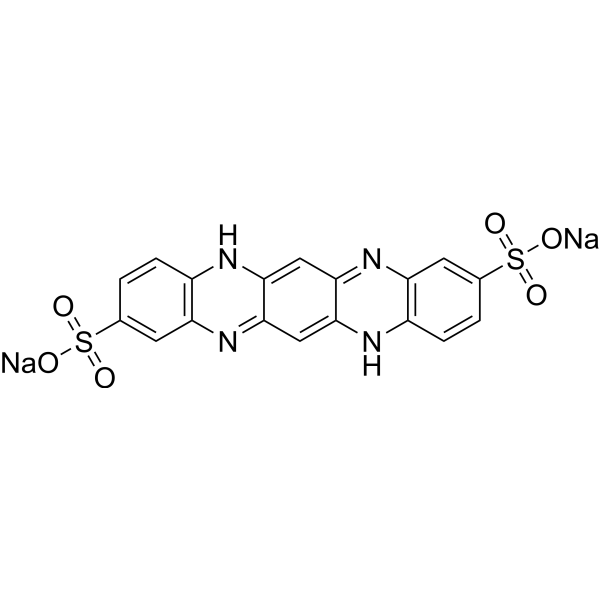
Azapentacene (Phacolysine) sodium is an anti-cataract compound. Azapentacene sodium prevents cataract formation in guinea pigs with vitamin C deficiency and delays the progression of congenital cataract in Nakano mice. Azapentacene sodium undergoes reversible one-electron oxidation to form a stable radical cation, undergoes irreversible secondary oxidation to form a hydrolyzable unstable dication, and can also be oxidized by thallium (III) trifluoroacetate in trifluoroacetic acid to generate a detectable radical cation. Azapentacene sodium is used in research related to cataracts, vitamin C deficiency-induced cataracts, and congenital cataracts.
Nos produits utilisent uniquement pour la recherche. Nous ne vendons pas aux patients.
- CAS No.: 3863-80-7
- Formule: C18H10N4Na2O6S2
- Masse moléculaire:488.40
-
Stockage:
Please store the product under the recommended conditions in the Certificate of Analysis.

To place orders, for customer services and technical support, please contact: MedChemExpress USA
Tel: 609-228-6898 E-mail: [email protected] [email protected]


-
 Activité biologique
-
Chemical Information
- Pureté et documentation
- Références
-
 Help & FAQs




Activité biologique
Description
In Vivo


Chemical Information
-
CAS No. 3863-80-7
-
Masse moléculaire 488.40
-
Formule C18H10N4Na2O6S2
-
SMILES
O=S(C1=CC(N=C2C=C3C(C=C2N4)=NC5=C(C=CC(S(=O)(O[Na])=O)=C5)N3)=C4C=C1)(O[Na])=O
-
Synonyms
Phacolysine sodium
-
Livraison
Room temperature in continental US; may vary elsewhere.
-
Stockage
Please store the product under the recommended conditions in the Certificate of Analysis.


Pureté et documentation
Références

Calculators
Concentration (start) × Volume (start) = Concentration (final) × Volume (final)


Azapentacene sodium Related Classifications
HY-112573A Related Classifications
 Powered by Bioz