



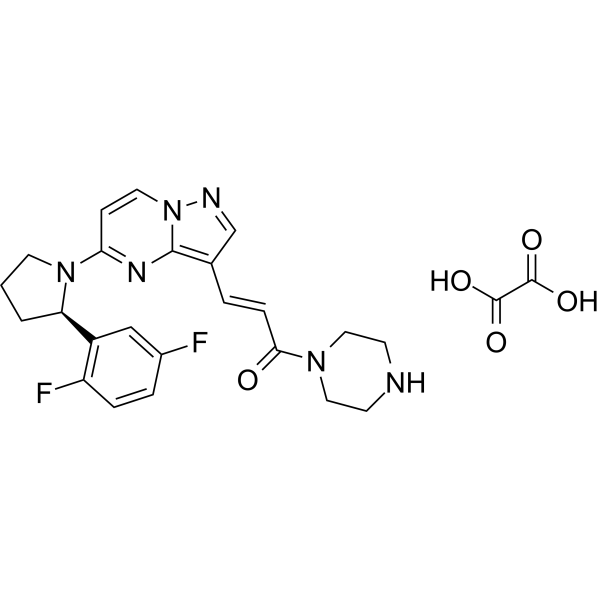
Boditrectinib oxalate
Boditrectinib oxalate is a potent tyrosine kinase inhibitor. Boditrectinib oxalate serves as an antineoplastic agent. Boditrectinib oxalate is useful in the research of cancer, inflammation, neurodegenerative diseases and certain infectious diseases.
For research use only. We do not sell to patients.
- CAS No.: 2773577-41-4
- Formula: C25H26F2N6O5
- Molecular Weight:528.51
-
Storage:
Please store the product under the recommended conditions in the Certificate of Analysis.

To place orders, for customer services and technical support, please contact: MedChemExpress USA
Tel: 609-228-6898 E-mail: [email protected] [email protected]


-
 Biological Activity
-
Chemical Information
- Protocols
- Purity & Documentation
- References
-
 Help & FAQs




Biological Activity
Description


Chemical Information
-
CAS No. 2773577-41-4
-
Molecular Weight 528.51
-
Formula C25H26F2N6O5
-
SMILES
FC1=C(C=C(C=C1)F)[C@@H]2N(C3=NC4=C(/C=C/C(N5CCNCC5)=O)C=NN4C=C3)CCC2.O=C(O)C(O)=O
-
Synonyms
HL5101 oxalate
-
Shipping
Room temperature in continental US; may vary elsewhere.
-
Storage
Please store the product under the recommended conditions in the Certificate of Analysis.

Protocols
-
Research Protocol for Inflammation-related Diseases
The NLRP3 inflammasome is a cytosolic innate immune signaling platform that integrates priming signals and danger-signal activation to promote caspase-1 activation, maturation of IL-1β and IL-18, and gasdermin D-mediated pyroptotic cell death. The core experimental logic is to determine whether inflammatory disease phenotypes are driven by increased NLRP3 expression, ASC-containing inflammasome assembly, caspase-1 cleavage, GSDMD cleavage, and extracellular release of IL-1β/IL-18 rather than by nonspecific cell injury alone. The pathway is strongly linked to inflammation-related disease phenotypes because monosodium urate crystals activate NALP3/NLRP3 inflammasome signaling in gout-like crystal inflammation, cholesterol crystals activate NLRP3 inflammasomes in atherogenesis models, and DSS-induced intestinal inflammation has been reported to involve NLRP3 inflammasome activity. However, experimental colitis studies also show context-dependent protective effects of NLRP3 inflammasome co


Purity & Documentation
References

Calculators
Concentration (start) × Volume (start) = Concentration (final) × Volume (final)


Boditrectinib oxalate Related Classifications
HY-152849A Related Classifications
 Powered by Bioz