



Azure C

Based on 1 Customer Validation
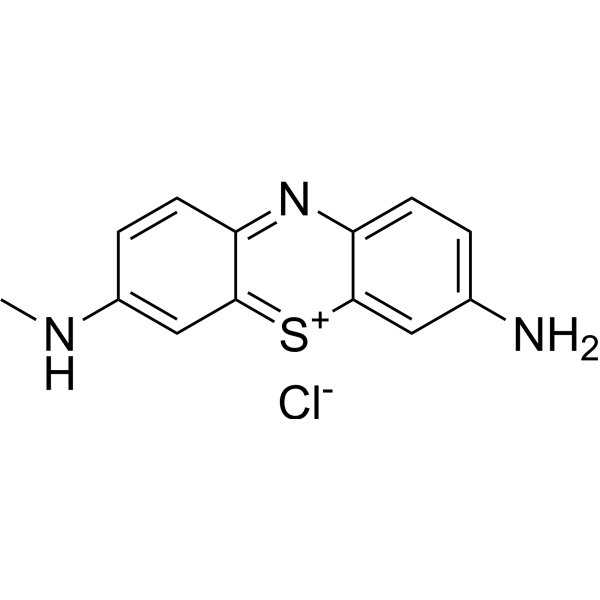
Azure C (Monomethylthionine) acts as a tau oligomer inhibitor and Aβ42 oligomerization inhibitor. Azure C regulates hsp70 ATPase activity, thereby mediating the clearance of tau protein. Azure C reduces the levels of toxic tau oligomers by promoting the formation of non-toxic tau aggregates, rescues neuroblastoma cells from tau oligomer-induced toxicity, and binds to and inhibits Aβ42 oligomerization. Azure C is generated via continuous oxidation of methylene blue or azure B through a horseradish peroxidase-mediated reaction. Azure C can be used in research related to tauopathies, including Alzheimer's disease.
For research use only. We do not sell to patients.
- Assay : 65.15%
- CAS No.: 531-57-7
- Formula: C13H12ClN3S
- Molecular Weight:277.78
-
Storage:
4°C, protect from light
* In solvent : -80°C, 6 months; -20°C, 1 month (protect from light)

To place orders, for customer services and technical support, please contact: MedChemExpress USA
Tel: 609-228-6898 E-mail: [email protected] [email protected]


-
 Biological Activity
-
Chemical Information
-
Solvent & Solubility
- Protocols
- Purity & Documentation
- References
-
 Help & FAQs




Biological Activity
Description
IC50 & Target
[1]|
HSP70 |
In Vitro
Azure C (0.05-10 μM; 16 h) reduces levels of purified preformed tau oligomers in a concentration-dependent manner, with a significant reduction observed at 5 μM[1].
Azure C (2.5-10 μM; 16 h) significantly reduces levels of purified preformed tau oligomers, without altering total tau levels[1].
Azure C (5 μM; 16 h preincubation with preformed tau oligomers) reduces the oligomers' toxicity to SH-SY5Y human neuroblastoma cells[1].
Azure C (5 μM; 16 h) reduces levels of toxic tau oligomers from crude tau oligomeric preparations and decreases their hydrophobicity, without disassembling oligomers into monomeric tau[1].
MedChemExpress (MCE) has not independently confirmed the accuracy of these methods. They are for reference only.
-
Cell Line:SH-SY5Y human neuroblastoma cells
-
Concentration:5 μM (preincubated with tau oligomers)
-
Incubation Time:16 h (preincubation with tau oligomers); 24 h (cell treatment)
-
Result:Resulted in significantly higher cell viability compared to treatment with tau oligomers alone.
Caused minimal cell shrinkage and preserved neurite processes, unlike cells treated with tau oligomers alone.


Chemical Information
-
CAS No. 531-57-7
-
Appearance Solid
-
Molecular Weight 277.78
-
Formula C13H12ClN3S
-
Color Brown to dark green
-
SMILES
[Cl-].N=1C2=CC=C(N)C=C2[S+]=C3C=C(C=CC13)NC
-
Synonyms
Monomethylthionine
-
Shipping
Room temperature in continental US; may vary elsewhere.
-
Storage
4°C, protect from light
* In solvent : -80°C, 6 months; -20°C, 1 month (protect from light)


Solvent & Solubility
In Vitro:
DMSO : 1.96 mg/mL (7.06 mM; ultrasonic and warming and heat to 60°C; Hygroscopic DMSO has a significant impact on the solubility of product, please use newly opened DMSO)
Ethanol : < 1 mg/mL (insoluble)
Please refer to the solubility information to select the appropriate solvent. Once prepared, please aliquot and store the solution to prevent product inactivation from repeated freeze-thaw cycles.
Storage method and period of stock solution: -80°C, 6 months; -20°C, 1 month (protect from light). When stored at -80°C, please use it within 6 months. When stored at -20°C, please use it within 1 month.
Please refer to the solubility information to select the appropriate solvent. Once prepared, please aliquot and store the solution to prevent product inactivation from repeated freeze-thaw cycles.
Storage method and period of stock solution: -80°C, 6 months; -20°C, 1 month (protect from light). When stored at -80°C, please use it within 6 months. When stored at -20°C, please use it within 1 month.
Concentration (start) × Volume (start) = Concentration (final) × Volume (final)


Purity & Documentation
-
Data Sheet (273 KB)
-
SDS (393 KB)
- English - EN (393 KB)
- Français - FR (393 KB)
- Deutsch - DE (393 KB)
- Norwegian - NO (393 KB)
- Español - ES (393 KB)
- Swedish - SV (393 KB)
- Italian - IT (393 KB)
- Korean - KR (393 KB)
- Portuguese - PT (393 KB)
-
Handling Instructions (2659 KB)
References


Complete Stock Solution Preparation Table
Please refer to the solubility information to select the appropriate solvent. Once prepared, please aliquot and store the solution to prevent product inactivation from repeated freeze-thaw cycles.
Storage method and period of stock solution: -80°C, 6 months; -20°C, 1 month (protect from light). When stored at -80°C, please use it within 6 months. When stored at -20°C, please use it within 1 month.
| Optional Solvent | Concentration Solvent Mass | 1 mg | 5 mg | 10 mg | 25 mg |
|---|---|---|---|---|---|
| DMSO | 1 mM | 3.6000 mL | 17.9999 mL | 35.9997 mL | 89.9993 mL |
| 5 mM | 0.7200 mL | 3.6000 mL | 7.1999 mL | 17.9999 mL |


Azure C Related Classifications
HY-W143216 Related Classifications
 Powered by Bioz