



CUR5g

Based on 1 Customer Validation
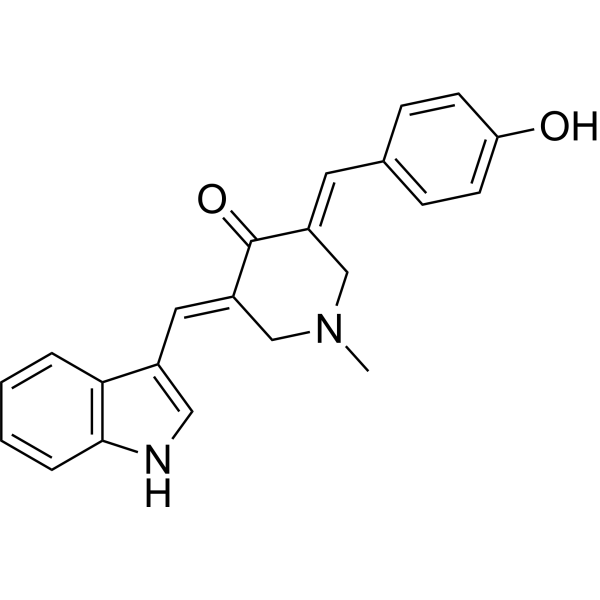
CUR5g is a potent autophagy inhibitor. CUR5g selectively inhibits autophagosome degradation in cancer cells by blocking autophagosome-lysosome fusion. CUR5g blocks the recruitment of STX17 to autophagosomes via a UVRAG-dependent mechanism, resulting in the inability of autophagosomes to fuse with lysosomes. CUR5g improves the anticancer effect of Cisplatin (HY-17394) against A549 cells both in vitro and in vivo.
For research use only. We do not sell to patients.
- Purity : 98.69%
- CAS No.: 1370032-20-4
- Formula: C22H20N2O2
- Molecular Weight:344.41
-
Storage:Powder -20°C, 3 years , 4°C, 2 years ; In solvent -80°C, 6 months , -20°C, 1 month

To place orders, for customer services and technical support, please contact: MedChemExpress USA
Tel: 609-228-6898 E-mail: [email protected] [email protected]


-
 Biological Activity
-
Chemical Information
-
Solvent & Solubility
- Protocols
- Purity & Documentation
- References
-
 Help & FAQs




Biological Activity
Description
In Vitro
CUR5g (0-40 μM, 0-24 h) selectively induces autophagosome accumulation in cancer cells[1].
CUR5g (0-40 μM, 0-24 h) up-regulates LC3B-II and sequestosome 1 (SQSTM1) levels[1].
CUR5g (0-40 μM, 24 h) inhibits proliferation and migration of A549 cells, but dose not induce apoptosis or necrosis[1].
MedChemExpress (MCE) has not independently confirmed the accuracy of these methods. They are for reference only.
-
Cell Line:A549 cells
-
Concentration:0, 1, 5, 10, 20, and 40 μM
-
Incubation Time:3, 6, 12, and 24 h
-
Result:Induced extensive cytoplasmic vacuolization, and GFP-LC3B signal shifted from diffuse cytosolic staining to a punctate pattern outlining autophagosomes.
-
Cell Line:A549 cells
-
Concentration:0, 1, 5, 10, 20, and 40 μM
-
Incubation Time:0, 1, 3, 6, 12, and 24 h
-
Result:Up-regulated LC3B-II and sequestosome 1 (SQSTM1) levels time- and dose-dependently. This increase was not the result of enhanced transcription, as mRNA expression of SQSTM1 and LC3B were not increased within CUR5g-exposed cells, suggesting that CUR5g might block autophagic flux rather than increase autophagosome formation.
-
Cell Line:A549 cells
-
Concentration:0, 1, 5, 10, 20, and 40 μM
-
Incubation Time:24 h
-
Result:Exhibited great toxicity to A549 cells at 20 μM. Slightly decreased A549 cell number at 10 µM, while decreased the number of A549 cells significantly at 20 µM. Showed no discernable activity in healthy human umbilical vein endothelial cell (HUVEC) viability at 40 µM.
In Vivo
MedChemExpress (MCE) has not independently confirmed the accuracy of these methods. They are for reference only.
-
Animal Model:BALB/c nude mice (4-week-old, A549 cells were subcutaneously injected into the right scapula of each nude mouse)[1]
-
Dosage:40 mg/kg, CUR5g (40 mg/kg) and Cisplatin (1 mg/kg)
-
Administration:Injected via caudal vein, once every 2 days for up to 15 days
-
Result:Retarded the growth of xenografted tumors, whereas the combination treatment with Cisplatin almost completely inhibited tumor growth. Promoted the cisplatin sensitivity of A549 cells by inhibiting autophagic flux.


Chemical Information
-
CAS No. 1370032-20-4
-
Appearance Solid
-
Molecular Weight 344.41
-
Formula C22H20N2O2
-
Color Yellow to brown
-
SMILES
O=C1/C(CN(C)C/C1=C\C2=CNC3=C2C=CC=C3)=C/C4=CC=C(O)C=C4
-
Shipping
Room temperature in continental US; may vary elsewhere.
-
Storage
Powder -20°C 3 years 4°C 2 years In solvent -80°C 6 months -20°C 1 month


Solvent & Solubility
In Vitro:
DMSO : 41.67 mg/mL (120.99 mM; ultrasonic and warming and heat to 60°C; Hygroscopic DMSO has a significant impact on the solubility of product, please use newly opened DMSO)
Please refer to the solubility information to select the appropriate solvent. Once prepared, please aliquot and store the solution to prevent product inactivation from repeated freeze-thaw cycles.
Storage method and period of stock solution: -80°C, 6 months; -20°C, 1 month. When stored at -80°C, please use it within 6 months. When stored at -20°C, please use it within 1 month.
Please refer to the solubility information to select the appropriate solvent. Once prepared, please aliquot and store the solution to prevent product inactivation from repeated freeze-thaw cycles.
Storage method and period of stock solution: -80°C, 6 months; -20°C, 1 month. When stored at -80°C, please use it within 6 months. When stored at -20°C, please use it within 1 month.
Concentration (start) × Volume (start) = Concentration (final) × Volume (final)
In Vivo:
Select the appropriate dissolution method based on your experimental animal and administration route.
- For the following dissolution methods, please ensure to first prepare a clear stock solution using an In Vitro approach and then sequentially add co-solvents:
- To ensure reliable experimental results, the clarified stock solution can be appropriately stored based on storage conditions. As for the working solution for In Vivo experiments, it is recommended to prepare freshly and use it on the same day.
- The percentages shown for the solvents indicate their volumetric ratio in the final prepared solution. If precipitation or phase separation occurs during preparation, heat and/or sonication can be used to aid dissolution.
Add each solvent one by one: 10% DMSO 40% PEG300 5% Tween-80 45% Saline
Solubility: ≥ 2.5 mg/mL (7.26 mM); Clear solution
This protocol yields a clear solution of ≥ 2.5 mg/mL (saturation unknown).
Taking 1 mL working solution as an example, add 100 μL DMSO stock solution (25.0 mg/mL) to 400 μL PEG300, and mix evenly; then add 50 μL Tween-80 and mix evenly; then add 450 μL Saline to adjust the volume to 1 mL.
Preparation of Saline: Dissolve 0.9 g sodium chloride in ddH₂O and dilute to 100 mL to obtain a clear Saline solution.
In Vivo Dissolution Calculator
Please enter the basic information of animal experiments:
-
-
-
-
Recommended: Prepare an additional quantity of animals to account for potential losses during experiments.
Please enter your animal formula composition:
-
%DMSO +
Recommended: Keep the proportion of DMSO in working solution below 2% if your animal is weak.
-
%+
-
+%Tween-80 + +
-
%Saline +
The co-solvents required include: DMSO, . All of co-solvents are available by MedChemExpress (MCE). , Tween 80. All of co-solvents are available by MedChemExpress (MCE).
Working solution concentration: 0.22 mg/mL
Method for preparing stock solution: mg drug dissolved in μL DMSO. Stock solution concentration: mg/mL.
1. Take μL DMSO stock solution;
2. Add μL .
μL , mix evenly;
3. Then add μL Tween 80, mix evenly;
4. Then add μL
Please ensure that the stock solution in the first step is dissolved to a clear state, and add co-solvents in sequence. You can use ultrasonic heating (ultrasonic cleaner, recommended frequency 20-40 kHz), vortexing, etc. to assist dissolution.


Purity & Documentation
-
Data Sheet (278 KB)
-
SDS (251 KB)
- English - EN (251 KB)
- Français - FR (251 KB)
- Deutsch - DE (251 KB)
- Norwegian - NO (251 KB)
- Español - ES (251 KB)
- Swedish - SV (251 KB)
- Italian - IT (251 KB)
- Korean - KR (251 KB)
- Portuguese - PT (251 KB)
-
Handling Instructions (2659 KB)
References


Complete Stock Solution Preparation Table
Please refer to the solubility information to select the appropriate solvent. Once prepared, please aliquot and store the solution to prevent product inactivation from repeated freeze-thaw cycles.
Storage method and period of stock solution: -80°C, 6 months; -20°C, 1 month. When stored at -80°C, please use it within 6 months. When stored at -20°C, please use it within 1 month.
| Optional Solvent | Concentration Solvent Mass | 1 mg | 5 mg | 10 mg | 25 mg |
|---|---|---|---|---|---|
| DMSO | 1 mM | 2.9035 mL | 14.5176 mL | 29.0352 mL | 72.5879 mL |
| 5 mM | 0.5807 mL | 2.9035 mL | 5.8070 mL | 14.5176 mL | |
| 10 mM | 0.2904 mL | 1.4518 mL | 2.9035 mL | 7.2588 mL | |
| 15 mM | 0.1936 mL | 0.9678 mL | 1.9357 mL | 4.8392 mL | |
| 20 mM | 0.1452 mL | 0.7259 mL | 1.4518 mL | 3.6294 mL | |
| 25 mM | 0.1161 mL | 0.5807 mL | 1.1614 mL | 2.9035 mL | |
| 30 mM | 0.0968 mL | 0.4839 mL | 0.9678 mL | 2.4196 mL | |
| 40 mM | 0.0726 mL | 0.3629 mL | 0.7259 mL | 1.8147 mL | |
| 50 mM | 0.0581 mL | 0.2904 mL | 0.5807 mL | 1.4518 mL | |
| 60 mM | 0.0484 mL | 0.2420 mL | 0.4839 mL | 1.2098 mL | |
| 80 mM | 0.0363 mL | 0.1815 mL | 0.3629 mL | 0.9073 mL | |
| 100 mM | 0.0290 mL | 0.1452 mL | 0.2904 mL | 0.7259 mL |


CUR5g Related Classifications
HY-152100 Related Classifications
 Powered by Bioz