



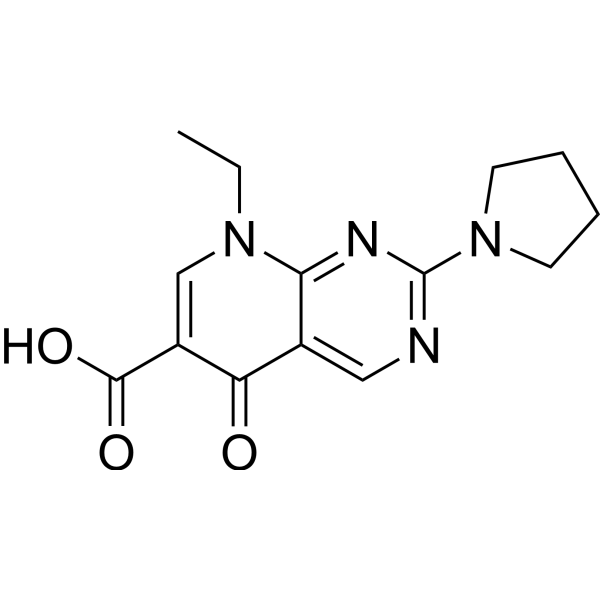
Piromidic acid

Based on 1 Customer Validation
Piromidic acid is an antibacterial agent. Piromidic acid is active against gramnegative bacteria and staphylococci and can be used for the research of intestinal, urinary, and biliary tract infections.
Nos produits utilisent uniquement pour la recherche. Nous ne vendons pas aux patients.
- Pureté : 98.96%
- CAS No.: 19562-30-2
- Formule: C14H16N4O3
- Masse moléculaire:288.30
-
Stockage:Powder -20°C, 3 years , 4°C, 2 years ; In solvent -80°C, 2 years , -20°C, 1 year

To place orders, for customer services and technical support, please contact: MedChemExpress USA
Tel: 609-228-6898 E-mail: [email protected] [email protected]


-
 Activité biologique
-
Chemical Information
-
Solvant et solubilité
- Protocole
- Pureté et documentation
- Références
-
 Help & FAQs


-
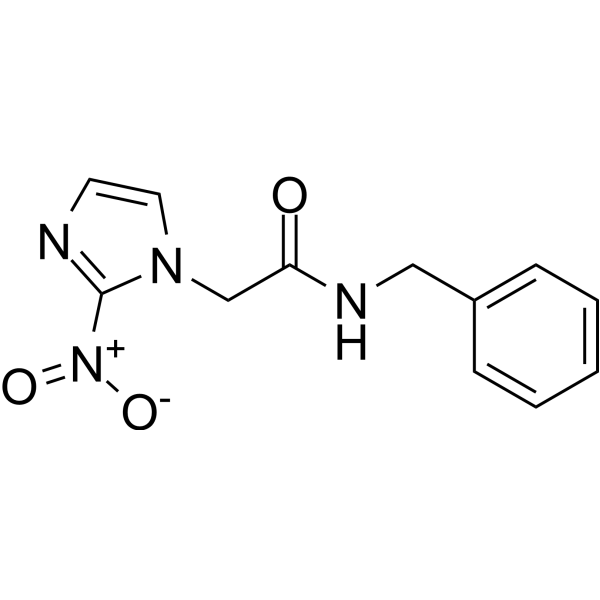
HY-B1548
BenznidazoleAntibiotic -
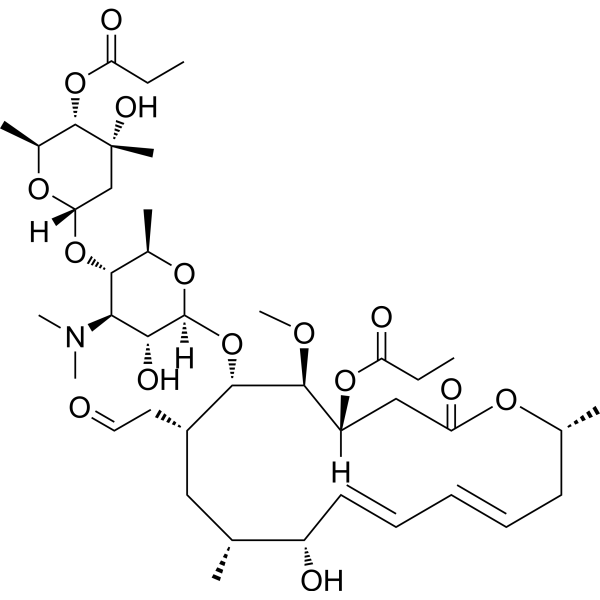
HY-B1908
MidecamycinBacterial Inhibitor -
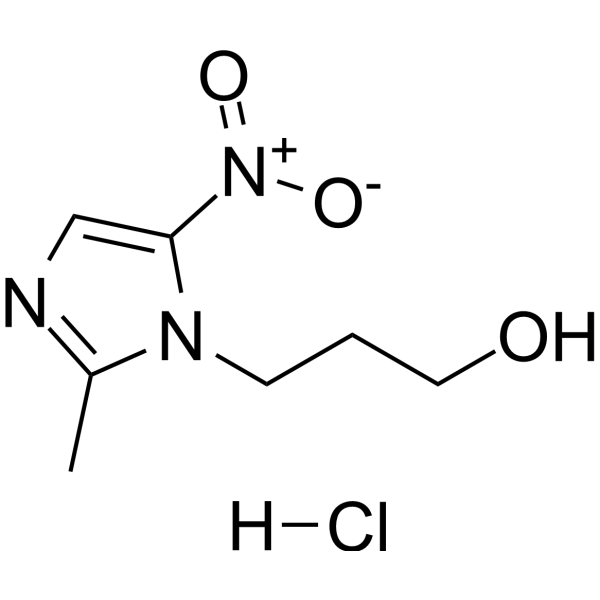
HY-136436
Ternidazole hydrochlorideAntibiotic -
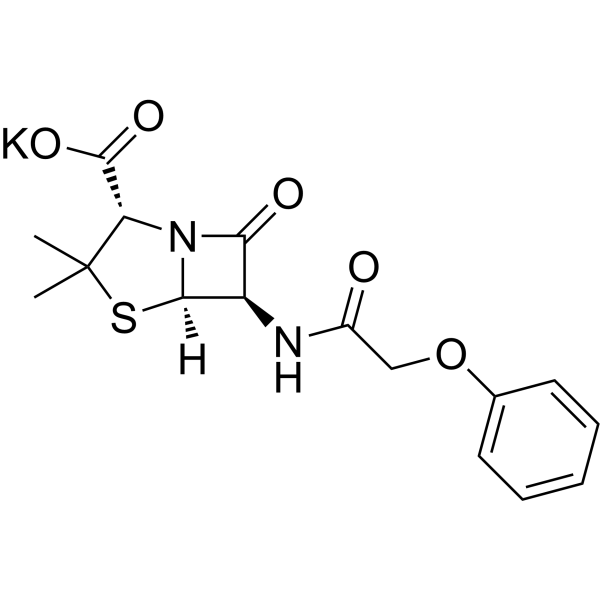
HY-B0975
Penicillin V PotassiumAntibiotic -

HY-B1043R
Piromidic acid (Standard)Antibacterial Agent -
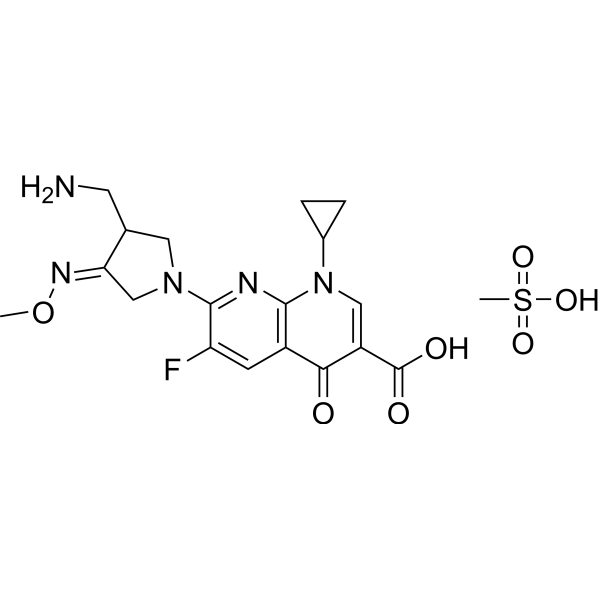
HY-B1050
Gemifloxacin mesylateAntibacterial Agent -

HY-B1050R
Gemifloxacin mesylate (Standard)Antibacterial Agent -

HY-B0975R
Penicillin V Potassium (Standard)Antibiotic
Voir tous les produits spécifiques à Isoform Antibiotic
More

Activité biologique
Description
Cellular Effect
|
Cell Line

|
Type | Value | Description | References |
|---|---|---|---|---|
| HeLa | IC50 |
97 μM
Compound: Piromidic acid
|
Compound was evaluated for the inhibition of cell proliferation of human cervix epithelioid carcinoma, HeLa (ATCC CCL2).
Compound was evaluated for the inhibition of cell proliferation of human cervix epithelioid carcinoma, HeLa (ATCC CCL2).
|
10.1016/0960-894X(96)00418-0 |
| HepG2 | IC50 |
110 μM
Compound: Piromidic acid
|
Compound was evaluated for the inhibition of cell proliferation of human hepatocellular carcinoma, HepG2 (ATCC HB8065).
Compound was evaluated for the inhibition of cell proliferation of human hepatocellular carcinoma, HepG2 (ATCC HB8065).
|
10.1016/0960-894X(96)00418-0 |


Chemical Information
-
CAS No. 19562-30-2
-
Appearance Solid
-
Masse moléculaire 288.30
-
Formule C14H16N4O3
-
Color White to yellow
-
SMILES
O=C(C1=CN(CC)C2=NC(N3CCCC3)=NC=C2C1=O)O
-
Structure Classification
-
Initial Source
-
Livraison
Room temperature in continental US; may vary elsewhere.
-
Stockage
Powder -20°C 3 years 4°C 2 years In solvent -80°C 2 years -20°C 1 year


Solvant et solubilité
In Vitro:
DMSO : 1 mg/mL (3.47 mM; Need ultrasonic; Hygroscopic DMSO has a significant impact on the solubility of product, please use newly opened DMSO)
H2O : < 0.1 mg/mL (insoluble)
Please refer to the solubility information to select the appropriate solvent. Once prepared, please aliquot and store the solution to prevent product inactivation from repeated freeze-thaw cycles.
Storage method and period of stock solution: -80°C, 2 years; -20°C, 1 year. When stored at -80°C, please use it within 2 years. When stored at -20°C, please use it within 1 year.
Please refer to the solubility information to select the appropriate solvent. Once prepared, please aliquot and store the solution to prevent product inactivation from repeated freeze-thaw cycles.
Storage method and period of stock solution: -80°C, 2 years; -20°C, 1 year. When stored at -80°C, please use it within 2 years. When stored at -20°C, please use it within 1 year.
Concentration (start) × Volume (start) = Concentration (final) × Volume (final)
In Vivo:
For the following dissolution methods, please prepare the working solution directly:
It is recommended to prepare fresh solutions and use them promptly within a short period of time.
The percentages shown for the solvents indicate their volumetric ratio in the final prepared solution. If precipitation or phase separation occurs during preparation, heat and/or sonication can be used to aid dissolution.
Add each solvent one by one: 0.5% CMC-Na/saline water
Solubility: 10 mg/mL (34.69 mM); Suspended solution; Need ultrasonic

Protocole
-
Research Protocol for Infectious Diseases
Infectious-disease experiments test how pathogens interact with host barriers, innate immune receptors, inflammatory signaling, pathogen replication, and tissue injury; pattern-recognition receptors such as TLRs, RIG-I-like receptors, NOD-like receptors, and inflammasomes detect microbial molecules and activate NF-κB, interferon, and cytokine responses. The central hypothesis is that infection severity reflects the balance between pathogen burden and host response: protective inflammation restricts pathogen growth, whereas excessive or mislocalized inflammation contributes to tissue damage and disease phenotype. Unresolved questions include which host pathways are protective versus pathogenic, why some infection models fail to translate to human disease, and which combined readouts best predict clinically relevant infection outcomes.


Pureté et documentation
-
Fiche technique (270 KB)
-
SDS (393 KB)
- English - EN (393 KB)
- Français - FR (393 KB)
- Deutsch - DE (393 KB)
- Norwegian - NO (393 KB)
- Español - ES (393 KB)
- Swedish - SV (393 KB)
- Italian - IT (393 KB)
- Korean - KR (393 KB)
- Portuguese - PT (393 KB)
-
Instruction de manipulation (2659 KB)
Références
[1]. Sekine Y, et al. Metabolism in rats and man of piromidic acid, a new antibacterial agent. Xenobiotica. 1976 Mar;6(3):185-8. [Content Brief]
[2]. Shimizu M, et, al. Pipemidic acid, a new antibacterial agent active against Pseudomonas aeruginosa: in vitro properties. Antimicrob Agents Chemother. 1975 Aug;8(2):132-8. [Content Brief]


Complete Stock Solution Preparation Table
Please refer to the solubility information to select the appropriate solvent. Once prepared, please aliquot and store the solution to prevent product inactivation from repeated freeze-thaw cycles.
Storage method and period of stock solution: -80°C, 2 years; -20°C, 1 year. When stored at -80°C, please use it within 2 years. When stored at -20°C, please use it within 1 year.
| Optional Solvent | Concentration Solvent Mass | 1 mg | 5 mg | 10 mg | 25 mg |
|---|---|---|---|---|---|
| DMSO | 1 mM | 3.4686 mL | 17.3430 mL | 34.6861 mL | 86.7152 mL |


Piromidic acid Related Classifications
HY-B1043 Related Classifications
 Powered by Bioz