



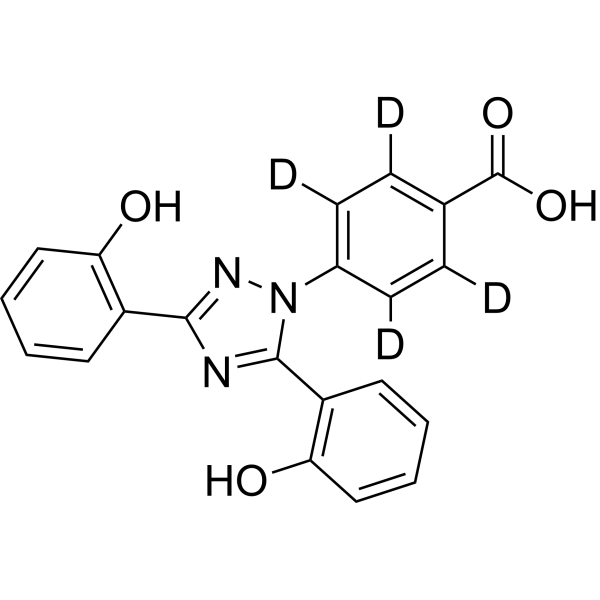
Deferasirox-d4
Deferasirox-d4 is the deuterium labeled Deferasirox. Deferasirox (ICL 670) is an orally available iron chelator used for the management of transfusional iron overload.
Nos produits utilisent uniquement pour la recherche. Nous ne vendons pas aux patients.
- CAS No.: 1133425-75-8
- Formule: C21H11D4N3O4
- Masse moléculaire:377.39
-
Stockage:Powder -20°C, 3 years , 4°C, 2 years ; In solvent -80°C, 6 months , -20°C, 1 month

To place orders, for customer services and technical support, please contact: MedChemExpress USA
Tel: 609-228-6898 E-mail: [email protected] [email protected]


-
 Activité biologique
-
Chemical Information
- Protocole
- Pureté et documentation
- Références
-
 Help & FAQs




Activité biologique
Description
In Vitro
Stable heavy isotopes of hydrogen, carbon, and other elements have been incorporated into drug molecules, largely as tracers for quantitation during the drug development process. Deuteration has gained attention because of its potential to affect the pharmacokinetic and metabolic profiles of drugs[1].
MedChemExpress (MCE) has not independently confirmed the accuracy of these methods. They are for reference only. Further protocols information, click here.
Application
1. This compound can be used as a tracer
2. This compound can be used as an internal standard for quantitative analysis by NMR, GC-MS, or LC-MS.


Chemical Information
-
CAS No. 1133425-75-8
-
Unlabeled CAS 201530-41-8
-
Appearance Solid
-
Masse moléculaire 377.39
-
Formule C21H11D4N3O4
-
Color White to off-white
-
SMILES
OC1=C(C=CC=C1)C2=NC(C3=C(C=CC=C3)O)=NN2C4=C([2H])C([2H])=C(C([2H])=C4[2H])C(O)=O
-
Livraison
Room temperature in continental US; may vary elsewhere.
-
Stockage
Powder -20°C 3 years 4°C 2 years In solvent -80°C 6 months -20°C 1 month

Protocole
-
Perls' Prussian Blue Iron Staining
Perls' Prussian blue staining is a histochemical method used to detect non-heme ferric iron (Fe3+) in biological tissues by exploiting an acid-mediated release of loosely bound iron from storage complexes such as ferritin or hemosiderin, followed by its reaction with potassium ferrocyanide to form an insoluble blue ferric ferrocyanide (Prussian blue) precipitate that marks iron localization under light microscopy. The reaction is classically performed under acidic conditions, which liberate Fe3+ ions that subsequently bind ferrocyanide to generate the visible chromogen, enabling spatial visualization of iron deposits in tissues such as brain, liver, and spleen. Histochemical interpretations are limited to a reactive iron pool rather than total iron content, reflecting only histologically accessible iron species rather than tightly protein-bound iron.


Pureté et documentation
-
Fiche technique (274 KB)
-
SDS (252 KB)
- English - EN (252 KB)
- Français - FR (252 KB)
- Deutsch - DE (252 KB)
- Norwegian - NO (252 KB)
- Español - ES (252 KB)
- Swedish - SV (252 KB)
- Italian - IT (252 KB)
- Korean - KR (252 KB)
- Portuguese - PT (252 KB)
-
Instruction de manipulation (2659 KB)
Références
[1]. Russak EM, et al. Impact of Deuterium Substitution on the Pharmacokinetics of Pharmaceuticals. Ann Pharmacother. 2019;53(2):211-216. [Content Brief]
[2]. Sobbe A, et al. Inconsistent hepatic antifibrotic effects with the iron chelator deferasirox. J Gastroenterol Hepatol. 2015 Mar;30(3):638-45. [Content Brief]
[3]. Kim JL, et al. The oral iron chelator deferasirox induces apoptosis in myeloid leukemia cells by targetingcaspase. Acta Haematol. 2011;126(4):241-5. [Content Brief]
[4]. Lee DH, et al. Deferasirox shows in vitro and in vivo antileukemic effects on murine leukemic cell lines regardless of iron status. Exp Hematol. 2013 Jun;41(6):539-46. [Content Brief]

Calculators
Concentration (start) × Volume (start) = Concentration (final) × Volume (final)


Deferasirox-d4 Related Classifications
HY-17359S Related Classifications
 Powered by Bioz