



Calcitonin Gene Related Peptide II (rat)
Based on 1 publication(s) in Google Scholar
Calcitonin Gene Related Peptide II rat, a CGRP receptor activator, is a potent and long-lasting vasodilator. Calcitonin Gene Related Peptide II rat can be used in the research of cardiovascular diseases.
For research use only. We do not sell to patients.
- CAS No.: 99889-63-1
- Formula: C163H267N51O50S2
- Molecular Weight:3805.31
-
Storage:
Please store the product under the recommended conditions in the Certificate of Analysis.

To place orders, for customer services and technical support, please contact: MedChemExpress USA
Tel: 609-228-6898 E-mail: [email protected] [email protected]


-
 Biological Activity
-
Chemical Information
-
Solvent & Solubility
- Purity & Documentation
- References
-
 Help & FAQs


Publications Citing Use of MedChemExpress (MCE) Calcitonin Gene Related Peptide II (rat)
More

Biological Activity
Description
In Vitro
Calcitonin Gene Related Peptide (CGRP) II, rat induces vasodilator effects in small-diameter pig left anterior descending (LAD) coronary arteries with an EC50 value of 0.56 nM[1].
Calcitonin Gene Related Peptide (CGRP) II, rat relaxes the spontaneous tone in isolated internal anal sphincter (IAS) strips, with an EC50 value of 83 μM[2].
Calcitonin Gene Related Peptide (CGRP) II, rat (rβCGRP) inhibits [125I]hαCGRP binding (IC50: 7 nM), and stimulates cAMP accumulation (EC50: 0.56 nM) in the cells co-expressing mRAMP1 (mouse receptor-activity-modifying-protein 1) and rCRLR (rat calcitonin receptor-like receptor)[3].
Calcitonin Gene Related Peptide (CGRP) II, rat (rat-βCGRP, 0.01-100 nM) induces endothelium-independent relaxations in the coronary arteries from male and female Sprague-Dawley rats, with an IC50 value of 2.8 nM approximately[4].
MedChemExpress (MCE) has not independently confirmed the accuracy of these methods. They are for reference only. .
In Vivo
MedChemExpress (MCE) has not independently confirmed the accuracy of these methods. They are for reference only.
-
Animal Model:Male Sprague-Dawley rats[5].
-
Dosage:0.01 ng/kg-3 μg/kg (100 μL), succeeded by a 150 μL isotonic saline flush, at 10 min intervals.
-
Administration:A bolus injection
-
Result:Induced PA (pial artery) dilatation and increased in LCBFFlux (local cortical cerebral blood flow).


Chemical Information
-
CAS No. 99889-63-1
-
Molecular Weight 3805.31
-
Formula C163H267N51O50S2
-
Synonyms
CGRP II (rat)
-
Sequence
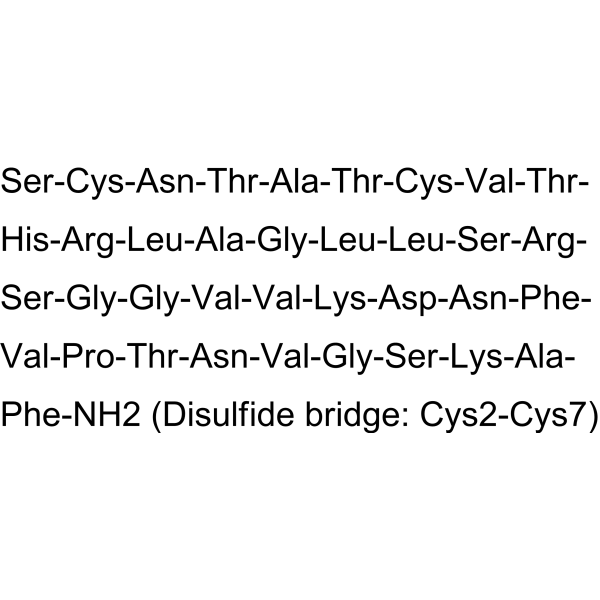
Ser-Cys-Asn-Thr-Ala-Thr-Cys-Val-Thr-His-Arg-Leu-Ala-Gly-Leu-Leu-Ser-Arg-Ser-Gly-Gly-Val-Val-Lys-Asp-Asn-Phe-Val-Pro-Thr-Asn-Val-Gly-Ser-Lys-Ala-Phe-NH2 (Disulfide bridge: Cys2-Cys7)
-
Sequence Shortening
SCNTATCVTHRLAGLLSRSGGVVKDNFVPTNVGSKAF-NH2 (Disulfide bridge: Cys2-Cys7)
-
Shipping
Room temperature in continental US; may vary elsewhere.
-
Storage
Please store the product under the recommended conditions in the Certificate of Analysis.


Publications (1)
-
Journal Impact Factor
-
Most Recent


Solvent & Solubility
In Vitro
H2O
Peptide Solubility and Storage Guidelines:
1. Calculate the length of the peptide.
2. Calculate the overall charge of the entire peptide according to the following table:
| Contents | Assign value | |
|---|---|---|
| Acidic amino acid | Asp (D), Glu (E), and the C-terminal -COOH. | -1 |
| Basic amino acid | Arg (R), Lys (K), His (H), and the N-terminal -NH2 | +1 |
| Neutral amino acid | Gly (G), Ala (A), Leu (L), Ile (I), Val (V), Cys (C), Met (M), Thr (T), Ser (S), Phe (F), Tyr (Y), Trp (W), Pro (P), Asn (N), Gln (Q) | 0 |
3. Recommended solution:
| Overall charge of peptide | Details |
|---|---|
| Negative (<0) |
1. Try to dissolve the peptide in water first. 2. If water fails, add NH4OH (<50 μL). 3. If the peptide still does not dissolve, add DMSO (50-100 μL) to solubilize the peptide. |
| Positive (>0) |
1. Try to dissolve the peptide in water first. 2. If water fails, try dissolving the peptide in a 10%-30% acetic acid solution. 3. If the peptide still does not dissolve, try dissolving the peptide in a small amount of DMSO. |
| Zero (=0) |
1. Try to dissolve the peptide in organic solvent (acetonitrile, methanol, etc.) first. 2. For very hydrophobic peptides, try dissolving the peptide in a small amount of DMSO, and then dilute the solution with water to the desired concentration. |


Purity & Documentation
References
[1]. D Wu, et al. Development and potential of non-peptide antagonists for calcitonin-gene-related peptide (CGRP) receptors: evidence for CGRP receptor heterogeneity. Biochem Soc Trans. 2002 Aug;30(4):468-73. [Content Brief]
[2]. F M Wisskirchen, et al. CGRP(2) receptor in the internal anal sphincter of the rat: implications for CGRP receptor classification. Br J Pharmacol. 2000 May;130(2):464-70. [Content Brief]
[3]. K Husmann, et al. Mouse receptor-activity-modifying proteins 1, -2 and -3: amino acid sequence, expression and function. Mol Cell Endocrinol. 2000 Apr 25;162(1-2):35-43. [Content Brief]
[4]. M Sheykhzade, et al. Characterization of calcitonin gene-related peptide (CGRP) receptors in intramural coronary arteries from male and female Sprague Dawley rats. Br J Pharmacol. 1998 Apr;123(7):1464-70. [Content Brief]
[5]. Kenneth A Petersen, et al. Inhibitory effect of BIBN4096BS on cephalic vasodilatation induced by CGRP or transcranial electrical stimulation in the rat. Br J Pharmacol. 2004 Nov;143(6):697-704. [Content Brief]

Calculators
Concentration (start) × Volume (start) = Concentration (final) × Volume (final)


Calcitonin Gene Related Peptide II (rat) Related Classifications
HY-P1913 Related Classifications
 Powered by Bioz