



Carbodine
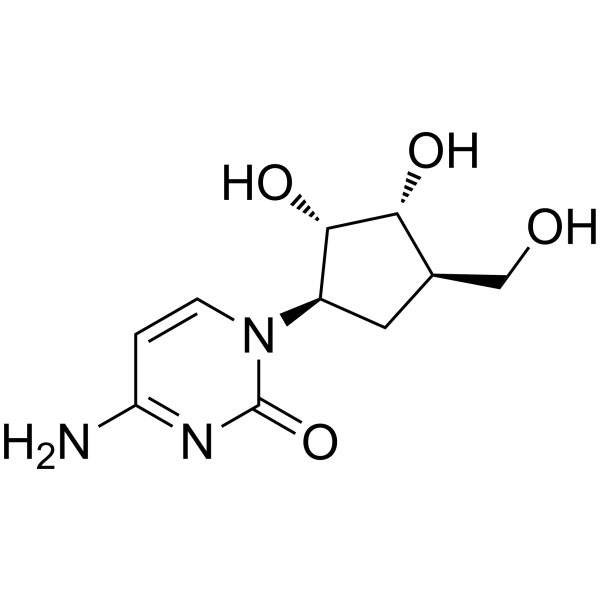
Carbodine (Carbocyclic cytidine) is a broad-spectrum antiviral agent active against DNA viruses, (+)RNA viruses, (-)RNA viruses, paramyxo, rhabdo and (+/-)RNA viruses, targets CTP synthetase that converts UTP to CTP. Carbodine (Carbocyclic cytidine) possesses significant antiviral activity against influenza virus types A0/PR-8/34 and A2/Aichi/2/68 in vitro.
Nur für Forschungszwecke. Wir verkaufen nicht an Patienten.
- CAS. Nr.: 71184-20-8
- Formel: C10H15N3O4
- Molecular Weight:241.24
-
Speicherung:
Please store the product under the recommended conditions in the Certificate of Analysis.

To place orders, for customer services and technical support, please contact: MedChemExpress USA
Tel: 609-228-6898 E-mail: [email protected] [email protected]


-
 Biologische Aktivität
-
Chemical Information
- Protokoll
- Reinheit & Dokumentation
- Verweise
-
 Help & FAQs




Biologische Aktivität
Beschreibung
Cellular Effect
|
Cell Line

|
Type | Value | Description | References |
|---|---|---|---|---|
| MDCK | EC50 |
0.7 μM
Compound: (+/-)-Carbodine
|
Antiviral activity against Influenza A virus Hong Kong/213/2003/H5N1 infected MDCK cells assessed as inhibition of virus-induced cytopathic effect after 3 days
Antiviral activity against Influenza A virus Hong Kong/213/2003/H5N1 infected MDCK cells assessed as inhibition of virus-induced cytopathic effect after 3 days
|
[PMID: 20231094] |
| MDCK | IC50 |
>414 μM
Compound: (+/-)-Carbodine
|
Cytotoxicity against MDCK cells after 3 days by neutral red dye uptake assay
Cytotoxicity against MDCK cells after 3 days by neutral red dye uptake assay
|
[PMID: 20231094] |


Chemical Information
-
CAS. Nr. 71184-20-8
-
Molecular Weight 241.24
-
Formel C10H15N3O4
-
SMILES
O=C1N=C(N)C=CN1[C@H]2[C@H](O)[C@H](O)[C@@H](CO)C2
-
Versand
Room temperature in continental US; may vary elsewhere.
-
Speicherung
Please store the product under the recommended conditions in the Certificate of Analysis.

Protokoll
-
Research Protocol for Infectious Diseases
Infectious-disease experiments test how pathogens interact with host barriers, innate immune receptors, inflammatory signaling, pathogen replication, and tissue injury; pattern-recognition receptors such as TLRs, RIG-I-like receptors, NOD-like receptors, and inflammasomes detect microbial molecules and activate NF-κB, interferon, and cytokine responses. The central hypothesis is that infection severity reflects the balance between pathogen burden and host response: protective inflammation restricts pathogen growth, whereas excessive or mislocalized inflammation contributes to tissue damage and disease phenotype. Unresolved questions include which host pathways are protective versus pathogenic, why some infection models fail to translate to human disease, and which combined readouts best predict clinically relevant infection outcomes.


Reinheit & Dokumentation
Verweise
[1]. De Clercq E, et al. Broad-spectrum antiviral activity of carbodine, the carbocyclic analogue of cytidine. Biochem Pharmacol. 1990 Jan 15;39(2):319-25. [Content Brief]
[2]. Shannon WM, et al. Evaluation of carbodine, the carbocyclic analog of cytidine, and related carbocyclic analogs of pyrimidine nucleosides for antiviral activity against human influenza Type A viruses. Antimicrob Agents Chemother. 1981 Dec;20(6):769-76. [Content Brief]

Calculators
Konzentration (Stammlösung) × Volumen (Stammlösung) = Konzentration (Ziellösung) × Volumen (Ziellösung)


Carbodine Related Classifications
HY-128718 Related Classifications
 Powered by Bioz