



2407452-77-9
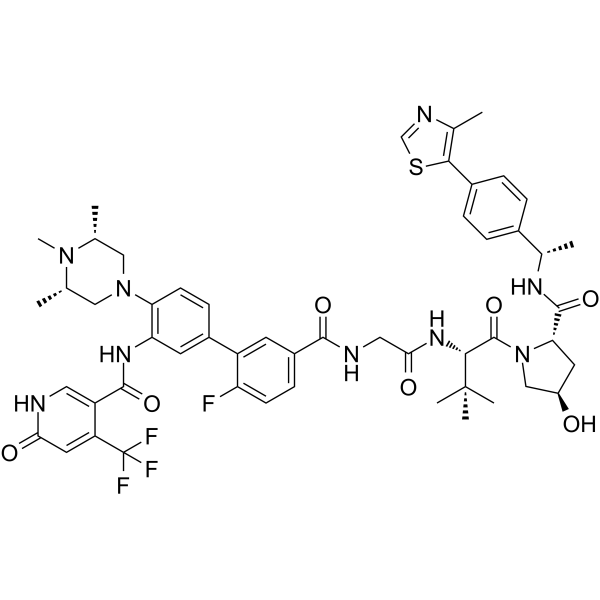
Chemical Structure
MS67
- CAS No.: 2407452-77-9
- Formula:C52H59F4N9O7S
- Molecular Weight:1030.14
IUPAC Name: N-(2'-fluoro-5'-((2-(((S)-1-((2S,4R)-4-hydroxy-2-(((S)-1-(4-(4-methylthiazol-5-yl)phenyl)ethyl)carbamoyl)pyrrolidin-1-yl)-3,3-dimethyl-1-oxobutan-2-yl)amino)-2-oxoethyl)carbamoyl)-4-((3R,5S)-3,4,5-trimethylpiperazin-1-yl)-[1,1'-biphenyl]-3-yl)-6-oxo-4-(trifluoromethyl)-1,6-dihydropyridine-3-carboxamide
InChIKey: HBHSDSLZXDASLT-FLKKWHKHSA-N
SMILES: O=C(C(C(C(F)(F)F)=C1)=CNC1=O)NC2=C(N3C[C@H](N([C@H](C3)C)C)C)C=CC(C4=CC(C(NCC(N[C@@H](C(C)(C)C)C(N5[C@@H](C[C@H](C5)O)C(N[C@H](C6=CC=C(C7=C(N=CS7)C)C=C6)C)=O)=O)=O)=O)=CC=C4F)=C2
Biological Activity: MS67 is a PROTAC degrader that selectively targets WDR5 (Kd = 63 nM). MS67 forms a cooperative WDR5-VHL ternary complex, leading to ubiquitin-proteasome-dependent degradation of WDR5/RBBP5. MS67 reduces SS18::SSX chromatin binding, SWI/SNF components, H3K4me2/3, and associated oncogenic/developmental/ribosomal transcription, and activates p53-mediated arrest, senescence, and apoptosis (apoptosis) in synovial sarcoma (SS), with minimal effect on the growth of non-SS sarcomas. MS67 selectively depletes WDR5 in MLL-rearranged AML/PDAC, inhibits WDR5-regulated genes, chromatin-bound MLL components, c-MYC, and H3K4 methylation, and suppresses proliferation. MS67 can be used for research on synovial sarcoma, acute myeloid leukemia, and pancreatic ductal adenocarcinoma[1][2][3][4].
| Cat. No. | Product Name | Purity | Description | Pricing | |||||||||||||||||||
|---|---|---|---|---|---|---|---|---|---|---|---|---|---|---|---|---|---|---|---|---|---|---|---|
|
|
MS67 | 99.12% | MS67 is a PROTAC degrader that selectively targets WDR5 (Kd = 63 nM). MS67 forms a cooperative WDR5-VHL ternary complex, leading to ubiquitin-proteasome-dependent degradation of WDR5/RBBP5. MS67 reduces SS18::SSX chromatin binding, SWI/SNF components, H3K4me2/3, and associated oncogenic/developmental/ribosomal transcription, and activates p53-mediated arrest, senescence, and apoptosis (apoptosis) in synovial sarcoma (SS), with minimal effect on the growth of non-SS sarcomas. MS67 selectively depletes WDR5 in MLL-rearranged AML/PDAC, inhibits WDR5-regulated genes, chromatin-bound MLL components, c-MYC, and H3K4 methylation, and suppresses proliferation. MS67 can be used for research on synovial sarcoma, acute myeloid leukemia, and pancreatic ductal adenocarcinoma. | ||||||||||||||||||||
|
loading...
/
|
|||||||||||||||||||||||
-
Similarity Score 1.00
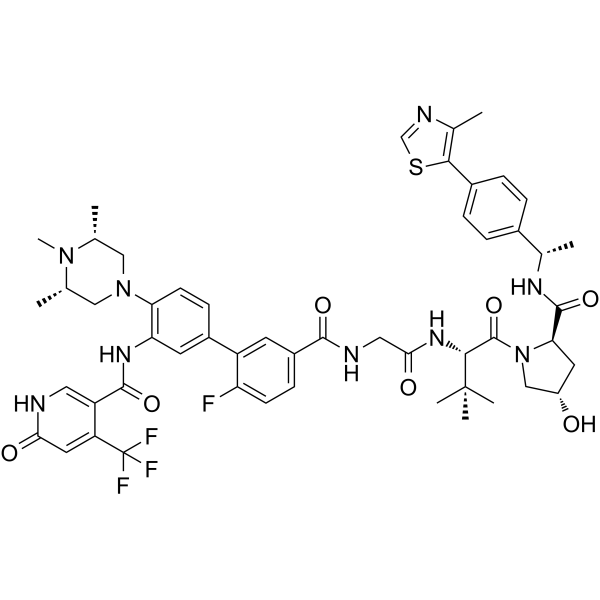 HY-150403XF067-68
-
Similarity Score 0.93
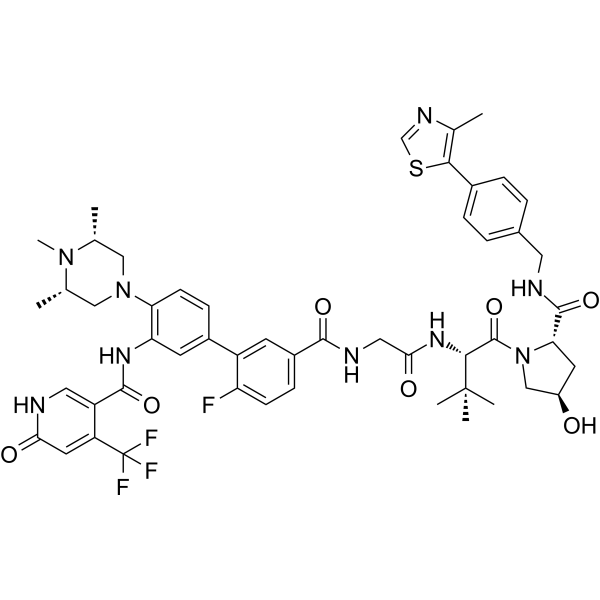 HY-150400XF056-132 free base
-
Similarity Score 0.89
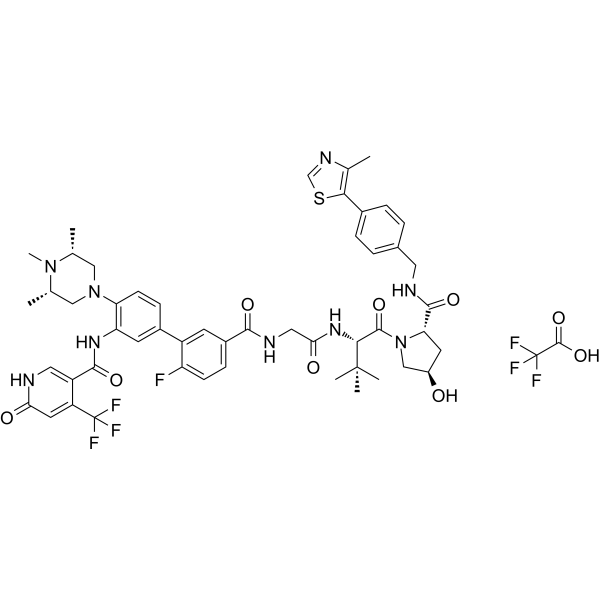 HY-150400AXF056-132
-
Similarity Score 0.74
 HY-168487PROTAC WDR5 degrader 1
-
Similarity Score 0.68
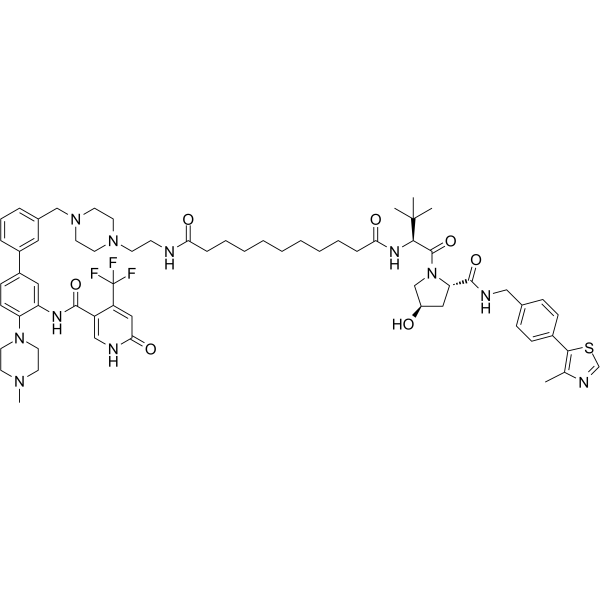 HY-141797MS33
-
Similarity Score 0.63
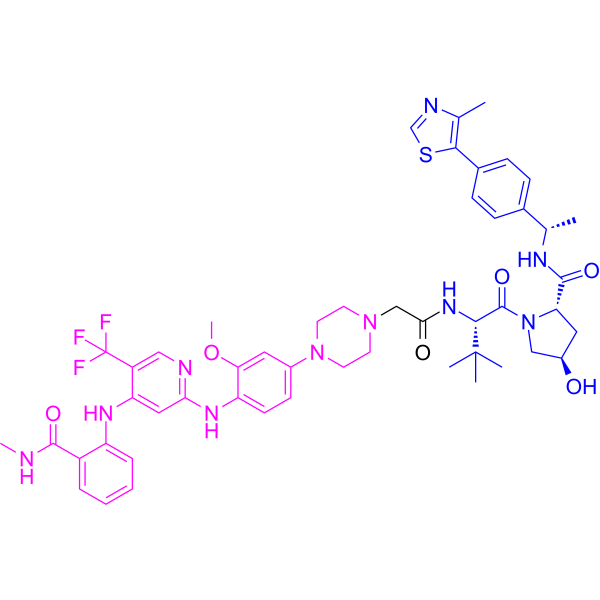 HY-132296GSK215
-
Similarity Score 0.62
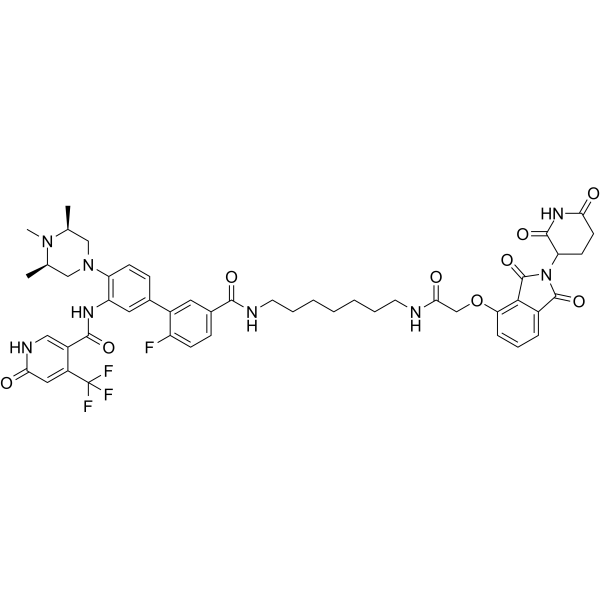 HY-162014WDR5 degrader-1
-
Similarity Score 0.62
 HY-187361PROTAC HIV-1 degrader-1
-
Similarity Score 0.60
 HY-169093MS41
-

Explore the MedChemAI to find more analogs


References
- [1]. Yu Y, et al. Pharmacologic degradation of WDR5 suppresses oncogenic activities of SS18::SSX and provides a therapeutic of synovial sarcoma. Science advances. 2025 Apr 25;11(17):eads7876.
- [2]. Schwalm MP, et al. Tracking the PROTAC degradation pathway in living cells highlights the importance of ternary complex measurement for PROTAC optimization. Cell chemical biology. 2023 Jul 20;30(7):753-765.e8.
- [3]. Kabir M, et al. Chemically induced degradation of epigenetic targets. Chemical Society reviews. 2023 Jul 03;52(13):4313-4342. [Content Brief]
- [4]. Yu X, et al. A selective WDR5 degrader inhibits acute myeloid leukemia in patient-derived mouse models. Science translational medicine. 2021 Sep 29;13(613):eabj1578. [Content Brief]



