



53109-32-3
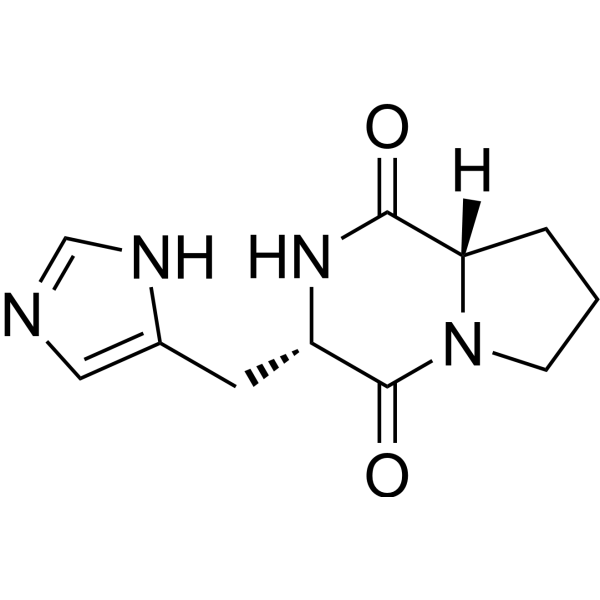
Chemical Structure
Cyclo(his-pro)
Synonym(s): Cyclohistidyl-proline; Histidylproline diketopiperazine
- CAS No.: 53109-32-3
- Formula:C11H14N4O2
- Molecular Weight:234.25
IUPAC Name: (3S,8aS)-3-((1H-imidazol-5-yl)methyl)hexahydropyrrolo[1,2-a]pyrazine-1,4-dione
InChIKey: NAKUGCPAQTUSBE-IUCAKERBSA-N
SMILES: O=C(N[C@H]1CC2=CN=CN2)[C@@](CCC3)([H])N3C1=O
Biological Activity: Cyclo(his-pro) (Cyclo(histidyl-proline)) is an orally active cyclic dipeptide structurally related to tyreotropin-releasing hormone[1]. Cyclo(his-pro) could inhibit NF-κB nuclear accumulation. Cyclo(his-pro) can cross the brain-blood-barrier and affect diverse inflammatory and stress responses[2].
| Cat. No. | Product Name | Purity | Description | Pricing | |||||||||||||||||||
|---|---|---|---|---|---|---|---|---|---|---|---|---|---|---|---|---|---|---|---|---|---|---|---|
|
|
Cyclo(his-pro) | 98.95% | Cyclo(his-pro) (Cyclo(histidyl-proline)) is an orally active cyclic dipeptide structurally related to tyreotropin-releasing hormone. Cyclo(his-pro) could inhibit NF-κB nuclear accumulation. Cyclo(his-pro) can cross the brain-blood-barrier and affect diverse inflammatory and stress responses. | ||||||||||||||||||||
|
loading...
/
|
|||||||||||||||||||||||
-
Similarity Score 1.00
 HY-P5032Cyclo(D-His-Pro)
-
Similarity Score 0.86
 HY-101402ARCyclo(his-pro) TFA (Standard)
-
Similarity Score 0.73
 HY-N3655Cyclo(D-Phe-L-Pro)
-
Similarity Score 0.73
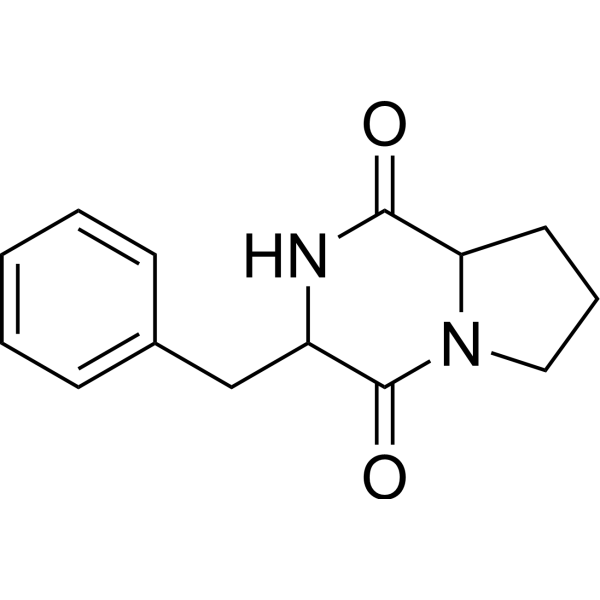 HY-P1934Cyclo(Phe-Pro)
-
Similarity Score 0.73
 HY-P1934ARCyclo(L-Phe-L-Pro) (Standard)
-
Similarity Score 0.71
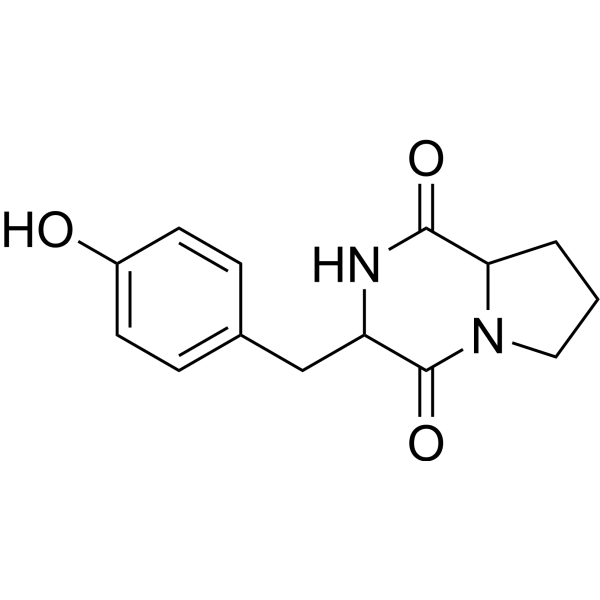 HY-N12524Cyclo(prolyltyrosyl)
-
Similarity Score 0.71
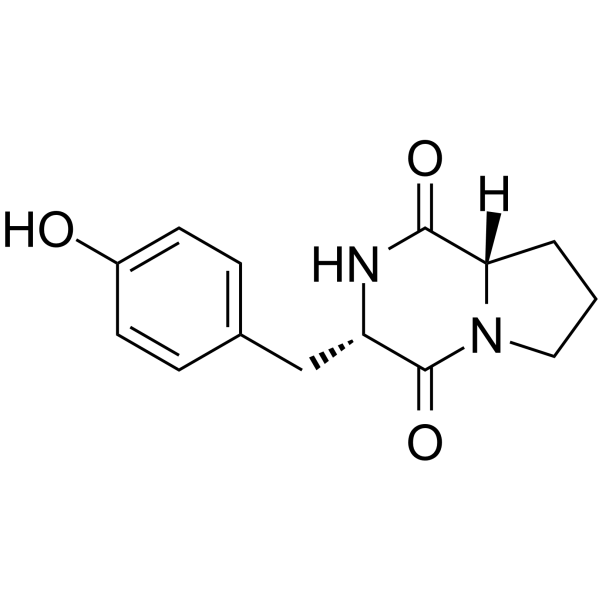 HY-P1940Maculosin
-
Similarity Score 0.65
 HY-P5028Cyclo(His-Phe)
-
Similarity Score 0.64
 HY-111659His-Pro
-

Explore the MedChemAI to find more analogs


References
- [1]. Grottelli S, et al. The Role of Cyclo(His-Pro) in Neurodegeneration. Int J Mol Sci. 2016 Aug 12;17(8). pii: E1332. [Content Brief]
- [2]. Minelli A, et al. Cyclo(His-Pro) exerts anti-inflammatory effects by modulating NF-κB and Nrf2 signalling. Int J Biochem Cell Biol. 2012 Mar;44(3):525-35. [Content Brief]



