



56974-61-9
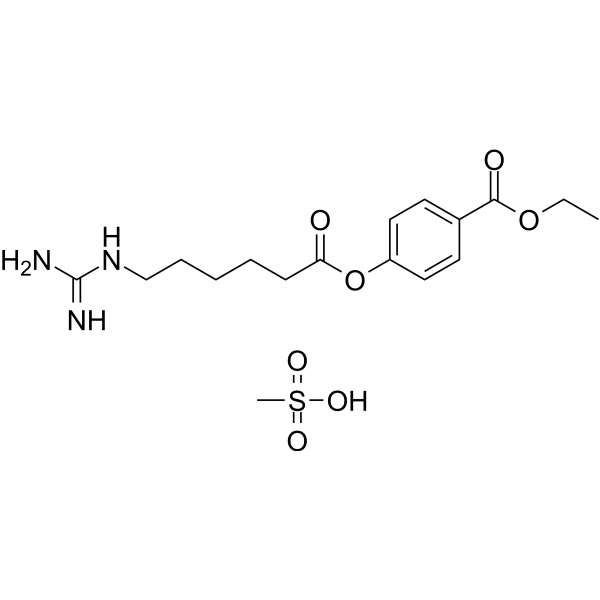
Chemical Structure
Gabexate mesylate
Synonym(s): FOY
- CAS No.: 56974-61-9
- Formula:C17H27N3O7S
- Molecular Weight:417.48
IUPAC Name: ethyl 4-((6-guanidinohexanoyl)oxy)benzoate methanesulfonate
InChIKey: DNTNDFLIKUKKOC-UHFFFAOYSA-N
SMILES: O=C(OCC)C1=CC=C(OC(CCCCCNC(N)=N)=O)C=C1.CS(=O)(O)=O
Biological Activity: Gabexate mesylate (FOY) is is a competitive and non-antigenic synthetic inhibitor of trypsin-like serine proteinases. Gabexate mesylate inhibits human thrombin, urokinase, plasmin, and Factor Xa with Kis of 0.97, 1.3, 1.6, and 8.5 μM, respectively. Gabexate mesylate binds to human and bovine tryptase with Kis of 3.4 nM and 18 μM, respectively. Gabexate mesylate exerts an anticoagulant effect on the clotting activity of thrombin and has anti-inflammatory effect by viainhibition of NF-κB, proinflammatory cytokines, and nitric oxide. Gabexate mesylate is used for pancreatitis and disseminated intravascular coagulation[1][2][3][4].
| Cat. No. | Product Name | Purity | Description | Pricing | |||||||||||||||||||
|---|---|---|---|---|---|---|---|---|---|---|---|---|---|---|---|---|---|---|---|---|---|---|---|
|
|
Gabexate mesylate | 98.64% | Gabexate mesylate (FOY) is is a competitive and non-antigenic synthetic inhibitor of trypsin-like serine proteinases. Gabexate mesylate inhibits human thrombin, urokinase, plasmin, and Factor Xa with Kis of 0.97, 1.3, 1.6, and 8.5 μM, respectively. Gabexate mesylate binds to human and bovine tryptase with Kis of 3.4 nM and 18 μM, respectively. Gabexate mesylate exerts an anticoagulant effect on the clotting activity of thrombin and has anti-inflammatory effect by viainhibition of NF-κB, proinflammatory cytokines, and nitric oxide. Gabexate mesylate is used for pancreatitis and disseminated intravascular coagulation. | ||||||||||||||||||||
|
loading...
/
|
|||||||||||||||||||||||
|
|
Gabexate mesylate (Standard) | ≥98% | Gabexate (mesylate) (Standard) is the analytical standard of Gabexate (mesylate). This product is intended for research and analytical applications. Gabexate mesylate (FOY) is is a competitive and non-antigenic synthetic inhibitor of trypsin-like serine proteinases. Gabexate mesylate inhibits human thrombin, urokinase, plasmin, and Factor Xa with Kis of 0.97, 1.3, 1.6, and 8.5 μM, respectively. Gabexate mesylate binds to human and bovine tryptase with Kis of 3.4 nM and 18 μM, respectively. Gabexate mesylate exerts an anticoagulant effect on the clotting activity of thrombin and has anti-inflammatory effect by viainhibition of NF-κB, proinflammatory cytokines, and nitric oxide. Gabexate mesylate is used for pancreatitis and disseminated intravascular coagulation. | ||||||||||||||||||||
|
loading...
/
|
|||||||||||||||||||||||
-
Similarity Score 0.71
 HY-100365RRemetinostat (Standard)
-
Similarity Score 0.61
 HY-W127523p-Tolyl octanoate
-
Similarity Score 0.57
 HY-167689Parethoxycaine hydrochloride
-
Similarity Score 0.57
 HY-184034Parethoxycaine
-
Similarity Score 0.56
 HY-W150903N-Heptyl 4-hydroxybenzoate
-
Similarity Score 0.56
 HY-W099118RSodium ethylparaben (Standard)
-
Similarity Score 0.56
 HY-W150866Hexyl 4-hydroxybenzoate
-
Similarity Score 0.56
 HY-N0741ARLeonurine hydrochloride (Standard)
-
Similarity Score 0.56
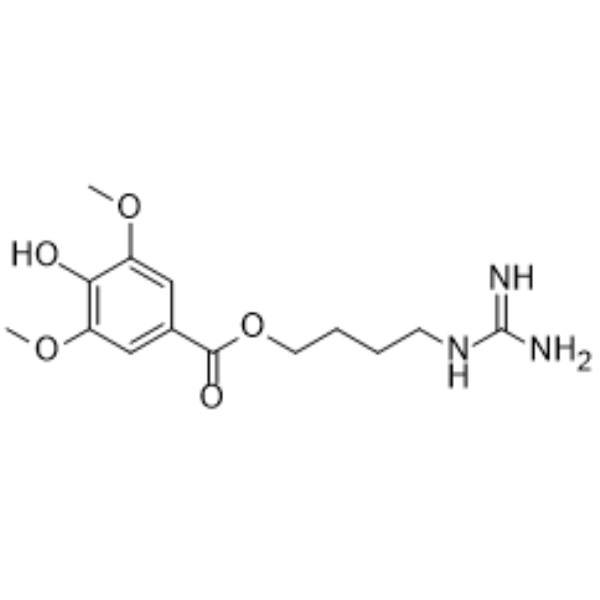 HY-N0741Leonurine
-

Explore the MedChemAI to find more analogs


References
- [1]. H Ohno, et al. FOY: [ethyl P-(6-guanidinohexanoyloxy) benzoate] methanesulfonate as a serine proteinase inhibitor. I. Inhibition of thrombin and factor Xa in vitro. Thromb Res. 1980;19(4-5):579-88. [Content Brief]
- [2]. F Erba, et al. Selective inhibition of human mast cell tryptase by gabexate mesylate, an antiproteinase drug. Biochem Pharmacol. 2001 Feb 1;61(3):271-6. [Content Brief]
- [3]. Tsuneo Ozeki, et al. The specific inhibition of HepG2 cells proliferation by apoptosis induced by gabexate mesilate. Int J Clin Exp Pathol. 2010 Aug 15;3(7):710-7. [Content Brief]
- [4]. Seon Hee Oh, et al. Gabexate mesilate ameliorates the neuropathic pain in a rat model by inhibition of proinflammatory cytokines and nitric oxide pathway via suppression of nuclear factor-κB. Korean J Pain. 2020 Jan 1;33(1):30-39. [Content Brief]



