



Q901 TFA

Based on 1 Customer Validation
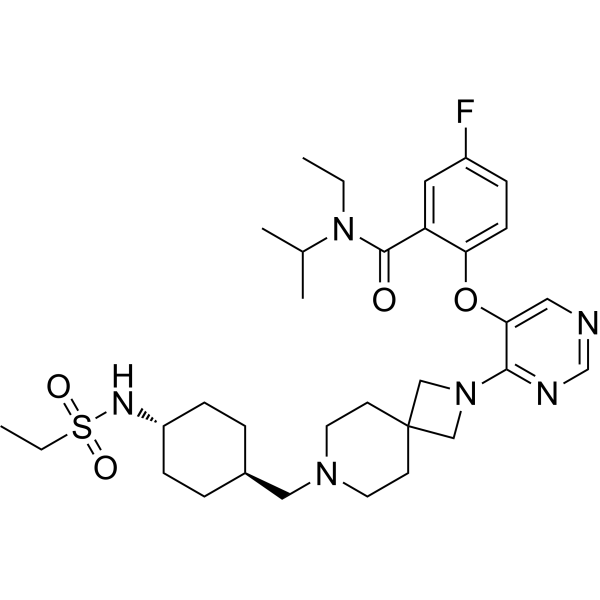
Q901 (CDK7-IN-21) TFA is a selective and potent CDK7 inhibitor with an IC50 of 10 nM. Q901 TFA disrupts MYC and E2FTOP1-DPCs and sensitizes tumor to TOP1 inhibitors by suppressing RNAPII transition from initiation to elongation. Q901 TFA can inhibit tumor growth and significantly enhances tumor growth inhibition combined with TOP1 inhibitors. Q901 TFA can be used for the research of cancer, such as colon cancer and lung cancer.
Nos produits utilisent uniquement pour la recherche. Nous ne vendons pas aux patients.
- Pureté : 98.55%
- Formule: C35H37F4N9O4
- Masse moléculaire:723.72
-
Stockage:
4°C, stored under nitrogen, away from moisture
* In solvent : -80°C, 6 months; -20°C, 1 month (stored under nitrogen, away from moisture)


To place orders, for customer services and technical support, please contact: MedChemExpress USA
Tel: 609-228-6898 E-mail: [email protected] [email protected]


-
 Activité biologique
-
Chemical Information
-
Solvant et solubilité
- Protocole
- Pureté et documentation
- Références
-
 Help & FAQs


Voir tous les produits spécifiques à Isoform DNA/RNA Synthesis
MoreVoir tous les produits spécifiques à Isoform Topoisomerase
More

Activité biologique
Description
IC50 & Target
[1]|
CDK7 10 nM (IC50) |
In Vitro
Q901 (72-120 h) TFA inhibits the proliferation of MCF-7 breast cancer cells with IC50 values of 95 nM (72 h), 16 nM (96 h) and 5 nM (120 h)[1].
Q901 (100 nM, 1-24 h) TFA traps CDK7 at promoter-proximal regions, reduces chromatin-bound RNAPII and its Ser5/Ser2 phosphorylation, and downregulates MYC/E2F-driven transcription programs[1].
Q901 (10-1000 nM, 24-72 h) TFA downregulates DNA damage repair (DDR) genes and increases p-H2AX levels, inducing DNA damage accumulation in MCF-7 cells[1].
Q901 (1 μM, 24 h) TFA reduces ubiquitination of TOP1-DPCs induced by TPT (1 μM, 0.5-2 h) and prolongs the stability of TOP1-DPCs in MCF-7 cells[1].
Q901 TFA combined with Topotecan (HY-13768), T-DXd (HY-138298) and Sacituzumab govitecan (HY-132254) synergistically inhibits the proliferation of H82, DMS53 small cell lung cancer cells, HCT116 colon cancer cells and H292 lung cancer cells[1].
MedChemExpress (MCE) has not independently confirmed the accuracy of these methods. They are for reference only.
-
Cell Line:MCF-7 cells
-
Concentration:10, 100, 1000 nM
-
Incubation Time:24, 48, 72 h
-
Result:Does-and time-dependently increased p-H2AX levels at 24 and 48 h.
Increased p-H2AX levels at 72 h.
In Vivo
Q901 (3-10 mg/kg, i.p., once daily) TFA inhibits tumor growth in H292 lung cancer xenograft mice and significantly enhances tumor growth inhibition combined with Sacituzumab govitecan (3-10 mg/kg, i.v., on day 1 and 8) [1].
MedChemExpress (MCE) has not independently confirmed the accuracy of these methods. They are for reference only.
-
Animal Model:HCT116 colon cancer xenograft mice models[1]
-
Dosage:10 mg/kg
-
Administration:Intraperitoneally injection, once daily, 30 days
-
Result:Reduced tumor volume alone and significantly reduced volume to near 0 combined with T-DXd.


Chemical Information
-
Appearance Solid
-
Masse moléculaire 723.72
-
Formule C35H37F4N9O4
-
Color White to off-white
-
SMILES
C=C(F)C(NC(C=C1)=CC2=C1C(C(C=CC=C3)=C3CNC(N4N=C5)=NC(NC[C@@H]6[C@H](CNCC6)O)=NC4=C5C(C)C)=NC=C2)=O.OC(C(F)(F)F)=O
-
Synonyms
CDK7-IN-21 TFA
-
Livraison
Room temperature in continental US; may vary elsewhere.
-
Stockage
4°C, stored under nitrogen, away from moisture
* In solvent : -80°C, 6 months; -20°C, 1 month (stored under nitrogen, away from moisture)


Solvant et solubilité
In Vitro:
DMSO : 50 mg/mL (69.09 mM; Need ultrasonic; Hygroscopic DMSO has a significant impact on the solubility of product, please use newly opened DMSO)
Please refer to the solubility information to select the appropriate solvent. Once prepared, please aliquot and store the solution to prevent product inactivation from repeated freeze-thaw cycles.
Storage method and period of stock solution: -80°C, 6 months; -20°C, 1 month (stored under nitrogen, away from moisture). When stored at -80°C, please use it within 6 months. When stored at -20°C, please use it within 1 month.
Please refer to the solubility information to select the appropriate solvent. Once prepared, please aliquot and store the solution to prevent product inactivation from repeated freeze-thaw cycles.
Storage method and period of stock solution: -80°C, 6 months; -20°C, 1 month (stored under nitrogen, away from moisture). When stored at -80°C, please use it within 6 months. When stored at -20°C, please use it within 1 month.
Concentration (start) × Volume (start) = Concentration (final) × Volume (final)
In Vivo:
Select the appropriate dissolution method based on your experimental animal and administration route.
- For the following dissolution methods, please ensure to first prepare a clear stock solution using an In Vitro approach and then sequentially add co-solvents:
- To ensure reliable experimental results, the clarified stock solution can be appropriately stored based on storage conditions. As for the working solution for In Vivo experiments, it is recommended to prepare freshly and use it on the same day.
- The percentages shown for the solvents indicate their volumetric ratio in the final prepared solution. If precipitation or phase separation occurs during preparation, heat and/or sonication can be used to aid dissolution.
Add each solvent one by one: 10% DMSO 40% PEG300 5% Tween-80 45% Saline
Solubility: ≥ 2.5 mg/mL (3.45 mM); Clear solution
This protocol yields a clear solution of ≥ 2.5 mg/mL (saturation unknown).
Taking 1 mL working solution as an example, add 100 μL DMSO stock solution (25.0 mg/mL) to 400 μL PEG300, and mix evenly; then add 50 μL Tween-80 and mix evenly; then add 450 μL Saline to adjust the volume to 1 mL.
Preparation of Saline: Dissolve 0.9 g sodium chloride in ddH₂O and dilute to 100 mL to obtain a clear Saline solution.
Add each solvent one by one: 10% DMSO 90% (20% SBE-β-CD in Saline)
Solubility: ≥ 2.5 mg/mL (3.45 mM); Clear solution
This protocol yields a clear solution of ≥ 2.5 mg/mL (saturation unknown).
Taking 1 mL working solution as an example, add 100 μL DMSO stock solution (25.0 mg/mL) to 900 μL 20% SBE-β-CD in Saline, and mix evenly.
Preparation of 20% SBE-β-CD in Saline (4°C, storage for one week): 2 g SBE-β-CD powder is dissolved in 10 mL Saline, completely dissolve until clear.
In Vivo Dissolution Calculator
Please enter the basic information of animal experiments:
-
-
-
-
Recommended: Prepare an additional quantity of animals to account for potential losses during experiments.
Please enter your animal formula composition:
-
%DMSO +
Recommended: Keep the proportion of DMSO in working solution below 2% if your animal is weak.
-
%+
-
+%Tween-80 + +
-
%Saline +
The co-solvents required include: DMSO, . All of co-solvents are available by MedChemExpress (MCE). , Tween 80. All of co-solvents are available by MedChemExpress (MCE).
Working solution concentration: 0.22 mg/mL
Method for preparing stock solution: mg drug dissolved in μL DMSO. Stock solution concentration: mg/mL. * In solvent : -80°C, 6 months; -20°C, 1 month (stored under nitrogen, away from moisture)
1. Take μL DMSO stock solution;
2. Add μL .
μL , mix evenly;
3. Then add μL Tween 80, mix evenly;
4. Then add μL
Please ensure that the stock solution in the first step is dissolved to a clear state, and add co-solvents in sequence. You can use ultrasonic heating (ultrasonic cleaner, recommended frequency 20-40 kHz), vortexing, etc. to assist dissolution.


Pureté et documentation
-
Fiche technique (275 KB)
-
SDS (252 KB)
- English - EN (252 KB)
- Français - FR (252 KB)
- Deutsch - DE (252 KB)
- Norwegian - NO (252 KB)
- Español - ES (252 KB)
- Swedish - SV (252 KB)
- Italian - IT (252 KB)
- Korean - KR (252 KB)
- Portuguese - PT (252 KB)
-
Instruction de manipulation (2659 KB)
Références


Complete Stock Solution Preparation Table
Please refer to the solubility information to select the appropriate solvent. Once prepared, please aliquot and store the solution to prevent product inactivation from repeated freeze-thaw cycles.
Storage method and period of stock solution: -80°C, 6 months; -20°C, 1 month (stored under nitrogen, away from moisture). When stored at -80°C, please use it within 6 months. When stored at -20°C, please use it within 1 month.
| Optional Solvent | Concentration Solvent Mass | 1 mg | 5 mg | 10 mg | 25 mg |
|---|---|---|---|---|---|
| DMSO | 1 mM | 1.3817 mL | 6.9087 mL | 13.8175 mL | 34.5437 mL |
| 5 mM | 0.2763 mL | 1.3817 mL | 2.7635 mL | 6.9087 mL | |
| 10 mM | 0.1382 mL | 0.6909 mL | 1.3817 mL | 3.4544 mL | |
| 15 mM | 0.0921 mL | 0.4606 mL | 0.9212 mL | 2.3029 mL | |
| 20 mM | 0.0691 mL | 0.3454 mL | 0.6909 mL | 1.7272 mL | |
| 25 mM | 0.0553 mL | 0.2763 mL | 0.5527 mL | 1.3817 mL | |
| 30 mM | 0.0461 mL | 0.2303 mL | 0.4606 mL | 1.1515 mL | |
| 40 mM | 0.0345 mL | 0.1727 mL | 0.3454 mL | 0.8636 mL | |
| 50 mM | 0.0276 mL | 0.1382 mL | 0.2763 mL | 0.6909 mL | |
| 60 mM | 0.0230 mL | 0.1151 mL | 0.2303 mL | 0.5757 mL |


Q901 TFA Related Classifications
HY-153278A Related Classifications
 Powered by Bioz