



Calcium hydroxide

Based on 1 Customer Validation
Calcium hydroxide (Dihydroxycalcium) is a strongly alkaline inorganic compound that can create a strongly alkaline environment by releasing hydroxide ions. Calcium hydroxide can cause lipid peroxidation of bacterial cell membranes, protein denaturation, and DNA strand breaks. Calcium hydroxide can be used in research on osteoporosis, apical periodontitis, and bacterial infections.
Nur für Forschungszwecke. Wir verkaufen nicht an Patienten.
- CAS. Nr.: 1305-62-0
- Formel: Ca(OH)2
- Molecular Weight:74.09
-
Speicherung:
Store at room temperature, keep dry and cool.
In solvent -80°C, 1 year , -20°C, 6 months


To place orders, for customer services and technical support, please contact: MedChemExpress USA
Tel: 609-228-6898 E-mail: [email protected] [email protected]


-
 Biologische Aktivität
-
Chemical Information
- Protokoll
- Reinheit & Dokumentation
- Verweise
-
 Help & FAQs


-

HY-B2217D
Calcium hydroxide, ACS, 95%Bactericidal Drug -

HY-W243408C
Calcium carbonate, 99%Calcium Carbonate Salt -

HY-W243408D
Calcium carbonate, for cell cultureAcidity Regulator -
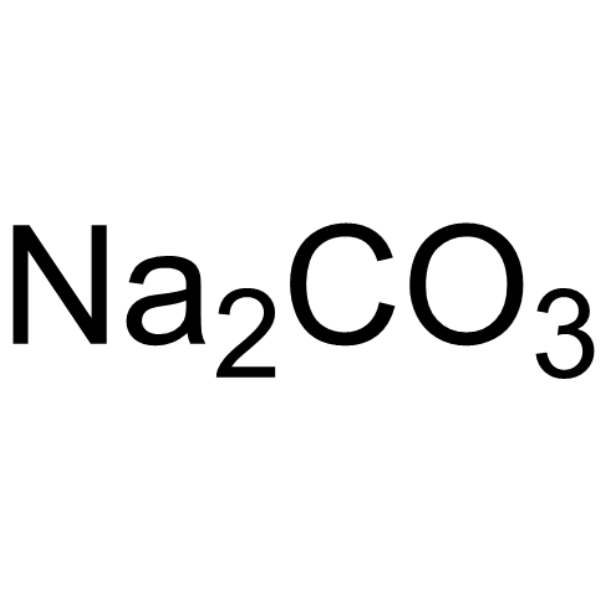
HY-ER013C
Sodium carbonate anhydrous, 99.8%Biochemical Reagent -

HY-Y0344D
Sodium chloride, for cell cultureBiochemical Assay Reagent -

HY-Y1269
Ammonium chloride, AR, 99.5%Autophagy Inhibitor/Ionic Compound -

HY-Y1269C
Ammonium chloride, for cell cultureAutophagy Inhibitor -
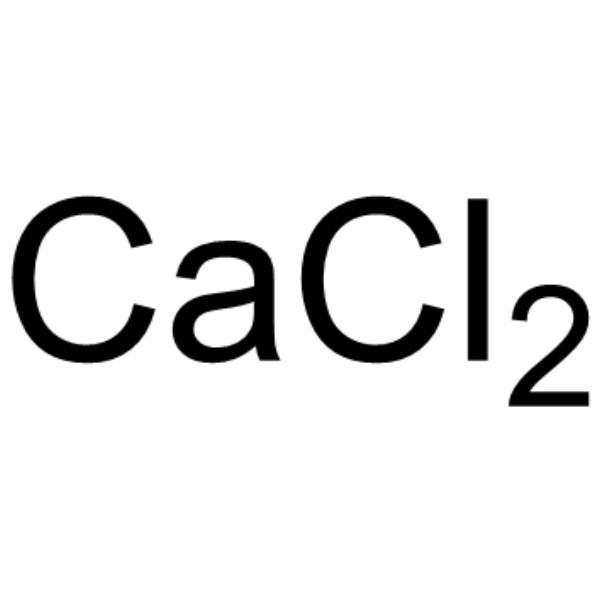
HY-Y0406E
Calcium chloride anhydrous, for cell cultureCalcium Chloride -
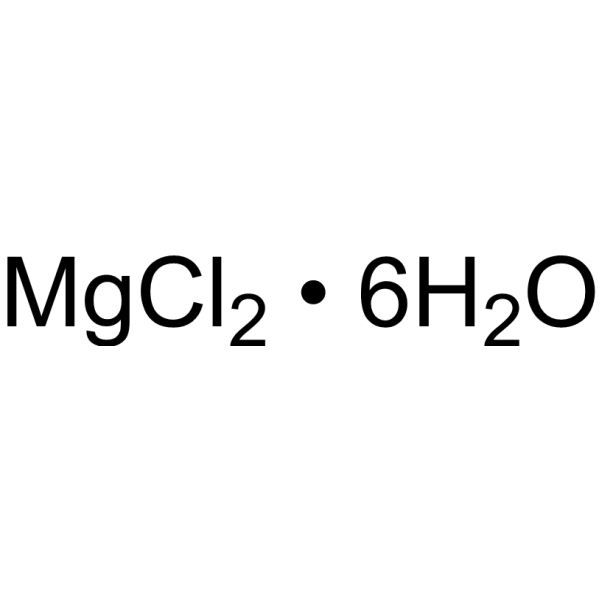
HY-W019981B
Magnesium chloride hexahydrate, for molecular biologySource of Magnesium Ion


Biologische Aktivität
Beschreibung
In Vitro
Calcium hydroxide did not affect the cell survival rate of Enterococcus faecalis JH2-2 after protein synthesis was blocked by 100 μg/mL Chloramphenicol (HY-B0239) at pH 11.1 and 11.5[1].
Calcium hydroxide pretreatment does not induce adaptive tolerance to higher pH calcium hydroxide stress in Enterococcus faecalis JH2-2[1].
Calcium‑hydroxide‑derived CaNP releases hydroxide ions via component dissolution to neutralize acidic microenvironment and elevate pH. Calcium‑hydroxide‑derived CaNP induces osteogenic lineage differentiation of BMSCs, and 14‑day treatment further promotes late‑stage osteogenic differentiation and mineralization of BMSCs[1].
Calcium hydroxide (Ca[OH]2) (0.048-25.00 µg/mL; 3 h) does not exhibit cytotoxic effects on the RAW 264.7 mouse macrophage cell line at the evaluated concentrations[3].
Calcium hydroxide releases hydroxyl ions that diffuse through root dentin, producing higher hydroxyl‑ion levels in the cervical region than in the apical region, and achieving full‑thickness dentin saturation after 2 to 3 weeks[1].
Calcium hydroxide exhibits low immunostimulatory activity against the RAW 264.7 mouse macrophage cell line, as it does not significantly increase NO production at concentrations ranging from 0.048 to 12.5 µg/mL[3].
Calcium hydroxide (6.25-25 µg/mL; 2 h pretreatment; overnight LPS stimulation) showed no anti-inflammatory potential in the RAW 264.7 mouse macrophage cell line, as it promoted increased TNF-α and IL-1α release in a dose-dependent manner[3].
Calcium hydroxide can hydrolyze lipid A, releasing non-toxic free hydroxy fatty acids[4].
Calcium hydroxide exerts a bactericidal effect on most endodontic pathogen-related bacteria of root canal origin, but it cannot eliminate Enterococcus faecalis within the dentinal tubules[4].
Calcium hydroxide is unrelated to the survival and stress-induced protein synthesis of E. faecalis, but a functional proton pump is essential for survival at high pH[4].
MedChemExpress (MCE) has not independently confirmed the accuracy of these methods. They are for reference only. Further protocols information, click here.
-
Cell Line:RAW 264.7 murine macrophage cell line
-
Concentration:0.048, 0.097, 0.19, 0.39, 0.78, 1.56, 3.12, 6.25, 12.50, 25.00 µg/mL
-
Incubation Time:3 h
-
Result:Did not present cytotoxic effects to RAW 264.7 murine macrophage cell line.
-
Cell Line:RAW 264.7 murine macrophage cell line
-
Concentration:6.25, 12.5, 25 µg/mL
-
Incubation Time:2 h pretreatment; overnight LPS stimulation
-
Result:Promoted an increase in TNF-α release with a dose-dependent pattern at 6.25, 12.5, and 25 µg/mL.
Promoted an increase in IL-1α release.
Inhibited NO production with a dose-dependent pattern; values at 6.25, 12.5, and 25 µg/mL were lower than the LPS control.
In Vivo
Calcium hydroxide can eliminate the toxic effects of bacterial endotoxins in vivo[4].
MedChemExpress (MCE) has not independently confirmed the accuracy of these methods. They are for reference only.
Clinical Trial
| NCT Number | Sponsor | Condition | Start Date |
Phase

|
|---|---|---|---|---|
| NCT01329991 | Plexxikon| | 2011-05 | PHASE1 |


Chemical Information
-
CAS. Nr. 1305-62-0
-
Appearance Solid
-
Molecular Weight 74.09
-
Formel Ca(OH)2
-
Color White to off-white
-
SMILES
O[Ca]O
-
Synonyms
Dihydroxycalcium
-
Versand
Room temperature in continental US; may vary elsewhere.
-
Speicherung
Store at room temperature, keep dry and cool
In solvent -80°C 1 year -20°C 6 months

Protokoll
-
Ferroptosis Solutions
Ferroptosis is an iron-dependent, non-apoptotic form of regulated cell death characterized by lethal lipid peroxidation and sensitivity to suppression by iron chelators or lipophilic radical-trapping antioxidants. The core pathway links cystine uptake through system Xc−, glutathione availability, GPX4-dependent detoxification of phospholipid hydroperoxides, iron-dependent oxidative reactions, and polyunsaturated-phospholipid metabolism into a cell-death program that is biochemically and morphologically distinct from apoptosis, necrosis, and autophagy. The ferroptosis pathway is experimentally linked to phenotype through chemical and genetic perturbation. Erastin induces ferroptosis by inhibiting cystine uptake through system Xc− and weakening antioxidant defenses, while GPX4 inhibition or depletion causes lipid peroxide accumulation and ferroptotic cancer-cell death. ACSL4 and oxidizable arachidonoyl- or adrenoyl-containing phosphatidylethanolamines shape ferroptosis sensitivity by con


Reinheit & Dokumentation
-
Data Sheet (286 KB)
-
SDS (614 KB)
- English - EN (614 KB)
- Français - FR (614 KB)
- Deutsch - DE (614 KB)
- Norwegian - NO (614 KB)
- Español - ES (614 KB)
- Swedish - SV (614 KB)
- Italian - IT (614 KB)
- Korean - KR (614 KB)
- Portuguese - PT (614 KB)
-
Handling Instructions (2659 KB)
Verweise

Calculators
Konzentration (Stammlösung) × Volumen (Stammlösung) = Konzentration (Ziellösung) × Volumen (Ziellösung)


Calcium hydroxide Related Classifications
HY-B2217 Related Classifications
 Powered by Bioz