



Sodium sulfite

Based on 1 Customer Validation
Sodium sulfite is an inorganic salt used as an antioxidant and preservative. Sodium sulfite is also used in sulfonation and sulfomethylation reactions. Sodium sulfite can also be used as a bleaching agent, desulfurizer, and dechlorinator. Sodium sulfite inhibits hepatocyte proliferation, promotes hepatocyte apoptosis and necrosis, and impairs mitochondrial integrity. Sodium sulfite induces superoxide anion production, primes neutrophils for enhanced superoxide anion generation, and induces neutrophil gene expression. Sodium sulfite can be used in studies related to pulmonary inflammation and gastric tissue injury.
Nur für Forschungszwecke. Wir verkaufen nicht an Patienten.
- Reinheit : 98.15%
- CAS. Nr.: 7757-83-7
- Formel: Na2SO3
- Molecular Weight:126.04
-
Speicherung:Powder -20°C, 3 years , 4°C, 2 years ; In solvent -80°C, 6 months , -20°C, 1 month


To place orders, for customer services and technical support, please contact: MedChemExpress USA
Tel: 609-228-6898 E-mail: [email protected] [email protected]


-
 Biologische Aktivität
-
Chemical Information
-
Lösungsmittel & Löslichkeit
- Protokoll
- Reinheit & Dokumentation
- Verweise
-
 Help & FAQs


-

HY-Y1103
Iron(II) sulfate heptahydrate, 99%Iron Salt -
HY-Y0317H
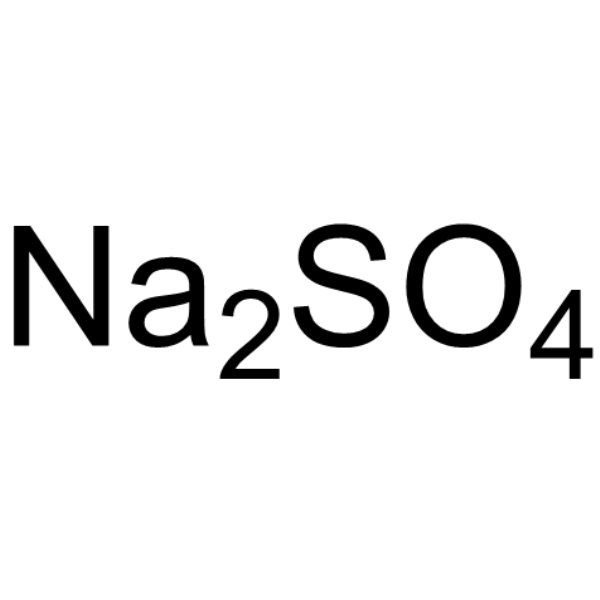
Sodium sulfate anhydrous, for cell cultureDrying Agent -

HY-B1770
Sodium Iodide,99%Iodide Salt -
HY-124011
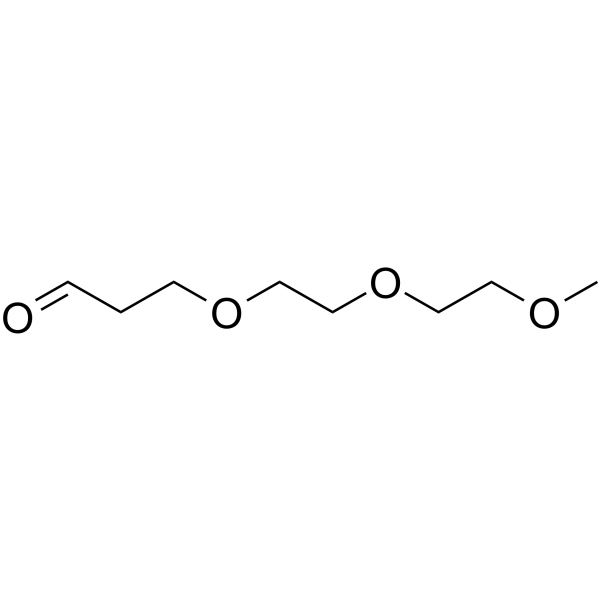
m-PEG3-aldehydePROTAC Linker -

HY-108775A
Sodium thiosulfate (99%, water≤1.0%)Antioxidant -

HY-Y1103A
Iron(II) sulfate heptahydrate, for cell culture, 99%Iron Salt -

HY-Y0849C
Ammonium acetate, for molecular biology, 98%Biochemical Reagent -
HY-B0178A
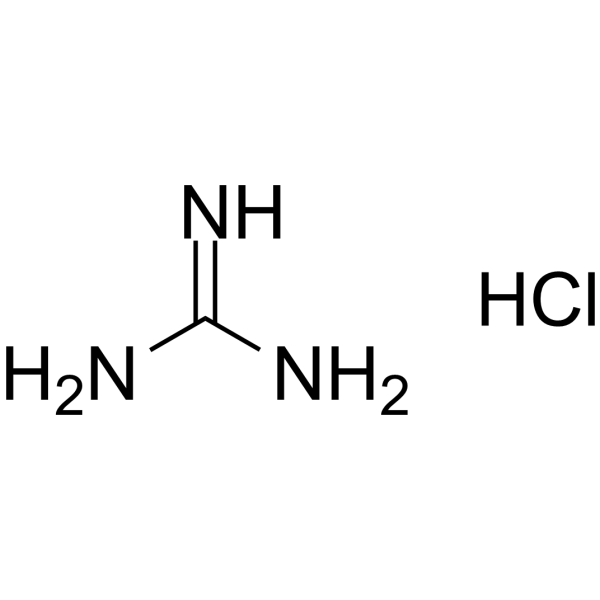
Guanidine hydrochlorideProtein Denaturant -

HY-108775
Sodium thiosulfate (98%)Antioxidant -

HY-23539C
Sodium thiosulfate pentahydrate (GR,≥99.5%)Biochemical Reagent


Biologische Aktivität
Beschreibung
In Vitro
Sodium sulfite (10-5-10-2 M; 24-72 h) alters the morphology of human hepatocytes L02 in a time- and concentration-dependent manner, with notable toxic effects occurring at 10-3 M and 10-2 M[1].
Sodium sulfite (10-5-10-2 M; 72 h) inhibits the viability of human hepatocytes L02 in a concentration-dependent manner, with an IC50 of 4.68×10⁻⁴ M after 72 h incubation[1].
Sodium sulfite (10-5-10-2 M; 24-72 h) inhibits the proliferation of human hepatocytes L02 in a time- and concentration-dependent manner, with significant inhibition occurring at concentrations of 5×10⁻⁴ M and higher[1].
Sodium sulfite (10-5-10-2 M; 72 h) induces apoptosis in human hepatocytes L02 in a concentration-dependent manner, with notable apoptosis starting at 10-4 M and severe cell death occurring at 10-2 M within 24 h[1].
Sodium sulfite (4.68×10⁻⁴ M; 72 h) alters the expression of 97 genes in human hepatocytes L02, with 13 genes significantly upregulated and 14 genes significantly downregulated, driving pathways that inhibit cell proliferation, induce apoptosis, and cause mitochondrial damage via reactive oxygen species production[1].
Sodium sulfite (0.1-10 mM; 5-30 min) concentration-dependently induces superoxide production in freshly isolated human neutrophils within 5 to 30 min, and (0.1-10 mM; 30 min pre-incubation followed by 5 min fMLP stimulation) concentration-dependently primes these neutrophils to enhance fMLP-induced superoxide production following 30 min pre-incubation[2].
Sodium sulfite (0.1-10 mM; 4 h) concentration-dependently induces RNA synthesis in freshly isolated human neutrophils following 4 h incubation, but does not induce neutrophil shape changes[2].
Sodium sulfite (0.1-10 mM; 20 h) does not modulate apoptosis rates in freshly isolated human neutrophils following 20 h incubation, nor does it reverse the apoptosis-delaying effect of GM-CSF in these cells[2].
Sodium sulfite (0.001-10 mM; 5-24 h) induces dose-dependent necrotic cell death in RGM1 cells via oxidative stress, with an IC50 of 0.17 mM, and this cytotoxicity is attenuated by the free radical scavenger Trolox[3].
Sodium sulfite (0-5 mM; 20 h) induces necrotic cell death in RGM1 cells independent of the apoptotic signaling pathway, as shown by unchanged caspase/PARP cleavage, caspase activity, and DNA fragmentation, alongside dose-dependent LDH release[3].
Sodium sulfite (0-10 mM; 0-120 min, 24 h) induces oxidative modification, aggregation, and inactivation of purified lysozyme via metal ion-catalyzed free radical formation, independent of superoxide or hydrogen peroxide scavenging[3].
MedChemExpress (MCE) has not independently confirmed the accuracy of these methods. They are for reference only.
-
Cell Line:human hepatocytes L02
-
Concentration:10-5 M, 10-4 M, 2.5×10⁻⁴ M, 5×10⁻⁴ M, 5×10⁻³ M, 10-2 M
-
Incubation Time:72 h
-
Result:Gradually decreased L02 cell viability with increasing sodium sulfite concentration.
Reached an IC50 of 4.68×10⁻⁴ M for L02 cells at 72 h.
-
Cell Line:human hepatocytes L02
-
Concentration:10-5 M, 10-4 M, 5×10⁻⁴ M, 5×10⁻³ M, 10-2 M
-
Incubation Time:24 h, 48 h, 72 h
-
Result:Significantly inhibited L02 cell proliferation at concentrations ≥5×10⁻⁴ M, with proliferation rate decreasing as incubation time increased.
Had no obvious effect on proliferation activity at low concentrations (10-5 M, 10-4 M).
-
Cell Line:human hepatocytes L02
-
Concentration:10-5 M, 10-4 M, 10-3 M, 10-2 M
-
Incubation Time:72 h
-
Result:Caused cell color changes from green to orange/red (indicating apoptosis) at 10-4 M with increased incubation time.
Induced significant apoptosis as early as 24 h at 10-3 M, indicated by dominant orange and red staining.
Led to majority of cells being dead by 24 h at 10-2 M.
-
Cell Line:human hepatocytes L02
-
Concentration:4.68×10⁻⁴ M (IC50)
-
Incubation Time:72 h
-
Result:Identified 97 significantly regulated differentially expressed genes between sodium sulfite-treated and control cells via transcriptomic analysis.
Confirmed the expression changes of 13 significantly upregulated genes (including SOCS3, FOSL1, PLK3, IL1B) and 14 significantly downregulated genes (including CPS1, FBN1, FKBP3) via qPCR.
Linked these genes to pathways including TNF signaling, IL-17 signaling, apoptosis, metabolism, and inflammatory responses.
-
Cell Line:rat gastric mucosal epithelial cells (RGM1)
-
Concentration:0-5 mM (20 h incubation); 0-5 mM (1 h pre-incubation followed by 20 h in fresh medium)
-
Incubation Time:20 h; 1 h (pre-incubation) + 20 h (fresh medium)
-
Result:Did not alter levels of cleaved caspase-9, cleaved caspase-3, or cleaved PARP, nor change caspase-9 or caspase-3 activity.
Showed no apoptotic DNA fragmentation, but dose-dependently increased LDH release into the culture medium.
- Phagocytosis Functional Assay
- RT-PCR
- RNA extraction experimental
- Detection of Apoptosis
- TUNEL staining for apoptotic DNA fragmentation
- Annexin V plus membrane-impermeant dye apoptosis staining
- Apoptosis Solutions
- Research Protocol for Inflammation-related Diseases
- Real Time qPCR (Q-PCR)
- Cell Viability Determination by MTT Colorimetric Assay


Chemical Information
-
CAS. Nr. 7757-83-7
-
Appearance Solid
-
Molecular Weight 126.04
-
Formel Na2SO3
-
Color White to off-white
-
SMILES
O=S(O[Na])([Na])=O
-
Versand
Room temperature in continental US; may vary elsewhere.
-
Speicherung
Powder -20°C 3 years 4°C 2 years In solvent -80°C 6 months -20°C 1 month


Lösungsmittel & Löslichkeit
In Vitro:
H2O : ≥ 200 mg/mL (1586.80 mM)
* "≥" means soluble, but saturation unknown.
Please refer to the solubility information to select the appropriate solvent. Once prepared, please aliquot and store the solution to prevent product inactivation from repeated freeze-thaw cycles.
Storage method and period of stock solution: -80°C, 6 months; -20°C, 1 month. When stored at -80°C, please use it within 6 months. When stored at -20°C, please use it within 1 month.
* Note: If you choose water as the stock solution, please dilute it to the working solution, then filter and sterilize it with a 0.22 μm filter before use.
Please refer to the solubility information to select the appropriate solvent. Once prepared, please aliquot and store the solution to prevent product inactivation from repeated freeze-thaw cycles.
Storage method and period of stock solution: -80°C, 6 months; -20°C, 1 month. When stored at -80°C, please use it within 6 months. When stored at -20°C, please use it within 1 month.
* Note: If you choose water as the stock solution, please dilute it to the working solution, then filter and sterilize it with a 0.22 μm filter before use.
Konzentration (Stammlösung) × Volumen (Stammlösung) = Konzentration (Ziellösung) × Volumen (Ziellösung)


Reinheit & Dokumentation
-
Data Sheet (282 KB)
-
SDS (394 KB)
- English - EN (394 KB)
- Français - FR (394 KB)
- Deutsch - DE (394 KB)
- Norwegian - NO (394 KB)
- Español - ES (394 KB)
- Swedish - SV (394 KB)
- Italian - IT (394 KB)
- Korean - KR (394 KB)
- Portuguese - PT (394 KB)
-
Handling Instructions (2659 KB)
Verweise
[1]. Han X, et al. Mechanism analysis of toxicity of sodium sulfite to human hepatocytes L02. Mol Cell Biochem. 2020;473(1-2):25-37. [Content Brief]
[2]. Labbé P, et al. Functional responses of human neutrophils to sodium sulfite (Na2SO3) in vitro. Hum Exp Toxicol. 1998 Nov;17(11):600-5. [Content Brief]
[3]. Oshimo M, et al. Sodium sulfite causes gastric mucosal cell death by inducing oxidative stress. Free Radic Res. 2021;55(6):731-743. [Content Brief]


Complete Stock Solution Preparation Table
Please refer to the solubility information to select the appropriate solvent. Once prepared, please aliquot and store the solution to prevent product inactivation from repeated freeze-thaw cycles.
Storage method and period of stock solution: -80°C, 6 months; -20°C, 1 month. When stored at -80°C, please use it within 6 months. When stored at -20°C, please use it within 1 month.
| Optional Solvent | Concentration Solvent Mass | 1 mg | 5 mg | 10 mg | 25 mg |
|---|---|---|---|---|---|
| H2O | 1 mM | 7.9340 mL | 39.6699 mL | 79.3399 mL | 198.3497 mL |
| 5 mM | 1.5868 mL | 7.9340 mL | 15.8680 mL | 39.6699 mL | |
| 10 mM | 0.7934 mL | 3.9670 mL | 7.9340 mL | 19.8350 mL | |
| 15 mM | 0.5289 mL | 2.6447 mL | 5.2893 mL | 13.2233 mL | |
| 20 mM | 0.3967 mL | 1.9835 mL | 3.9670 mL | 9.9175 mL | |
| 25 mM | 0.3174 mL | 1.5868 mL | 3.1736 mL | 7.9340 mL | |
| 30 mM | 0.2645 mL | 1.3223 mL | 2.6447 mL | 6.6117 mL | |
| 40 mM | 0.1983 mL | 0.9917 mL | 1.9835 mL | 4.9587 mL | |
| 50 mM | 0.1587 mL | 0.7934 mL | 1.5868 mL | 3.9670 mL | |
| 60 mM | 0.1322 mL | 0.6612 mL | 1.3223 mL | 3.3058 mL | |
| 80 mM | 0.0992 mL | 0.4959 mL | 0.9917 mL | 2.4794 mL | |
| 100 mM | 0.0793 mL | 0.3967 mL | 0.7934 mL | 1.9835 mL |
* Note: If you choose water as the stock solution, please dilute it to the working solution, then filter and sterilize it with a 0.22 μm filter before use.


Sodium sulfite Related Classifications
HY-Y0651 Related Classifications
 Powered by Bioz