



TMPO
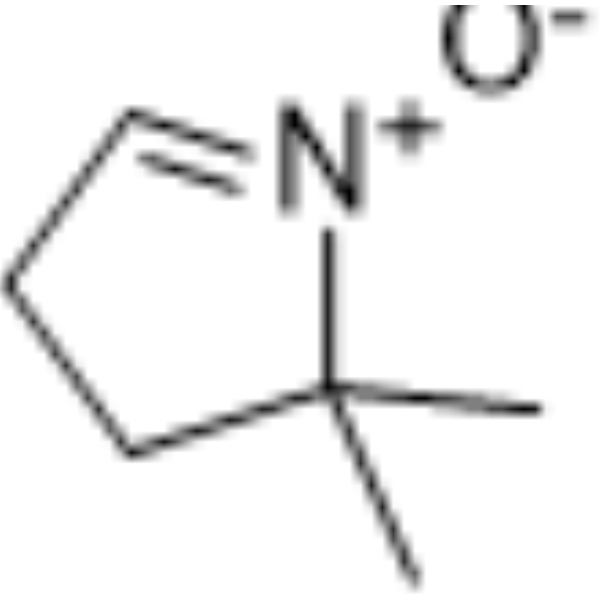
TMPO (3,3,5,5-Tetramethyl-1-pyrroline 1-oxide) is a spin trap targeting free radicals. TMPO is capable of scavenging superoxide, hydroxyl radicals and inhibits thymocyte apoptosis with EC50 values of 19.1 mM (MPS-induced) to 30.7 mM (Etoposide-induced) for inhibiting DNA fragmentation. TMPO reacts with intracellular free radicals to form stable nitroxide radical products, reducing oxidative stress (e.g., decreasing peroxide levels, maintaining glutathione content) and blocking oxidative events in the apoptotic pathway. TMPO is promising for research of apoptosis in immune cells like thymocytes.
Nur für Forschungszwecke. Wir verkaufen nicht an Patienten.
- Reinheit : 99.87%
- CAS. Nr.: 10135-38-3
- Formel: C8H15NO
- Molecular Weight:141.21
-
Speicherung:Pure form -20°C, 3 years , 4°C, 2 years ; In solvent -80°C, 6 months , -20°C, 1 month


To place orders, for customer services and technical support, please contact: MedChemExpress USA
Tel: 609-228-6898 E-mail: [email protected] [email protected]


-
 Biologische Aktivität
-
Chemical Information
-
Lösungsmittel & Löslichkeit
- Protokoll
- Reinheit & Dokumentation
- Verweise
-
 Help & FAQs




Biologische Aktivität
Beschreibung


Chemical Information
-
CAS. Nr. 10135-38-3
-
Appearance Liquid
-
Molecular Weight 141.21
-
Formel C8H15NO
-
Color Colorless to light yellow
-
SMILES
CC1(C)CC(C)(C)[N+](=C1)[O-]
-
Synonyms
3,3,5,5-Tetramethyl-1-pyrroline 1-oxide
-
Versand
Room temperature in continental US; may vary elsewhere.
-
Speicherung
Pure form -20°C 3 years 4°C 2 years In solvent -80°C 6 months -20°C 1 month


Lösungsmittel & Löslichkeit
In Vitro:
H2O : 100 mg/mL (708.17 mM; Need ultrasonic)
Please refer to the solubility information to select the appropriate solvent. Once prepared, please aliquot and store the solution to prevent product inactivation from repeated freeze-thaw cycles.
Storage method and period of stock solution: -80°C, 6 months; -20°C, 1 month. When stored at -80°C, please use it within 6 months. When stored at -20°C, please use it within 1 month.
* Note: If you choose water as the stock solution, please dilute it to the working solution, then filter and sterilize it with a 0.22 μm filter before use.
Please refer to the solubility information to select the appropriate solvent. Once prepared, please aliquot and store the solution to prevent product inactivation from repeated freeze-thaw cycles.
Storage method and period of stock solution: -80°C, 6 months; -20°C, 1 month. When stored at -80°C, please use it within 6 months. When stored at -20°C, please use it within 1 month.
* Note: If you choose water as the stock solution, please dilute it to the working solution, then filter and sterilize it with a 0.22 μm filter before use.
Konzentration (Stammlösung) × Volumen (Stammlösung) = Konzentration (Ziellösung) × Volumen (Ziellösung)


Reinheit & Dokumentation
-
Data Sheet (275 KB)
-
SDS (393 KB)
- English - EN (393 KB)
- Français - FR (393 KB)
- Deutsch - DE (393 KB)
- Norwegian - NO (393 KB)
- Español - ES (393 KB)
- Swedish - SV (393 KB)
- Italian - IT (393 KB)
- Korean - KR (393 KB)
- Portuguese - PT (393 KB)
-
Handling Instructions (2659 KB)
Verweise
[1]. Buettner GR, et al. The spin trapping of superoxide with M4PO (3,3,5,5-tetramethylpyrroline-N-oxide). Free Radic Biol Med. 1990;8(1):57-60. [Content Brief]
[2]. Slater AF, et al. Nitrone spin traps and a nitroxide antioxidant inhibit a common pathway of thymocyte apoptosis. Biochem J. 1995 Mar 15;306 ( Pt 3)(Pt 3):771-8. [Content Brief]


Complete Stock Solution Preparation Table
Please refer to the solubility information to select the appropriate solvent. Once prepared, please aliquot and store the solution to prevent product inactivation from repeated freeze-thaw cycles.
Storage method and period of stock solution: -80°C, 6 months; -20°C, 1 month. When stored at -80°C, please use it within 6 months. When stored at -20°C, please use it within 1 month.
| Optional Solvent | Concentration Solvent Mass | 1 mg | 5 mg | 10 mg | 25 mg |
|---|---|---|---|---|---|
| H2O | 1 mM | 7.0817 mL | 35.4083 mL | 70.8165 mL | 177.0413 mL |
| 5 mM | 1.4163 mL | 7.0817 mL | 14.1633 mL | 35.4083 mL | |
| 10 mM | 0.7082 mL | 3.5408 mL | 7.0817 mL | 17.7041 mL | |
| 15 mM | 0.4721 mL | 2.3606 mL | 4.7211 mL | 11.8028 mL | |
| 20 mM | 0.3541 mL | 1.7704 mL | 3.5408 mL | 8.8521 mL | |
| 25 mM | 0.2833 mL | 1.4163 mL | 2.8327 mL | 7.0817 mL | |
| 30 mM | 0.2361 mL | 1.1803 mL | 2.3606 mL | 5.9014 mL | |
| 40 mM | 0.1770 mL | 0.8852 mL | 1.7704 mL | 4.4260 mL | |
| 50 mM | 0.1416 mL | 0.7082 mL | 1.4163 mL | 3.5408 mL | |
| 60 mM | 0.1180 mL | 0.5901 mL | 1.1803 mL | 2.9507 mL | |
| 80 mM | 0.0885 mL | 0.4426 mL | 0.8852 mL | 2.2130 mL | |
| 100 mM | 0.0708 mL | 0.3541 mL | 0.7082 mL | 1.7704 mL |
* Note: If you choose water as the stock solution, please dilute it to the working solution, then filter and sterilize it with a 0.22 μm filter before use.


TMPO Related Classifications
HY-W271506 Related Classifications
 Powered by Bioz