



Avanbulin

Based on 1 Customer Validation
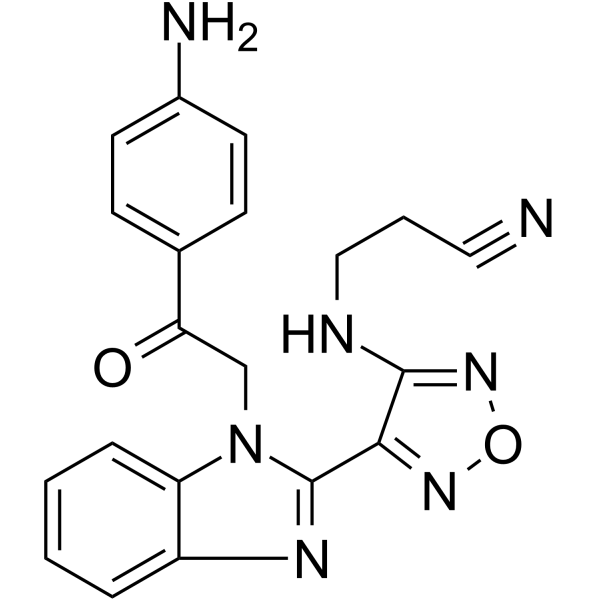
Avanbulin (BAL27862) is a potent, Colchicine site-binding, tubulin assembly inhibitor. Avanbulin inhibits tubulin assembly at 37 °C with an IC50 of 1.4 μM. Avanbulin binds to tubulin with an apparent Kd value of 244 nM. Avanbulin can be used for the research of cancer and cell division.
Nos produits utilisent uniquement pour la recherche. Nous ne vendons pas aux patients.
- Pureté : 99.08%
- CAS No.: 798577-91-0
- Formule: C20H17N7O2
- Masse moléculaire:387.39
-
Stockage:Powder -20°C, 3 years , 4°C, 2 years ; In solvent -80°C, 6 months , -20°C, 1 month

To place orders, for customer services and technical support, please contact: MedChemExpress USA
Tel: 609-228-6898 E-mail: [email protected] [email protected]


-
 Activité biologique
-
Chemical Information
-
Solvant et solubilité
- Protocole
- Pureté et documentation
- Références
-
 Help & FAQs




Activité biologique
Description
In Vitro
Avanbulin (0-4 μM) binds to tubulin in the site as Colchicine with an apparent Kd value of 244 nM.[1].
Avanbulin (50 μM; 0, 10, 20, 30, 60 min) induces the proteolysis of tubulin[1].
Avanbulin (33 nM; 0, 10, 20, 30, 60 min; HeLa-tubGFP cells) collapses the mitotic spindle and forms the tiny tubulin aggregates[1].
Avanbulin does not induce the formation of tubulin oligomers[1].
Avanbulin induces growth inhibition of 23 tumor cell lines with a median relative IC50 of 13.8 nM (96 hours) [2].
Avanbulin (6 nM and 20 nM) inhibits the migration of GBM6 and GBM9 cells[3].
Avanbulin (6 nM and 20 nM; GBM6-shEB1 and GBM6-sh0 cells) triggers astrocytic differentiation of GBM6 in an EB1-dependent manner[3].
Avanbulin (12 nM; 4 h) reduces kinetochore-microtubule (KT-MT) occupancy of MG132(10 μM; 2h) treated hTert-RPE1 eGFP-α-tubulin cells[4].
Avanbulin (12 nM; 4 h) reduces average inter-KT distances of cells, shows intact spindle morphology, and lacks obvious chromosome alignment defects[4].
MedChemExpress (MCE) has not independently confirmed the accuracy of these methods. They are for reference only. Further protocols information, click here.
-
Cell Line:23 cell lines, including RD, TC-71, SJ-GBM2, NB-1643.
-
Concentration:0.1 nM-1.0 μM
-
Incubation Time:96 hours
-
Result:Induced growth inhibition of cells with a median relative IC50 of 13.8 nM.


Chemical Information
-
CAS No. 798577-91-0
-
Appearance Solid
-
Masse moléculaire 387.39
-
Formule C20H17N7O2
-
Color White to yellow
-
SMILES
O=C(C1=CC=C(N)C=C1)CN2C(C3=NON=C3NCCC#N)=NC4=CC=CC=C24
-
Synonyms
BAL27862
-
Livraison
Room temperature in continental US; may vary elsewhere.
-
Stockage
Powder -20°C 3 years 4°C 2 years In solvent -80°C 6 months -20°C 1 month


Solvant et solubilité
In Vitro:
DMSO : 100 mg/mL (258.14 mM; Need ultrasonic; Hygroscopic DMSO has a significant impact on the solubility of product, please use newly opened DMSO)
Please refer to the solubility information to select the appropriate solvent. Once prepared, please aliquot and store the solution to prevent product inactivation from repeated freeze-thaw cycles.
Storage method and period of stock solution: -80°C, 6 months; -20°C, 1 month. When stored at -80°C, please use it within 6 months. When stored at -20°C, please use it within 1 month.
Please refer to the solubility information to select the appropriate solvent. Once prepared, please aliquot and store the solution to prevent product inactivation from repeated freeze-thaw cycles.
Storage method and period of stock solution: -80°C, 6 months; -20°C, 1 month. When stored at -80°C, please use it within 6 months. When stored at -20°C, please use it within 1 month.
Concentration (start) × Volume (start) = Concentration (final) × Volume (final)
In Vivo:
Select the appropriate dissolution method based on your experimental animal and administration route.
- For the following dissolution methods, please ensure to first prepare a clear stock solution using an In Vitro approach and then sequentially add co-solvents:
- To ensure reliable experimental results, the clarified stock solution can be appropriately stored based on storage conditions. As for the working solution for In Vivo experiments, it is recommended to prepare freshly and use it on the same day.
- The percentages shown for the solvents indicate their volumetric ratio in the final prepared solution. If precipitation or phase separation occurs during preparation, heat and/or sonication can be used to aid dissolution.
In Vivo Dissolution Calculator
Please enter the basic information of animal experiments:
-
-
-
-
Recommended: Prepare an additional quantity of animals to account for potential losses during experiments.
Please enter your animal formula composition:
-
%DMSO +
Recommended: Keep the proportion of DMSO in working solution below 2% if your animal is weak.
-
%+
-
+%Tween-80 + +
-
%Saline +
The co-solvents required include: DMSO, . All of co-solvents are available by MedChemExpress (MCE). , Tween 80. All of co-solvents are available by MedChemExpress (MCE).
Working solution concentration: 0.22 mg/mL
Method for preparing stock solution: mg drug dissolved in μL DMSO. Stock solution concentration: mg/mL.
1. Take μL DMSO stock solution;
2. Add μL .
μL , mix evenly;
3. Then add μL Tween 80, mix evenly;
4. Then add μL
Please ensure that the stock solution in the first step is dissolved to a clear state, and add co-solvents in sequence. You can use ultrasonic heating (ultrasonic cleaner, recommended frequency 20-40 kHz), vortexing, etc. to assist dissolution.

Protocole
-
CFSE Dye Dilution Proliferation Assay
The CFSE (carboxyfluorescein diacetate succinimidyl ester) dye dilution proliferation assay is based on the covalent labeling of intracellular proteins by a cell-permeant fluorescent dye that becomes fluorescent upon intracellular ester cleavage and then is stably retained within cells. As labeled cells divide, the dye is partitioned equally between daughter cells, resulting in a stepwise halving of fluorescence intensity that can be quantified by flow cytometry to determine the number of cell divisions undergone by each cell population. This fluorescence dilution approach enables quantitative tracking of lymphocyte proliferation at the single-cell level over multiple rounds of division. CFSE-based proliferation analysis has been widely applied to measure antigen-driven lymphocyte expansion in vitro, where discrete fluorescence peaks correspond to successive cell divisions and allow reconstruction of proliferative history within heterogeneous populations.
-
Dye-dilution cell tracking and proliferation staining
Dye-dilution cell tracking assays quantify cell proliferation by covalently labeling intracellular proteins with a stable fluorescent dye that is equally partitioned between daughter cells during mitosis, resulting in stepwise halving of fluorescence intensity with each cell division as measured by flow cytometry histograms. Carboxyfluorescein diacetate succinimidyl ester (CFSE) is a prototypical dye that diffuses into cells, is enzymatically converted into a fluorescent compound, and then covalently binds intracellular amine groups, producing long-lived fluorescence suitable for tracking multiple rounds of division in vitro and in vivo. Successive generations of dividing cells form discrete peaks of decreasing fluorescence intensity, enabling estimation of proliferation history, precursor frequency, and division index within heterogeneous populations. Alternative dyes such as CellTrace Violet (CTV) and far-red membrane dyes (e. g. , PKH26) follow the same dilution principle but differ


Pureté et documentation
-
Fiche technique (280 KB)
-
SDS (254 KB)
- English - EN (254 KB)
- Français - FR (254 KB)
- Deutsch - DE (254 KB)
- Norwegian - NO (254 KB)
- Español - ES (254 KB)
- Swedish - SV (254 KB)
- Italian - IT (254 KB)
- Korean - KR (254 KB)
- Portuguese - PT (254 KB)
-
Instruction de manipulation (2659 KB)
Références
[1]. Prota AE, et al. The novel microtubule-destabilizing drug avanbulin binds to the colchicine site of tubulin with distinct effects on microtubule organization. J Mol Biol. 2014 Apr 17;426(8):1848-60. [Content Brief]
[2]. Kolb EA, et al. Initial testing (stage 1) of BAL101553, a novel tubulin binding agent, by the pediatric preclinical testing program. Pediatr Blood Cancer. 2015 Jun;62(6):1106-9. [Content Brief]
[3]. Bergès R, et al. The Novel Tubulin-Binding Checkpoint Activator BAL101553 Inhibits EB1-Dependent Migration and Invasion and Promotes Differentiation of Glioblastoma Stem-like Cells. Mol Cancer Ther. 2016 Nov;15(11):2740-2749. [Content Brief]
[4]. Dudka D, et al. Complete microtubule-kinetochore occupancy favours the segregation of merotelic attachments. Nat Commun. 2018;9(1):2042. Published 2018 May 23. [Content Brief]


Complete Stock Solution Preparation Table
Please refer to the solubility information to select the appropriate solvent. Once prepared, please aliquot and store the solution to prevent product inactivation from repeated freeze-thaw cycles.
Storage method and period of stock solution: -80°C, 6 months; -20°C, 1 month. When stored at -80°C, please use it within 6 months. When stored at -20°C, please use it within 1 month.
| Optional Solvent | Concentration Solvent Mass | 1 mg | 5 mg | 10 mg | 25 mg |
|---|---|---|---|---|---|
| DMSO | 1 mM | 2.5814 mL | 12.9069 mL | 25.8138 mL | 64.5344 mL |
| 5 mM | 0.5163 mL | 2.5814 mL | 5.1628 mL | 12.9069 mL | |
| 10 mM | 0.2581 mL | 1.2907 mL | 2.5814 mL | 6.4534 mL | |
| 15 mM | 0.1721 mL | 0.8605 mL | 1.7209 mL | 4.3023 mL | |
| 20 mM | 0.1291 mL | 0.6453 mL | 1.2907 mL | 3.2267 mL | |
| 25 mM | 0.1033 mL | 0.5163 mL | 1.0326 mL | 2.5814 mL | |
| 30 mM | 0.0860 mL | 0.4302 mL | 0.8605 mL | 2.1511 mL | |
| 40 mM | 0.0645 mL | 0.3227 mL | 0.6453 mL | 1.6134 mL | |
| 50 mM | 0.0516 mL | 0.2581 mL | 0.5163 mL | 1.2907 mL | |
| 60 mM | 0.0430 mL | 0.2151 mL | 0.4302 mL | 1.0756 mL | |
| 80 mM | 0.0323 mL | 0.1613 mL | 0.3227 mL | 0.8067 mL | |
| 100 mM | 0.0258 mL | 0.1291 mL | 0.2581 mL | 0.6453 mL |


Avanbulin Related Classifications
HY-106008 Related Classifications
 Powered by Bioz