



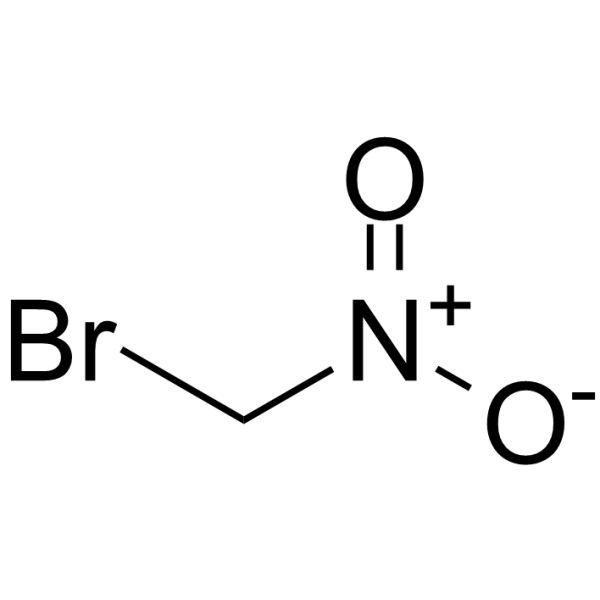
Bromonitromethane

Based on 1 Customer Validation
Bromonitromethane is a halogenated nitromethane disinfection byproduct. Bromonitromethane does not induce morphological changes in lung cells, alter cell growth status, change the secretion levels of matrix metalloproteinases, or enhance the anchorage-independent growth ability of lung cells. Bromonitromethane can act as a bromine donor to participate in the bis (amidine)-catalyzed enantioselective aza-Henry addition reaction of N-(trimethylsilyl) imines, which is used in the synthesis of α-bromonitroalkane donors for umpolung amide synthesis (UmAS). Bromonitromethane can be used in bronchial and cancer research.
Nos produits utilisent uniquement pour la recherche. Nous ne vendons pas aux patients.
- Pureté : 99.38%
- CAS No.: 563-70-2
- Formule: CH2BrNO2
- Masse moléculaire:139.94
-
Stockage:Pure form -20°C, 3 years , 4°C, 2 years ; In solvent -80°C, 6 months , -20°C, 1 month

To place orders, for customer services and technical support, please contact: MedChemExpress USA
Tel: 609-228-6898 E-mail: [email protected] [email protected]


-
 Activité biologique
-
Chemical Information
-
Solvant et solubilité
- Protocole
- Pureté et documentation
- Références
-
 Help & FAQs




Activité biologique
Description
Cellular Effect
|
Cell Line

|
Type | Value | Description | References |
|---|---|---|---|---|
| A-431 | IC50 |
38 μM
Compound: 4
|
Cytotoxicity against human A431 cells after 72 hrs by crystal violet staining method
Cytotoxicity against human A431 cells after 72 hrs by crystal violet staining method
|
[PMID: 23266177] |
| Calu-6 | IC50 |
23 μM
Compound: 4
|
Cytotoxicity against human Calu6 cells after 72 hrs by crystal violet staining method
Cytotoxicity against human Calu6 cells after 72 hrs by crystal violet staining method
|
[PMID: 23266177] |
| CAPAN-1 | IC50 |
69 μM
Compound: 4
|
Cytotoxicity against human Capan1 cells after 72 hrs by crystal violet staining method
Cytotoxicity against human Capan1 cells after 72 hrs by crystal violet staining method
|
[PMID: 23266177] |
| Ca-Ski | IC50 |
99 μM
Compound: 4
|
Cytotoxicity against human CaSki cells after 72 hrs by crystal violet staining method
Cytotoxicity against human CaSki cells after 72 hrs by crystal violet staining method
|
[PMID: 23266177] |
| HaCaT | IC50 |
25 μM
Compound: 4
|
Cytotoxicity against human HaCaT cells after 72 hrs by crystal violet staining method
Cytotoxicity against human HaCaT cells after 72 hrs by crystal violet staining method
|
[PMID: 23266177] |
| MeWo | IC50 |
40 μM
Compound: 4
|
Cytotoxicity against human MeWo cells after 72 hrs by crystal violet staining method
Cytotoxicity against human MeWo cells after 72 hrs by crystal violet staining method
|
[PMID: 23266177] |
In Vitro
Bromonitromethane (1-5 μM; 8 weeks continuous exposure, with medium changes every 48 h) does not induce cancer-like phenotypic changes (morphological alterations, increased proliferation, anchorage-independent growth, altered MMP secretion, or paracrine tumor-promoting effects) in human bronchial epithelial BEAS-2B cells[1].
MedChemExpress (MCE) has not independently confirmed the accuracy of these methods. They are for reference only.
-
Cell Line:human bronchial epithelial BEAS-2B cells
-
Concentration:2-120 μM
-
Incubation Time:24 h
-
Result:Exhibited cytotoxicity to BEAS-2B cells, with an IC50 of 32 μM.
Reduced cell viability to 32.4% relative to untreated control cells at 50 μM.


Chemical Information
-
CAS No. 563-70-2
-
Appearance Liquid (Density: 1.971±0.06 g/cm3)
-
Masse moléculaire 139.94
-
Formule CH2BrNO2
-
Color Colorless to light yellow
-
SMILES
O=[N+](CBr)[O-]
-
Livraison
Room temperature in continental US; may vary elsewhere.
-
Stockage
Pure form -20°C 3 years 4°C 2 years In solvent -80°C 6 months -20°C 1 month


Solvant et solubilité
In Vitro:
DMSO : ≥ 100 mg/mL (714.59 mM; Hygroscopic DMSO has a significant impact on the solubility of product, please use newly opened DMSO)
* "≥" means soluble, but saturation unknown.
Please refer to the solubility information to select the appropriate solvent. Once prepared, please aliquot and store the solution to prevent product inactivation from repeated freeze-thaw cycles.
Storage method and period of stock solution: -80°C, 6 months; -20°C, 1 month. When stored at -80°C, please use it within 6 months. When stored at -20°C, please use it within 1 month.
Please refer to the solubility information to select the appropriate solvent. Once prepared, please aliquot and store the solution to prevent product inactivation from repeated freeze-thaw cycles.
Storage method and period of stock solution: -80°C, 6 months; -20°C, 1 month. When stored at -80°C, please use it within 6 months. When stored at -20°C, please use it within 1 month.
Concentration (start) × Volume (start) = Concentration (final) × Volume (final)


Pureté et documentation
-
Fiche technique (272 KB)
-
SDS (550 KB)
- English - EN (550 KB)
- Français - FR (550 KB)
- Deutsch - DE (550 KB)
- Norwegian - NO (550 KB)
- Español - ES (550 KB)
- Swedish - SV (550 KB)
- Italian - IT (550 KB)
- Korean - KR (550 KB)
- Portuguese - PT (550 KB)
-
Instruction de manipulation (2659 KB)
Références
[1]. Marsà A, et al. In vitro studies on the tumorigenic potential of the halonitromethanes trichloronitromethane and bromonitromethane. Toxicology in vitro : an international journal published in association with BIBRA. 2017 Dec;45(Pt 1):72-80. [Content Brief]
[2]. Makley DM, et al. Silyl imine electrophiles in enantioselective catalysis: a Rosetta Stone for peptide homologation, enabling diverse N-protected aryl glycines from aldehydes in three steps. Organic letters. 2014 Jun 06;16(11):3146-9. [Content Brief]


Complete Stock Solution Preparation Table
Please refer to the solubility information to select the appropriate solvent. Once prepared, please aliquot and store the solution to prevent product inactivation from repeated freeze-thaw cycles.
Storage method and period of stock solution: -80°C, 6 months; -20°C, 1 month. When stored at -80°C, please use it within 6 months. When stored at -20°C, please use it within 1 month.
| Optional Solvent | Concentration Solvent Mass | 1 mg | 5 mg | 10 mg | 25 mg |
|---|---|---|---|---|---|
| DMSO | 1 mM | 7.1459 mL | 35.7296 mL | 71.4592 mL | 178.6480 mL |
| 5 mM | 1.4292 mL | 7.1459 mL | 14.2918 mL | 35.7296 mL | |
| 10 mM | 0.7146 mL | 3.5730 mL | 7.1459 mL | 17.8648 mL | |
| 15 mM | 0.4764 mL | 2.3820 mL | 4.7639 mL | 11.9099 mL | |
| 20 mM | 0.3573 mL | 1.7865 mL | 3.5730 mL | 8.9324 mL | |
| 25 mM | 0.2858 mL | 1.4292 mL | 2.8584 mL | 7.1459 mL | |
| 30 mM | 0.2382 mL | 1.1910 mL | 2.3820 mL | 5.9549 mL | |
| 40 mM | 0.1786 mL | 0.8932 mL | 1.7865 mL | 4.4662 mL | |
| 50 mM | 0.1429 mL | 0.7146 mL | 1.4292 mL | 3.5730 mL | |
| 60 mM | 0.1191 mL | 0.5955 mL | 1.1910 mL | 2.9775 mL | |
| 80 mM | 0.0893 mL | 0.4466 mL | 0.8932 mL | 2.2331 mL | |
| 100 mM | 0.0715 mL | 0.3573 mL | 0.7146 mL | 1.7865 mL |


Bromonitromethane Related Classifications
HY-131120 Related Classifications
 Powered by Bioz
Keywords
- Bromonitromethane
- 563-70-2
- Biochemical Assay Reagents
- human bronchial epithelial BEAS-2B cells
- Umpolung Amide Synthesis
- pronucleophile
- matrix metalloproteinases
- PBAM catalyst
- one-carbon synthon
- enantioselective aza-Henry addition
- human lung cells
- halonitromethane disinfection by-product
- N-(trimethylsilyl)imines
- Inhibitor
- inhibitor
- inhibit