



Hexadecanal (Standard)
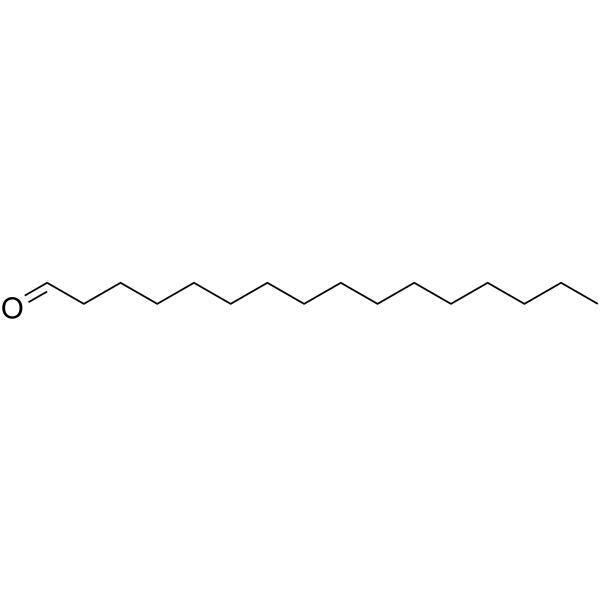
Hexadecanal (Standard) is an analytical standard for Hexadecanal. This product is intended for research and analytical applications. Hexadecanal (Palmitaldehyde), a volatile, long-chain fatty aldehyde, is released from human feces, skin, and breath. The hexadecanal receptor (OR37B) is highly conserved in mammals. Hexadecanal may exert its effects by modulating functional connectivity between social evaluation brain substrates and aggression execution brain substrates. Hexadecanal has also been shown to have a strong deterrent effect on black ants. Hexadecanal has potential for use in startle response and aggression behavior
Nos produits utilisent uniquement pour la recherche. Nous ne vendons pas aux patients.
- Pureté : 95%
- CAS No.: 629-80-1
- Formule: C16H32O
- Masse moléculaire:240.42
-
Stockage:
Please store the product under the recommended conditions in the Certificate of Analysis.


To place orders, for customer services and technical support, please contact: MedChemExpress USA
Tel: 609-228-6898 E-mail: [email protected] [email protected]


-
 Product Information
-
Chemical Information
- Pureté et documentation
-
 Help & FAQs




Product Information
Information
Application
The compound is the grade of analytical standard, which is the reference standard supplied assay. It is commonly used in qualitative, quantitative and methodological research experiments in HPLC, GC and MS.


Chemical Information
-
CAS No. 629-80-1
-
Masse moléculaire 240.42
-
Formule C16H32O
-
SMILES
CCCCCCCCCCCCCCCC=O
-
Synonyms
Palmitaldehyde (Standard)
-
Structure Classification
-
Initial Source
-
Livraison
Room temperature in continental US; may vary elsewhere.
-
Stockage
Please store the product under the recommended conditions in the Certificate of Analysis.


Pureté et documentation
Références
[1]. Mishor E, et al. Sniffing the human body volatile hexadecanal blocks aggression in men but triggers aggression in women[J]. Sci Adv. 2021 Nov 19;7(47):eabg1530. [Content Brief]
[2]. Jaffuel G, et al. Potent Ant Deterrents Emitted from Nematode-Infected Insect Cadavers[J]. J Chem Ecol. 2022 Jan;48(1):71-78. [Content Brief]
[3]. Gilbertson JR, et al. Isolation and analysis of free fatty aldehydes from rat, dog, and bovine heart muscle. J Lipid Res. 1967 Jan;8(1):38-45. [Content Brief]

Calculators
Concentration (start) × Volume (start) = Concentration (final) × Volume (final)


Hexadecanal (Standard) Related Classifications
HY-W004305R Related Classifications
 Powered by Bioz