



ICMT-IN-53
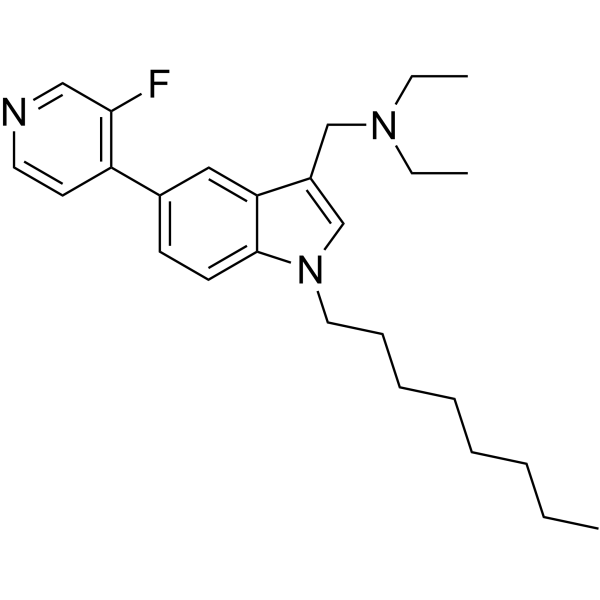
ICMT-IN-53 (compound 12) is an ICMT inhibitor (IC50=0.96 μM) with PAMPA permeability and antiproliferative activity. ICMT-IN-53 inhibits the proliferation of MDA-MB-231 and PC3 with IC50s of 5.14 μM and 5.88 μM, respectively.
Nos produits utilisent uniquement pour la recherche. Nous ne vendons pas aux patients.
- CAS No.: 1443253-17-5
- Formule: C26H36FN3
- Masse moléculaire:409.58
-
Stockage:
Please store the product under the recommended conditions in the Certificate of Analysis.

To place orders, for customer services and technical support, please contact: MedChemExpress USA
Tel: 609-228-6898 E-mail: [email protected] [email protected]


-
 Activité biologique
-
Chemical Information
- Protocole
- Pureté et documentation
- Références
-
 Help & FAQs




Activité biologique
Description
IC50 & Target
IC50: 0.96 μM (ICMT)[1]
Cellular Effect
|
Cell Line

|
Type | Value | Description | References |
|---|---|---|---|---|
| MDA-MB-231 | IC50 |
5.14 μM
Compound: 12
|
Antiproliferative activity against human MDA-MB-231 cells after 72 hrs by MTT assay
Antiproliferative activity against human MDA-MB-231 cells after 72 hrs by MTT assay
|
[PMID: 23514631] |
| PC-3 | IC50 |
5.88 μM
Compound: 12
|
Antiproliferative activity against human PC3 cells after 72 hrs by MTT assay
Antiproliferative activity against human PC3 cells after 72 hrs by MTT assay
|
[PMID: 23514631] |
| Sf9 | IC50 |
0.96 μM
Compound: 12
|
Inhibition of recombinant Icmt (unknown origin) expressed in Sf9 cells assessed as transfer of methyl group from [3H]-S-adenosylmethionine to [3H]-biotin-S-farnesyl-L-cysteine after 30 mins
Inhibition of recombinant Icmt (unknown origin) expressed in Sf9 cells assessed as transfer of methyl group from [3H]-S-adenosylmethionine to [3H]-biotin-S-farnesyl-L-cysteine after 30 mins
|
[PMID: 23514631] |


Chemical Information
-
CAS No. 1443253-17-5
-
Masse moléculaire 409.58
-
Formule C26H36FN3
-
SMILES
FC1=C(C=CN=C1)C2=CC=C(N(CCCCCCCC)C=C3CN(CC)CC)C3=C2
-
Livraison
Room temperature in continental US; may vary elsewhere.
-
Stockage
Please store the product under the recommended conditions in the Certificate of Analysis.


Pureté et documentation
Références

Calculators
Concentration (start) × Volume (start) = Concentration (final) × Volume (final)


ICMT-IN-53 Related Classifications
HY-149729 Related Classifications
 Powered by Bioz