



Mitoquinol
Based on 3 publication(s) in Google Scholar
Mitoquinol is an orally active mitochondria-targeted antioxidant. Mitoquinol can regulate mitochondrial respiration and oxidation. Mitoquinol inhibits ROS production, and improves phagocytosis and glycolysis in ethanol-exposed macrophages via the HIF-1α-PFKP axis. Additionally, Mitoquinol can partially alleviate heat stress-induced decreases in growth performance, inflammatory responses, and metabolic disorders in pigs.
Nos produits utilisent uniquement pour la recherche. Nous ne vendons pas aux patients.
- Pureté : 98.00%
- CAS No.: 845959-55-9
- Formule: C38H49O7PS
- Masse moléculaire:680.83
-
Stockage:
-20°C, sealed storage, away from moisture
* In solvent : -80°C, 6 months; -20°C, 1 month (sealed storage, away from moisture)


To place orders, for customer services and technical support, please contact: MedChemExpress USA
Tel: 609-228-6898 E-mail: [email protected] [email protected]


-
 Activité biologique
-
Chemical Information
-
Solvant et solubilité
- Protocole
- Pureté et documentation
- Références
-
 Help & FAQs


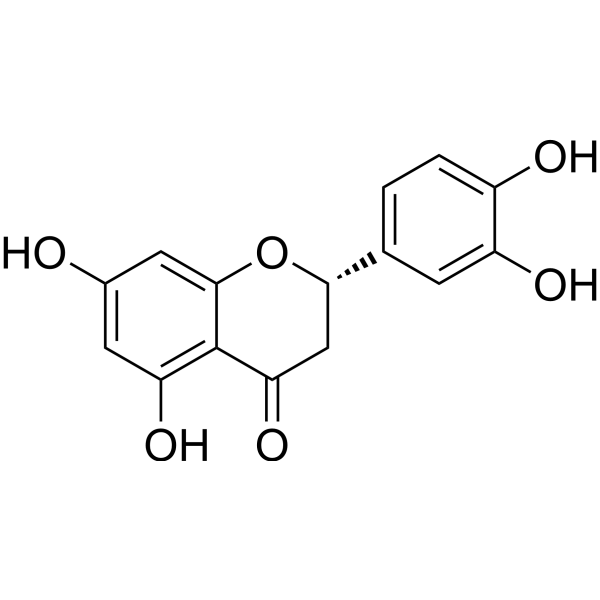
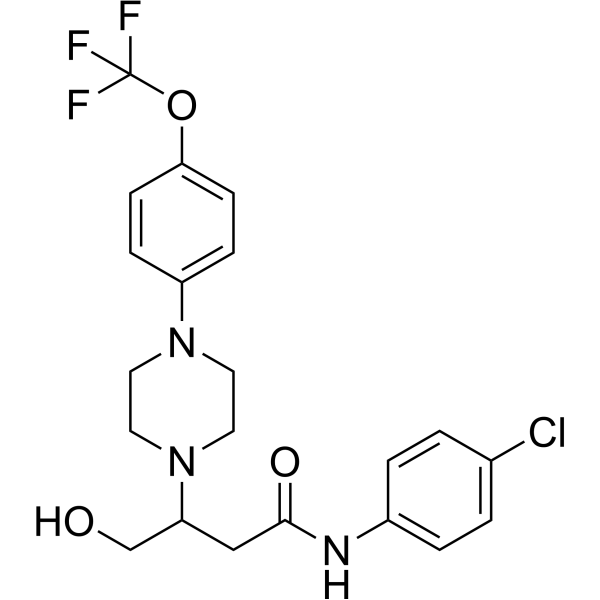
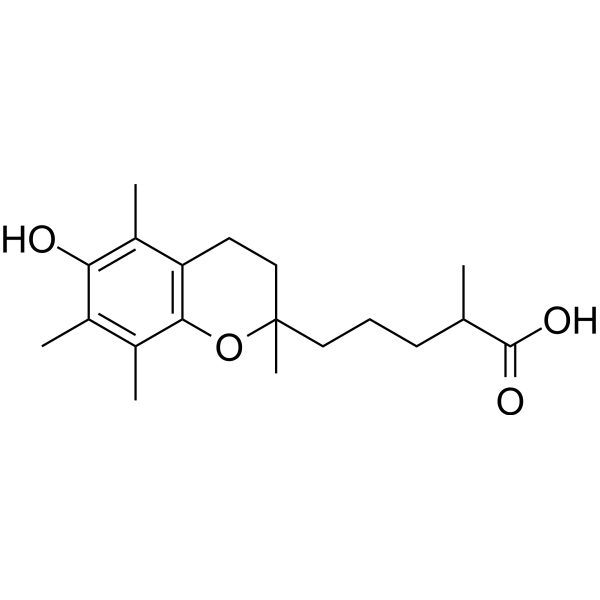
Publications Citing Use of MedChemExpress (MCE) Mitoquinol
More

Activité biologique
Description
In Vitro
Mitoquinol (150-500 nM; 30 min-18 h) reduces the oxygen consumption rate associated with ATP production (IC50: 189 nM), increases mitochondrial proton leak, basal oxygen consumption rate, superoxide anion and H2O2 production, and enhances glycolysis in bovine aortic endothelial cells[1].
MedChemExpress (MCE) has not independently confirmed the accuracy of these methods. They are for reference only.
-
Cell Line:Bovine aortic endothelial cells
-
Concentration:200 and 300 nM
-
Incubation Time:Overnight exposure
-
Result:Enhanced superoxide production as demonstrated by fluorescence of the mitochondrial-targeted dihydroethidium probe MitoSOX.
In Vivo
MedChemExpress (MCE) has not independently confirmed the accuracy of these methods. They are for reference only.
-
Animal Model:Crossbred barrows (59.0±5.6 kg) treated acute heat stress[2]
-
Dosage:40 mg/d
-
Administration:Oral administration; twice daily; 3 days
-
Result:Partially ameliorated the negative effects of acute heat stress on animal performance, inflammation, and metabolism, as evidenced by increased feed intake, attenuated body weight loss, increased blood glucose, and decreased circulating non-esterified fatty acids in heat-stressed pigs compared to heat-stressed controls.
Essai clinique
| NCT Number | Sponsor | Condition | Start Date |
Phase

|
|---|---|---|---|---|
| NCT01329991 | 2011-05 | PHASE1 |


Chemical Information
-
CAS No. 845959-55-9
-
Appearance Solid
-
Masse moléculaire 680.83
-
Formule C38H49O7PS
-
Color White to light yellow
-
SMILES
CC1=C(CCCCCCCCCC[P+](C2=CC=CC=C2)(C3=CC=CC=C3)C4=CC=CC=C4)C(O)=C(OC)C(OC)=C1O.CS(=O)([O-])=O
-
Livraison
Room temperature in continental US; may vary elsewhere.
-
Stockage
-20°C, sealed storage, away from moisture
* In solvent : -80°C, 6 months; -20°C, 1 month (sealed storage, away from moisture)


Publications (3)
-
Journal Impact Factor
-
Most Recent
-
Nat Commun
The long non-coding RNA RSDR protects against acute kidney injury in mice by interacting with hnRNPK to regulate DHODH-mediated ferroptosis. [Abstract]2025 Aug 12;16(1):7483. PMID: 40796740 -
Pharmacol Res
ER stress sensor PERK drives ferroptosis by disrupting MAMs-mediated mitochondrial homeostasis and promoting mtROS accumulation in acute myocardial infarction. [Abstract]2025 Dec:222:108029. PMID: 41205728 -
bioRxiv
Chronic sensing of host-derived lipids is an all-in-one signal that primes and activates NLRP3. [Abstract]2025 Oct 30:2025.10.29.685328. PMID: 41279623


Solvant et solubilité
In Vitro:
DMSO : 30 mg/mL (44.06 mM; Need ultrasonic and warming; Hygroscopic DMSO has a significant impact on the solubility of product, please use newly opened DMSO)
Please refer to the solubility information to select the appropriate solvent. Once prepared, please aliquot and store the solution to prevent product inactivation from repeated freeze-thaw cycles.
Storage method and period of stock solution: -80°C, 6 months; -20°C, 1 month (sealed storage, away from moisture). When stored at -80°C, please use it within 6 months. When stored at -20°C, please use it within 1 month.
Please refer to the solubility information to select the appropriate solvent. Once prepared, please aliquot and store the solution to prevent product inactivation from repeated freeze-thaw cycles.
Storage method and period of stock solution: -80°C, 6 months; -20°C, 1 month (sealed storage, away from moisture). When stored at -80°C, please use it within 6 months. When stored at -20°C, please use it within 1 month.
Concentration (start) × Volume (start) = Concentration (final) × Volume (final)


Pureté et documentation
-
Fiche technique (273 KB)
-
SDS (251 KB)
- English - EN (251 KB)
- Français - FR (251 KB)
- Deutsch - DE (251 KB)
- Norwegian - NO (251 KB)
- Español - ES (251 KB)
- Swedish - SV (251 KB)
- Italian - IT (251 KB)
- Korean - KR (251 KB)
- Portuguese - PT (251 KB)
-
Instruction de manipulation (2659 KB)
Références
[1]. Fink BD,et al. Bioenergetic effects of mitochondrial-targeted coenzyme Q analogs in endothelial cells. J Pharmacol Exp Ther. 2012 Sep;342(3):709-19. [Content Brief]
[2]. Mayorga EJ, et al. Therapeutic effects of mitoquinol during an acute heat stress challenge in growing barrows. J Anim Sci. 2024 Jan 3;102:skae161. [Content Brief]
[3]. Pant BD, et al. Mitoquinol improves phagocytosis and glycolysis in ethanol-exposed macrophages via HIF-1α-PFKP axis. J Immunol. 2025 May 12:vkaf078. [Content Brief]


Complete Stock Solution Preparation Table
Please refer to the solubility information to select the appropriate solvent. Once prepared, please aliquot and store the solution to prevent product inactivation from repeated freeze-thaw cycles.
Storage method and period of stock solution: -80°C, 6 months; -20°C, 1 month (sealed storage, away from moisture). When stored at -80°C, please use it within 6 months. When stored at -20°C, please use it within 1 month.
| Optional Solvent | Concentration Solvent Mass | 1 mg | 5 mg | 10 mg | 25 mg |
|---|---|---|---|---|---|
| DMSO | 1 mM | 1.4688 mL | 7.3440 mL | 14.6880 mL | 36.7199 mL |
| 5 mM | 0.2938 mL | 1.4688 mL | 2.9376 mL | 7.3440 mL | |
| 10 mM | 0.1469 mL | 0.7344 mL | 1.4688 mL | 3.6720 mL | |
| 15 mM | 0.0979 mL | 0.4896 mL | 0.9792 mL | 2.4480 mL | |
| 20 mM | 0.0734 mL | 0.3672 mL | 0.7344 mL | 1.8360 mL | |
| 25 mM | 0.0588 mL | 0.2938 mL | 0.5875 mL | 1.4688 mL | |
| 30 mM | 0.0490 mL | 0.2448 mL | 0.4896 mL | 1.2240 mL | |
| 40 mM | 0.0367 mL | 0.1836 mL | 0.3672 mL | 0.9180 mL |


Mitoquinol Related Classifications
HY-124410 Related Classifications
 Powered by Bioz