



Trihydroxycholestanoic acid

Based on 1 Customer Validation
Trihydroxycholestanoic acid is an endogenous metabolite present in Blood that can be used for the research of Zellweger Syndrome, Refsum Disease, D Bifunctional Protein Deficiency and Infantile Refsum Disease.
Nos produits utilisent uniquement pour la recherche. Nous ne vendons pas aux patients.
- Pureté : 99.48%
- CAS No.: 547-98-8
- Formule: C27H46O5
- Masse moléculaire:450.65
-
Stockage:Powder -20°C, 3 years ; In solvent -80°C, 6 months , -20°C, 1 month

To place orders, for customer services and technical support, please contact: MedChemExpress USA
Tel: 609-228-6898 E-mail: [email protected] [email protected]


-
 Activité biologique
-
Chemical Information
- Pureté et documentation
- Références
-
 Help & FAQs


-
HY-125731
Glycodeoxycholic acidEndogenous Metabolite -
HY-122141
Glycohyocholic acidConjugated Bile Acid -
HY-116374
Glycolithocholic acidSecondary Bile Acid -
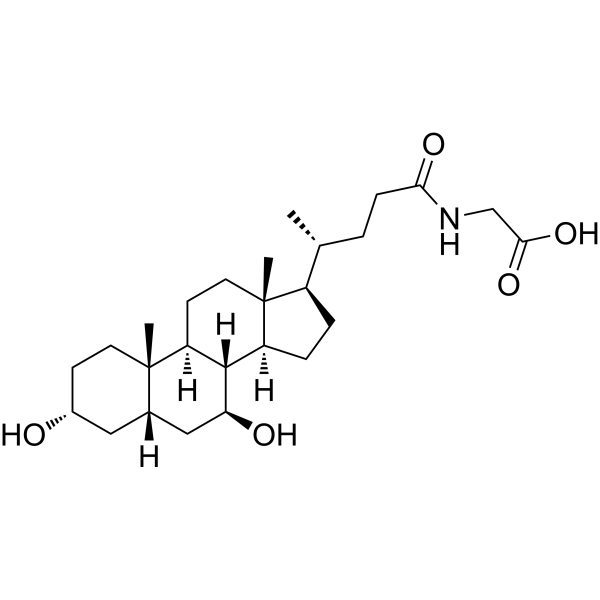
HY-N1424
Glycoursodeoxycholic acidEndogenous Metabolite -

HY-113308
Taurolithocholic acidFerroptosis Suppressor -
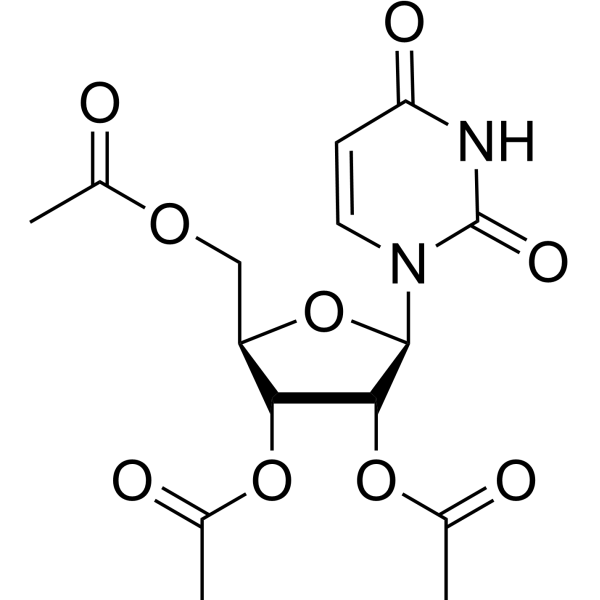
HY-14905
Uridine triacetateUridine Prodrug -
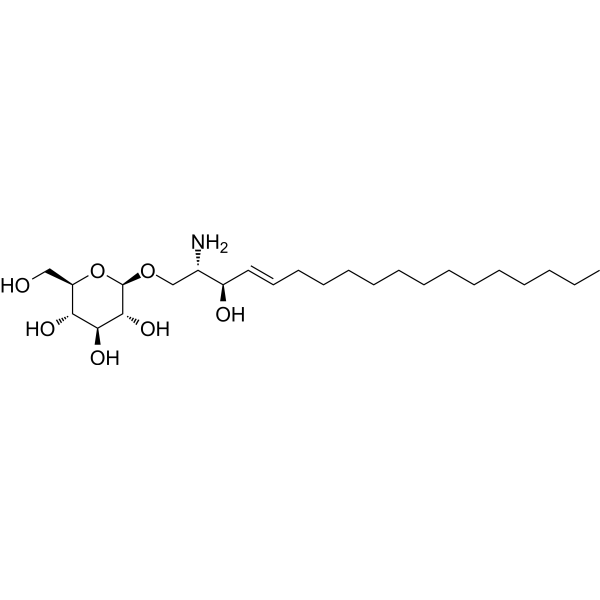
HY-N7745
GlucosylsphingosineGlucocerebrosidase Inhibitor -
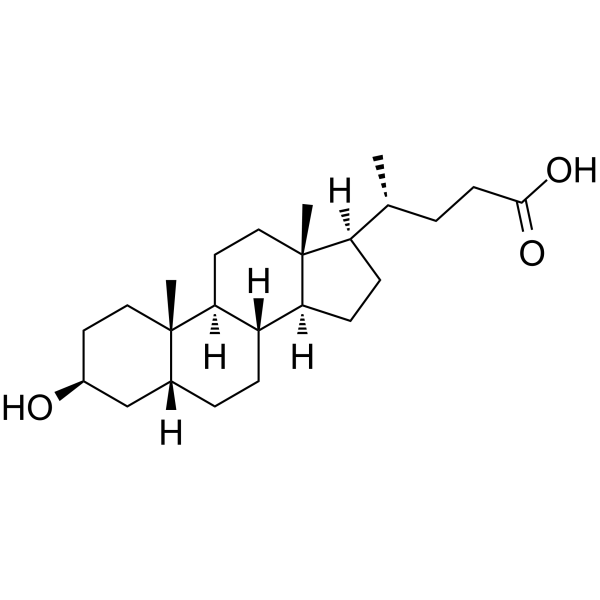
HY-B0172B
Isolithocholic acidBile Acid -
HY-41324
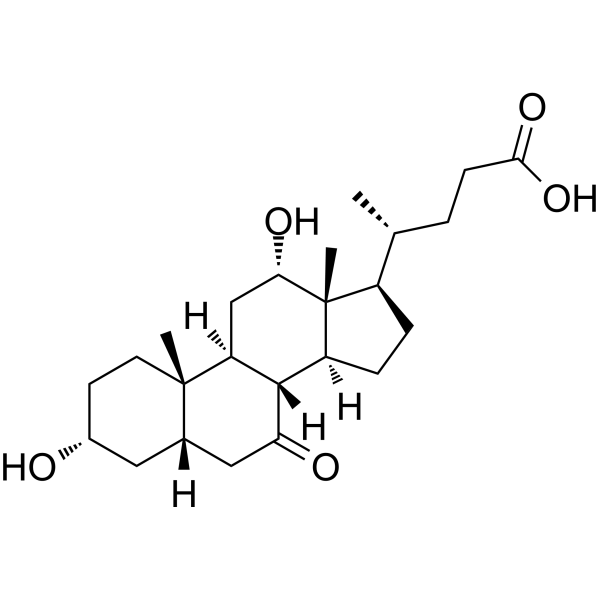
7-keto-Deoxycholic acidBile Acid -

HY-41324R
7-keto-Deoxycholic acid (Standard)Bile Acid -

HY-B0172BR
Isolithocholic acid (Standard)Bile Acid -

HY-156208
C2 Adamantanyl galactosylceramide (d18:1/2:0)GlcCer Inhibitor
Voir tous les produits spécifiques à Isoform Endogenous Metabolite
More

Activité biologique
Description
In Vitro
Endogenous metabolites is defined as those that are annotated by Kyoto Encyclopedia of Genes and Genomes as substrates or products of the ~1900 metabolic enzymes encoded in our genome. It is clear in the body of literature that there are documented toxic properties for many of these metabolites[1].
MedChemExpress (MCE) has not independently confirmed the accuracy of these methods. They are for reference only. .


Chemical Information
-
CAS No. 547-98-8
-
Appearance Solid
-
Masse moléculaire 450.65
-
Formule C27H46O5
-
Color White to off-white
-
SMILES
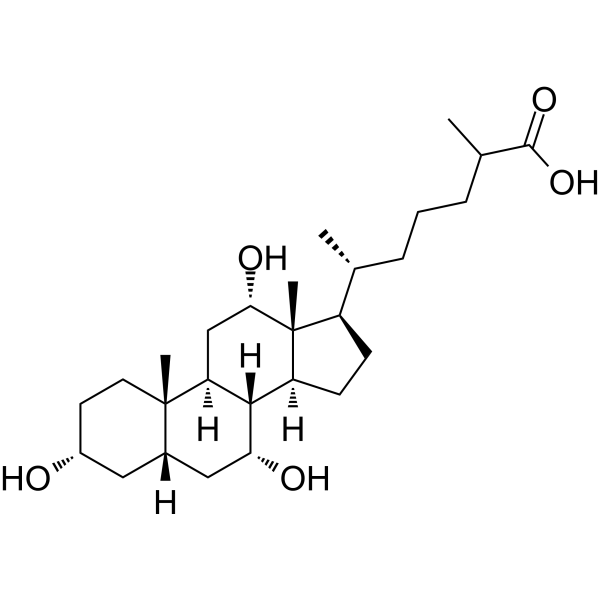
CC(C(O)=O)CCC[C@@H](C)[C@H]1CC[C@@]2([H])[C@]3([H])[C@H](O)C[C@]4([H])C[C@H](O)CC[C@]4(C)[C@@]3([H])C[C@H](O)[C@]12C
-
Synonyms
Coprocholic acid
-
Structure Classification
-
Initial Source
-
Livraison
Room temperature in continental US; may vary elsewhere.
-
Stockage
Powder -20°C 3 years In solvent -80°C 6 months -20°C 1 month


Pureté et documentation
-
Fiche technique (269 KB)
-
SDS (392 KB)
- English - EN (392 KB)
- Français - FR (392 KB)
- Deutsch - DE (392 KB)
- Norwegian - NO (392 KB)
- Español - ES (392 KB)
- Swedish - SV (392 KB)
- Italian - IT (392 KB)
- Korean - KR (392 KB)
- Portuguese - PT (392 KB)
-
Instruction de manipulation (2659 KB)
Références
[1]. Lee N, et al. Endogenous toxic metabolites and implications in cancer therapy. Oncogene. 2020 Aug;39(35):5709-5720. [Content Brief]
[2]. Baumgartner MR, et al. Clinical approach to inherited peroxisomal disorders: a series of 27 patients. Ann Neurol. 1998 Nov;44(5):720-30. [Content Brief]
[3]. Poll-The BT, et al. Infantile Refsum's disease: biochemical findings suggesting multiple peroxisomal dysfunction. J Inherit Metab Dis. 1986;9(2):169-74. [Content Brief]
[4]. Rizzo C, et al. Characteristic acylcarnitine profiles in inherited defects of peroxisome biogenesis: a novel tool for screening diagnosis using tandem mass spectrometry. Pediatr Res. 2003 Jun;53(6):1013-8. [Content Brief]

Calculators
Concentration (start) × Volume (start) = Concentration (final) × Volume (final)


Trihydroxycholestanoic acid Related Classifications
HY-113335 Related Classifications
 Powered by Bioz