



Crocin-4
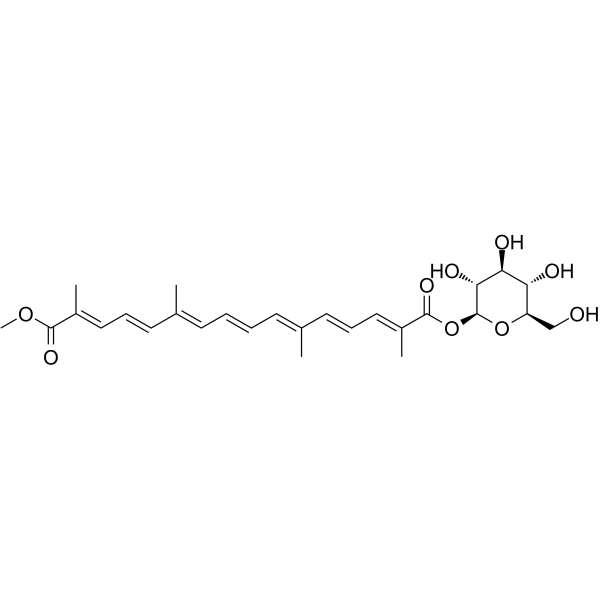
Crocin-4, a carotenoid constituent of saffron, is a potent and brain-penetrant antioxidant agent. Crocin-4 can inhibit the aggregation and the concomitant deposition of Aβ fibrils in the brain. Crocin-4 can be used for the research of Alzheimer's Disease. Crocin-4 also exhibits antitumor and anti-inflammatory activities.
商品は「研究用試薬」です。人や動物の医療用・臨床診断用・食品用の製品ではありません。
研究用途以外に使用した場合、当社は一切の責任を負いかねます。
- CAS 番号: 55750-86-2
- 分子式: C27H36O9
- 分子量:504.57
-
保管条件:
Please store the product under the recommended conditions in the Certificate of Analysis.

To place orders, for customer services and technical support, please contact: MedChemExpress USA
Tel: 609-228-6898 E-mail: [email protected] [email protected]


-
 生物活性
生物活性
-
化学情報
- プロトコル
- 純度とドキュメンテーション
- 参考文献
-
 Help & FAQs




生物活性
製品説明
体外実験
Crocin-4 (0.1-1000 μM; 24-72 h) do not compromise cell viability of neuron-like cells[1].
Crocin-4 (1 mM; 72 h) reduces total PSEN1, PSEN1 and PSEN2 complexes, BACE1, APP-C99 and sAPPα, while it increases PSEN1-CTF and PSEN2 in SH-SY5Y-APP cells[1].
Crocin-4 (1 mM; 72 h) suppresses GSK3β and ERK1/2 kinases in PC12-htau cells, and significantly reduces the levels and phosphorylation of tau on the pThr231 and pSer199/Ser202 epitopes[1].
MedChemExpress (MCE) has not independently confirmed the accuracy of these methods. They are for reference only.
-
Cell Line:Differentiated SH-SY5Y-APP cells
-
Concentration:1 mM
-
Incubation Time:72 hours
-
Result:Significantly reduced total PSEN1 by 19%, and the PSEN1 and PSEN2 complexes by 81 and 65%, while it increased PSEN1-CTF (26%) and PSEN2 (43%).
The key molecules of the amyloidogenic pathway, BACE1 and APP-C99 were significantly reduced by 20 and 28%, respectively.
The non-amyloidogenic pathway product sAPPα was also reduced, by 44%, while APP-C83 remained unaltered.
-
Cell Line:Differentiated PC12-htau cells
-
Concentration:1 mM
-
Incubation Time:72 hours
-
Result:Significantly reduced total tau levels (by 32%) and tau phosphorylation (pThr231 and pSer199/Ser202-tau by 22 and 75%, respectively).
Downregulates the active and inactive forms of GSK3β (total GSK3β by 34%, pSer9-GSK3β by 30%) and ERK1/2 (total ERK2 by 37%, pERK1 by 40%, pERK2 by 50%).
体内実験
MedChemExpress (MCE) has not independently confirmed the accuracy of these methods. They are for reference only.


化学情報
-
CAS 番号 55750-86-2
-
分子量 504.57
-
分子式 C27H36O9
-
SMILES
COC(/C(C)=C/C=C/C(C)=C/C=C/C=C(C)/C=C/C=C(C)/C(O[C@@H]1O[C@@H]([C@H]([C@@H]([C@H]1O)O)O)CO)=O)=O
-
Structure Classification
-
Initial Source
-
輸送条件
Room temperature in continental US; may vary elsewhere.
-
保管条件
Please store the product under the recommended conditions in the Certificate of Analysis.


純度とドキュメンテーション
参考文献
[1]. Chalatsa I, et, al. The Crocus sativus Compounds trans-Crocin 4 and trans-Crocetin Modulate the Amyloidogenic Pathway and Tau Misprocessing in Alzheimer Disease Neuronal Cell Culture Models. Front Neurosci. 2019 Mar 26;13:249. [Content Brief]
[2]. Koulakiotis NS, et, al. Crocus-derived compounds alter the aggregation pathway of Alzheimer's Disease: associated beta amyloid protein. Sci Rep. 2020 Oct 23;10(1):18150. [Content Brief]
[3]. Karkoula E, et, al. Trans-crocin 4 is not hydrolyzed to crocetin following i.p. administration in mice, while it shows penetration through the blood brain barrier. Fitoterapia. 2018 Sep;129:62-72. [Content Brief]

Calculators
濃度 (開始) × 体積 (開始) = 濃度 (終了) × 体積 (終了)


Crocin-4 関連分類
HY-N10183 関連分類
 Powered by Bioz