



Cyanine 5 DBCO
Based on 3 publication(s) in Google Scholar
Cyanine5 DBCO (DBCO-Cy5) is a low-toxicity azide reactive probe (NIR fluorescent dye), for imaging azide-labeled biomolecules via a copper-free "click-through" reaction. Cyanine5 DBCO has no apparent cytotoxicity or animal toxicity and shows no damage to the physiological functions of cells other than the target cells (azide-labeled cells). Cyanine5 DBCO can be used to label and track cells in vitro and in vivo (Ex=635 nm, Em=650-700 nm)
For research use only. We do not sell to patients.
- CAS No.: 3091879-39-6
- Formula: C53H59ClN4O2
- Molecular Weight:819.51
-
Storage:
Please store the product under the recommended conditions in the Certificate of Analysis.


To place orders, for customer services and technical support, please contact: MedChemExpress USA
Tel: 609-228-6898 E-mail: [email protected] [email protected]


-
 Biological Activity
-
Chemical Information
- Protocols
- Purity & Documentation
- References
-
 Help & FAQs


Publications Citing Use of MedChemExpress (MCE) Cyanine 5 DBCO
More Customer Validation & Images

-
Cell Imaging/Staining
-
Flow Cytometry


Biological Activity
Description
In Vitro
Guide (Following is our recommended protocol. This protocol only provides a guideline, and should be modified according to your specific needs).
1. Solution preparation[1][2]
1.1 Preparation of storage solution
Solvent: DMSO.
Concentration: 20 mM is recommended.
Storage: After aliquoting, store at -20°C or -80°C in the dark and avoid repeated freezing and thawing.
1.2 Preparation of working solution
Dilute to 20 μM with PBS or serum-free medium (optimized according to the experiment).
Note: The working solution should be prepared and used immediately, and should be protected from light.
2. Cell labeling
2.1 Seed cells.
2.2 Add Ac4ManNAz (50 μM, final concentration), incubate for 3 days (generate azide groups on the surface of cells).
2.3 Wash cells twice with DPBS (pH 7.4).
2.4 Incubate cells with Cyanine5 DBCO (20 μM, final concentration) for 1 h at 37°C.
2.5 Rinse cells with DPBS (pH 7.4) and fix with formaldehyde-glutaraldehyde combined fixative for 15 min at 25°C.
2.6 Wash cells twice with DPBS (pH 7.4) and stain cells with DAPI to label nuclei.
2.7 Measure Cyanine5 DBCO fluorescence (Ex=635 nm, Em=650-700 nm) using a confocal laser scanning microscope.
Note:
Artificially introduced azide groups on the cell surface can be targeted by Cyanine5 DBCO for more than 3 days after treatment with Ac4ManNAz.
MedChemExpress (MCE) has not independently confirmed the accuracy of these methods. They are for reference only.


Chemical Information
-
CAS No. 3091879-39-6
-
Molecular Weight 819.51
-
Formula C53H59ClN4O2
-
SMILES
O=C(CCCCC[N+]1=C(/C=C/C=C/C=C2N(C)C3=C(C\2(C)C)C=CC=C3)C(C)(C)C4=C1C=CC=C4)NCCCCCC(N5C6=C(C#CC7=C(C5)C=CC=C7)C=CC=C6)=O.[Cl-]
-
Synonyms
DBCO-Cy5; Cyanine5 dibenzocyclooctyne
-
Shipping
Room temperature in continental US; may vary elsewhere.
-
Storage
Please store the product under the recommended conditions in the Certificate of Analysis.


Publications (3)
-
Journal Impact Factor
-
Most Recent
-
Nat Commun
Bioengineered hybrid dual-targeting nanoparticles reprogram the tumour microenvironment for deep glioblastoma photodynamic therapy. [Abstract]2025 Aug 18;16(1):7672. PMID: 40826003 -
Adv Sci (Weinh)
A Spatially Distributed Microneedle System for Bioorthogonal T Cell-Guided Cancer Therapy. [Abstract]2025 Apr;12(13):e2416841. PMID: 39921874
Cyanine 5 DBCO purchased from MedChemExpress. Usage Cited in: Adv Sci (Weinh). 2025 Apr;12(13):e2416841. [Abstract]
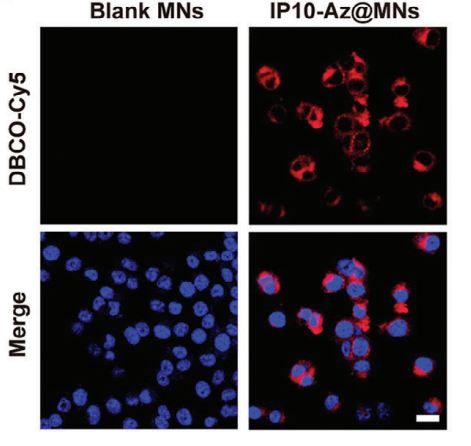
Representative CLSM images of 4T1 cells stained with Cyanine5 DBCO hexafluorophosphate (DBCO‐Cy5) for 30 min after incubation with IP10‐Az@MNs. Scale bar = 20 µm.
Cyanine 5 DBCO purchased from MedChemExpress. Usage Cited in: Adv Sci (Weinh). 2025 Apr;12(13):e2416841. [Abstract]
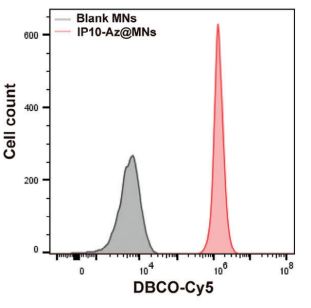
FSC analysis of 4T1 cells stained with Cyanine5 DBCO hexafluorophosphate (DBCO‐Cy5) for 30 min after incubation with Ip10‐Az@MNs.
-


Purity & Documentation
References
[1]. Kang SW, et al. Cell labeling and tracking method without distorted signals by phagocytosis of macrophages. Theranostics. 2014 Feb 12;4(4):420-31. [Content Brief]
[2]. Zhu L, et al. Coupling Aptamer-based Protein Tagging with Metabolic Glycan Labeling for In Situ Visualization and Biological Function Study of Exosomal Protein-Specific Glycosylation. Angew Chem Int Ed Engl. 2021 Aug 9;60(33):18111-18115. [Content Brief]
[3]. Song S, et al. In Situ One-Step Fluorescence Labeling Strategy of Exosomes via Bioorthogonal Click Chemistry for Real-Time Exosome Tracking In Vitro and In Vivo. Bioconjug Chem. 2020 May 20;31(5):1562-1574. [Content Brief]

Calculators
Concentration (start) × Volume (start) = Concentration (final) × Volume (final)


Cyanine 5 DBCO Related Classifications
HY-D2907 Related Classifications
 Powered by Bioz