



MEC/CCL28 Protein, Rat

Based on 1 Customer Validation
MEC/CCL28 Protein, Rat is a CC chemokine that is present in almost all mucosal tissues and acts as a unifying immunostimulant on mucosal surfaces. CCL28 can bind to CCR3 and CCR10 to mediate immune responses, viral infections, cancer, and antimicrobial effects. MEC/CCL28 Protein, Rat is a recombinant rat MEC/CCL28 (S20-R135) protein expressed by E. coli.
- Species: Rat
- Source: E. coli
-
Storage:Stored at -20°C for 2 years from date of receipt. After reconstitution, it is stable at 4°C for 1 week or -20°C for longer (with carrier protein). It is recommended to freeze aliquots at -20°C or -80°C for extended storage.


To place orders, for customer services and technical support, please contact: MedChemExpress USA
Tel: 609-228-6898 E-mail: [email protected] [email protected]


-
 Biological Activity
-
Technical Parameters
-
Product Properties
- Documentation
- References
- Help & FAQs




Biological Activity
Description
MEC/CCL28 Protein, Rat is a CC chemokine that is present in almost all mucosal tissues and acts as a unifying immunostimulant on mucosal surfaces. CCL28 can bind to CCR3 and CCR10 to mediate immune responses, viral infections, cancer, and antimicrobial effects. MEC/CCL28 Protein, Rat is a recombinant rat MEC/CCL28 (S20-R135) protein expressed by E. coli[1][2].
Background
CCL28, also known as mucosal associated epithelial chemokine (MEC), CCK1, and SCYA28, is a chemokine. It is expressed in various mucosal sites, including salivary glands and mammary glands, trachea and colon, and small intestine. CCL28 has been classified as an important component chemokine in homeostasis lymphocyte transport and can bind to CCR3 and CCR10. Among them, CCL28 can chemotactic CCR10 expression of CD4 and CD8 T cell populations, as well as CCR3 expression of eosinophils migration. However, in the intestinal mucosa, few T cells express CCR10. In contrast, in the B-cell population, CCR10 can be selectively expressed by IgA plasma mother cells and IgA-secreting cells (i.e. plasma cells), which play a key role in homing plasma mother cells to extraintestinal effector sites[1]. CCL28 is constitutively expressed in the colon, but its levels can be increased by pro-inflammatory cytokines and certain bacterial products that play a role in effector cell recruitment to sites of epithelial injury.CCL28 can act as a unifying immunostimulant on the mucosal surface and is involved in the migration of IgA-expressing cells to the breast, salivary glands, intestine, and other mucosal tissues. In addition, CCL28 exhibits broad-spectrum antimicrobial activity against Gram-negative and Gram-positive bacteria as well as fungi, such as Pseudomonas aeruginosa and Klebsiella pneumoniae. Further studies also showed that the positively charged amino acids at the C-terminal end of CCL28 significantly contributed to the antibacterial activity of the protein, and its characteristic hydrophobicity and amphiphilicity also contributed to its killing activity[2].
Verified Bioactivity
Determined by its ability to chemoattract murine lymphocytes. The ED50 for this effect is 4.031 ng/mL, corresponding to a specific activity is 2.48×10⁵ U/mg.
MCE Validation Data
-
Purity - SDS-PAGE
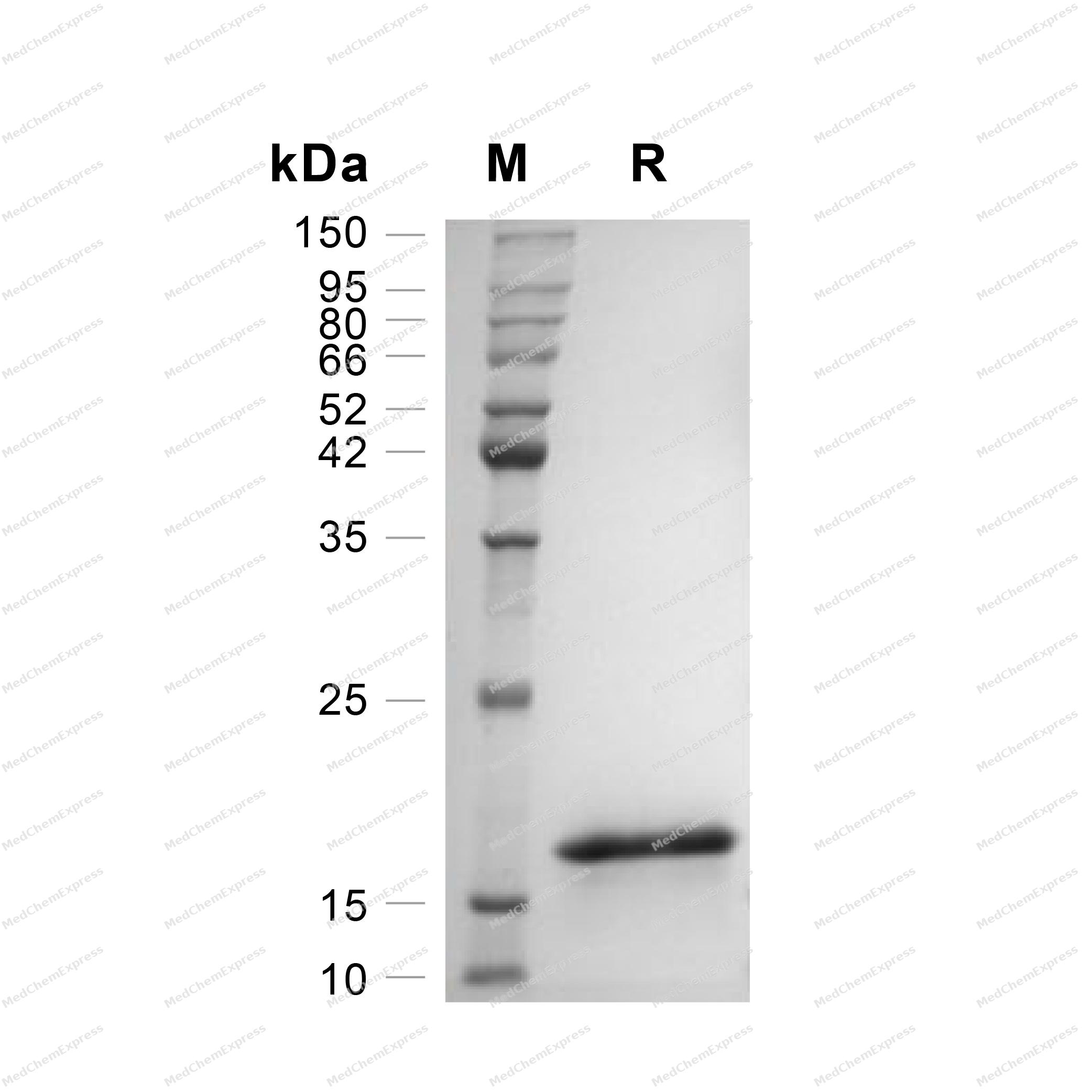
Purity - SDS-PAGE
-
Bioactivity - Cell-Based Assay
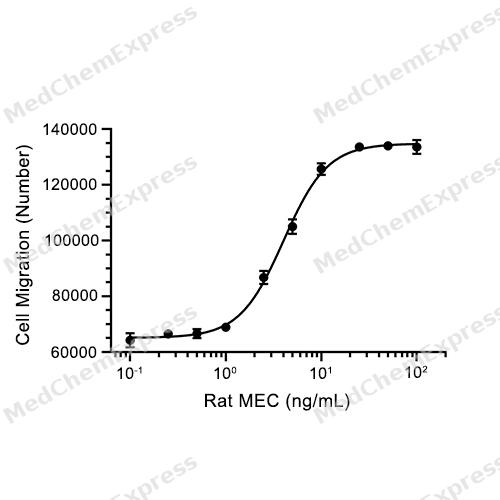
Bioactivity - Cell-Based Assay


Technical Parameters
-
Species Rat
-
Source E. coli
-
Tag Tag Free
-
Accession
Q91Y39 (S20-R135)
-
Molecular Construction
-
N-term
-
CCL28 (S20-R135)
Accession # Q91Y39 -
C-term
-
-
Protein Length
Full Length of C-C motif chemokine Chain
-
Synonyms
CCL28; Small Inducible Cytokine A28; C-C Motif Chemokine Ligand 28; C-C Motif Chemokine 28; SCYA28; CC Chemokine CCL28; MEC; Chemokine (C-C Motif) Ligand 28, Isoform CRA_b; Mucosae-Associated Epithelial Chemokine; Small-Inducible Cytokine A28; CCK1; C-C M
-
AA Sequence
SEAILPIASSCCTEVSHHIPRRLLERVNSCSIQRADGDCDLAAVILHVKRRRICVSPHNPTLKRWMSASEMKNGKENLCPRKKQDSGKDRKGHTPRKHGKHGTRRIHGTHDHEAPR
-
Predicted Molecular Mass
13.1 kDa
-
Molecular Weight
Approximately 18 kDa, based on SDS-PAGE under reducing conditions.
-
Purity
≥ 95%, as determined by reducing SDS-PAGE.


Product Properties
Lyophilized powder
Lyophilized from a 0.2 μm filtered solution of 20 mM PB, 150 mM NaCl, pH 7.4.
<1 EU/μg, determined by LAL method.
It is not recommended to reconstitute to a concentration less than 100 μg/mL in ddH2O. For long term storage it is recommended to add a carrier protein (0.1% BSA, 5% HSA, 10% FBS or 5% Trehalose).
Stored at -20°C for 2 years from date of receipt. After reconstitution, it is stable at 4°C for 1 week or -20°C for longer (with carrier protein). It is recommended to freeze aliquots at -20°C or -80°C for extended storage.
Room temperature in continental US; may vary elsewhere.


Documentation
-
Data Sheet (263 KB)
-
SDS (254 KB)
- English - EN (254 KB)
- Français - FR (254 KB)
- Deutsch - DE (254 KB)
- Norwegian - NO (254 KB)
- Español - ES (254 KB)
- Swedish - SV (254 KB)
- Italian - IT (254 KB)
- Korean - KR (254 KB)
- Portuguese - PT (254 KB)
-
Handling Instructions (2659 KB)


References
[1]. Hiroyuki Ogawa, et al. Regulated production of the chemokine CCL28 in human colon epithelium. Am J Physiol Gastrointest Liver Physiol. 2004 Nov;287(5):G1062-9. [Content Brief]
[2]. Meurens F, et al. Expression of mucosal chemokines TECK/CCL25 and MEC/CCL28 during fetal development of the ovine mucosal immune system. Immunology. 2007 Apr;120(4):544-55. [Content Brief]
[3]. Teena Mohan, et al. CCL28 chemokine: An anchoring point bridging innate and adaptive immunity. Int Immunopharmacol. 2017 Oct;51:165-170. [Content Brief]

Calculators
Concentration (start) × Volume (start) = Concentration (final) × Volume (final)


 Powered by Bioz

