



ADHP
Based on 3 publication(s) in Google Scholar
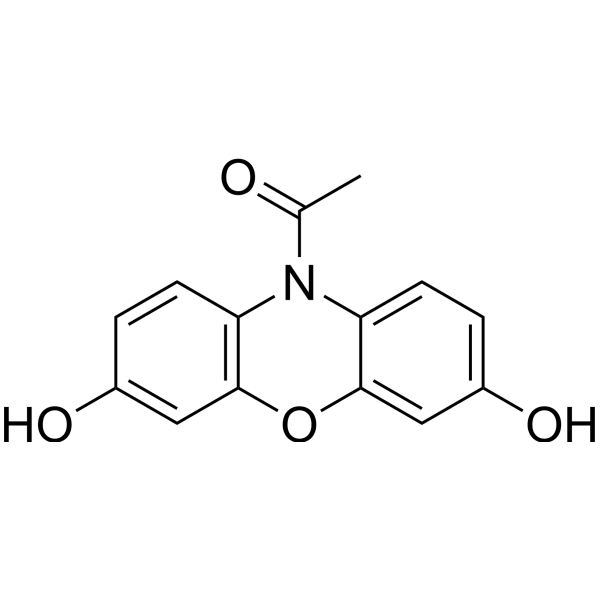
ADHP is a fluorogenic peroxidase substrate (λex=530 nm, λem=590 nm).
For research use only. We do not sell to patients.
- Purity : 99.90%
- CAS No.: 119171-73-2
- Formula: C14H11NO4
- Molecular Weight:257.24
-
Storage:
4°C, protect from light
* In solvent : -80°C, 6 months; -20°C, 1 month (protect from light)

To place orders, for customer services and technical support, please contact: MedChemExpress USA
Tel: 609-228-6898 E-mail: [email protected] [email protected]


-
 Biological Activity
-
Chemical Information
-
Solvent & Solubility
- Purity & Documentation
- References
-
 Help & FAQs


-

HY-125859
Peroxidase, HorseradishPeroxidase -
HY-109590
Arachidonic acidPolyunsaturated Fatty Acid -
HY-N1446B
Oleic acid sodiumNa+/K+ ATPase Activator -
HY-E70009
Acyl-CoA oxidasePeroxisomal Catalyst -
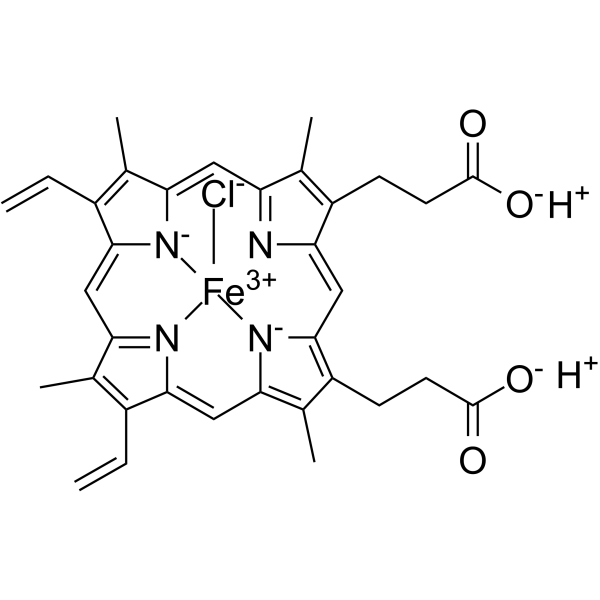
HY-19424
HeminHeme Oxygenase-1 Inducer -
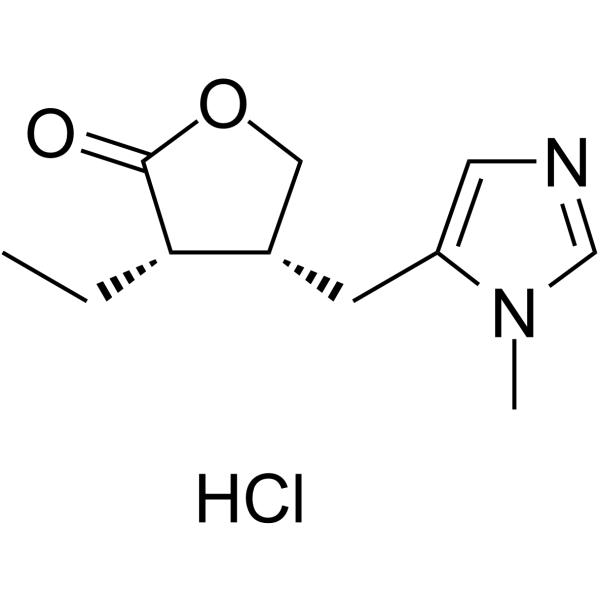
HY-B0726
Pilocarpine HydrochloridemAChR Agonist -
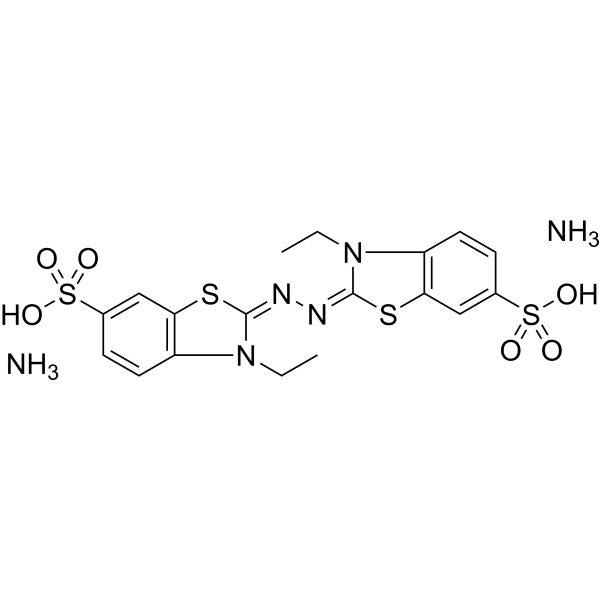
HY-15902
ABTS diammonium saltHRP Substrate -

HY-101880R
ADHP (Standard)Reference Standard -
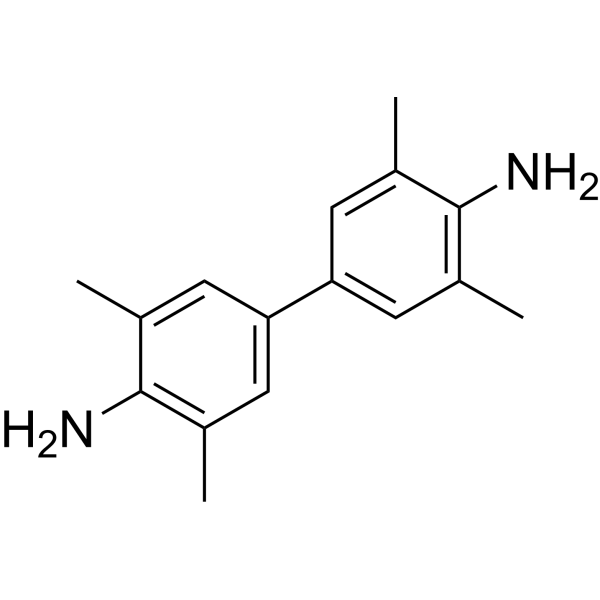
HY-15930
TMBChromogenic Agent -

HY-P2917
Glycerol kinase, microorganismNR4A1 Inhibitor -
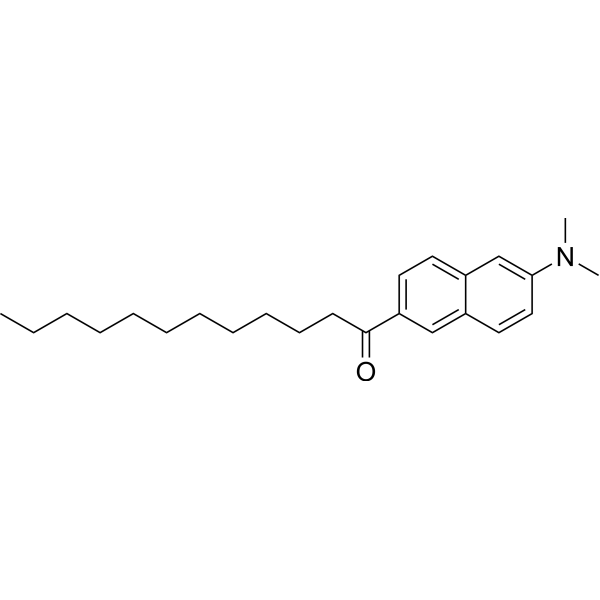
HY-D0080
LaurdanFluorescent Probe -
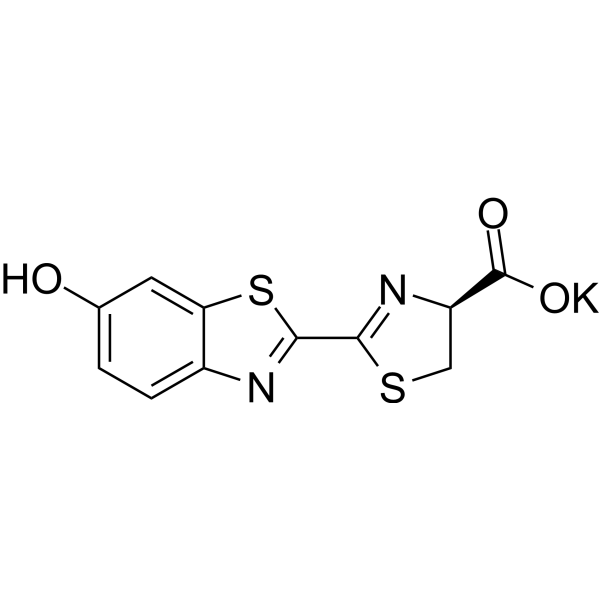
HY-12591B
D-Luciferin potassiumSubstrate for Luciferase
Publications Citing Use of MedChemExpress (MCE) ADHP
More

Biological Activity
Description
In Vitro
To obtain the parameters Km and kcat for Compound I, two independent methods are used. Initially, the oxidation of ADHP using the injector functionality built-in to the fluorescence plate reader is studied. The auto-injector dispenses the H2O2 to initiate the reaction, as a means of generating a set of progress curves. Analysis for MPO-mediated oxidation of ADHP gives a Km of 31±4 μM and the kcat of 186± 6 s 1.The kobs also increases over the experimental range of ADHP concentrations from 1 to 80 μM and for the converse experiment holding substrate constant over 3 to 45 nM MPO. The apparent second order rate constant obtain from the slope of kobs against ADHP concentration Kappon is 2.1±0.2 mM/s[1].
MedChemExpress (MCE) has not independently confirmed the accuracy of these methods. They are for reference only. .
Emission (Em)
585
Excitation (Ex)
571


Chemical Information
-
CAS No. 119171-73-2
-
Appearance Solid
-
Molecular Weight 257.24
-
Formula C14H11NO4
-
Color Light brown to brown
-
SMILES
CC(N1C2=C(C=C(O)C=C2)OC3=CC(O)=CC=C13)=O
-
Synonyms
10-Acetyl-3,7-dihydroxyphenoxazine
-
Shipping
Room temperature in continental US; may vary elsewhere.
-
Storage
4°C, protect from light
* In solvent : -80°C, 6 months; -20°C, 1 month (protect from light)


Publications (3)
-
Journal Impact Factor
-
Most Recent
-
-
J Colloid Interface Sci
Mimicking the process from secretory vesicles to organelles in eukaryotic cell evolution by clustering enzyme-liposomes in artificial cells. [Abstract]2025 Oct 15:696:137863. PMID: 40378444 -
J Med Chem
Regio-isomerization Optimization Strategy for Photosensitizers: Achieving Ultrahigh Type I Reactive Oxygen Species Generation to Enhance Cancer Photoimmunotherapy. [Abstract]2025 Mar 27;68(6):6431-6449. PMID: 40080540


Solvent & Solubility
In Vitro:
DMSO : 116.67 mg/mL (453.55 mM; Need ultrasonic; Hygroscopic DMSO has a significant impact on the solubility of product, please use newly opened DMSO)
Please refer to the solubility information to select the appropriate solvent. Once prepared, please aliquot and store the solution to prevent product inactivation from repeated freeze-thaw cycles.
Storage method and period of stock solution: -80°C, 6 months; -20°C, 1 month (protect from light). When stored at -80°C, please use it within 6 months. When stored at -20°C, please use it within 1 month.
Please refer to the solubility information to select the appropriate solvent. Once prepared, please aliquot and store the solution to prevent product inactivation from repeated freeze-thaw cycles.
Storage method and period of stock solution: -80°C, 6 months; -20°C, 1 month (protect from light). When stored at -80°C, please use it within 6 months. When stored at -20°C, please use it within 1 month.
Concentration (start) × Volume (start) = Concentration (final) × Volume (final)


Purity & Documentation
-
Data Sheet (275 KB)
-
SDS (393 KB)
- English - EN (393 KB)
- Français - FR (393 KB)
- Deutsch - DE (393 KB)
- Norwegian - NO (393 KB)
- Español - ES (393 KB)
- Swedish - SV (393 KB)
- Italian - IT (393 KB)
- Korean - KR (393 KB)
- Portuguese - PT (393 KB)
-
Handling Instructions (2659 KB)
References


Complete Stock Solution Preparation Table
Please refer to the solubility information to select the appropriate solvent. Once prepared, please aliquot and store the solution to prevent product inactivation from repeated freeze-thaw cycles.
Storage method and period of stock solution: -80°C, 6 months; -20°C, 1 month (protect from light). When stored at -80°C, please use it within 6 months. When stored at -20°C, please use it within 1 month.
| Optional Solvent | Concentration Solvent Mass | 1 mg | 5 mg | 10 mg | 25 mg |
|---|---|---|---|---|---|
| DMSO | 1 mM | 3.8874 mL | 19.4371 mL | 38.8742 mL | 97.1855 mL |
| 5 mM | 0.7775 mL | 3.8874 mL | 7.7748 mL | 19.4371 mL | |
| 10 mM | 0.3887 mL | 1.9437 mL | 3.8874 mL | 9.7186 mL | |
| 15 mM | 0.2592 mL | 1.2958 mL | 2.5916 mL | 6.4790 mL | |
| 20 mM | 0.1944 mL | 0.9719 mL | 1.9437 mL | 4.8593 mL | |
| 25 mM | 0.1555 mL | 0.7775 mL | 1.5550 mL | 3.8874 mL | |
| 30 mM | 0.1296 mL | 0.6479 mL | 1.2958 mL | 3.2395 mL | |
| 40 mM | 0.0972 mL | 0.4859 mL | 0.9719 mL | 2.4296 mL | |
| 50 mM | 0.0777 mL | 0.3887 mL | 0.7775 mL | 1.9437 mL | |
| 60 mM | 0.0648 mL | 0.3240 mL | 0.6479 mL | 1.6198 mL | |
| 80 mM | 0.0486 mL | 0.2430 mL | 0.4859 mL | 1.2148 mL | |
| 100 mM | 0.0389 mL | 0.1944 mL | 0.3887 mL | 0.9719 mL |


ADHP Related Classifications
HY-101880 Related Classifications
 Powered by Bioz