



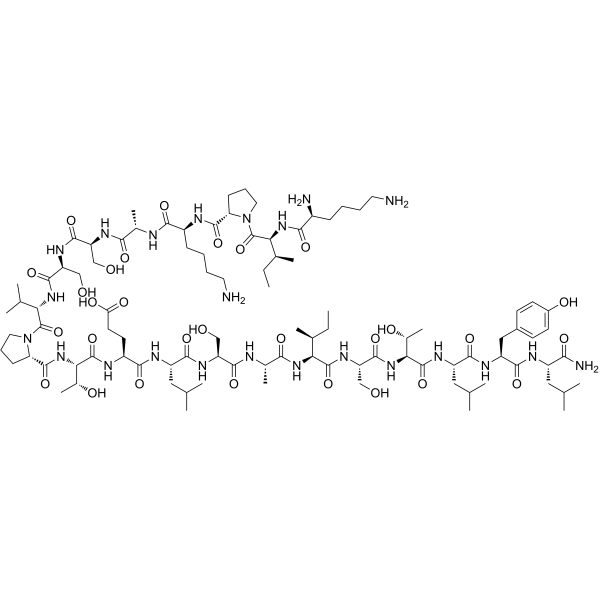
BMP2-derived peptide

Based on 1 Customer Validation
BMP2-derived peptide is an osteogenic inducer and BMP receptor ligand. BMP2-derived peptide binds to BMP receptors on the cell surface to form a complex, activates the downstream Smad signaling pathway, and regulates the expression of osteogenic transcription factors. BMP2-derived peptide effectively promotes the adhesion, proliferation, osteogenic differentiation and mineralization of bone marrow mesenchymal stem cells, significantly up-regulates the mRNA levels of OCN, Runx2 and type I collagen, and increases alkaline phosphatase activity and calcium deposition. BMP2-derived peptide induces osteoblast differentiation and ectopic bone regeneration, and improves cranial bone defect repair. Meanwhile, BMP2-derived peptide enhances the cytocompatibility of mesoporous silica nanoparticles, synergistically increases osteogenic activity with Dexamethasone (HY-14648), serving as an important tool for bone defect repair research.
For research use only. We do not sell to patients.
- Purity : 98.04%
- CAS No.: 836606-84-9
- Formula: C97H165N23O29
- Molecular Weight:2117.48
-
Storage:
Sealed storage, away from moisture and light.
Powder -80°C, 2 years , -20°C, 1 year* In solvent : -80°C, 6 months; -20°C, 1 month (sealed storage, away from moisture and light)

To place orders, for customer services and technical support, please contact: MedChemExpress USA
Tel: 609-228-6898 E-mail: [email protected] [email protected]


-
 Biological Activity
-
Chemical Information
-
Solvent & Solubility
- Protocols
- Purity & Documentation
- References
-
 Help & FAQs




Biological Activity
Description
IC50 & Target
|
RUNX2 |
In Vitro
When covalently conjugated with mesoporous silica nanoparticles (MSNs) (forming MSNs-pep), the BMP2-derived peptide (50-100 μg/mL; 24-48 h) significantly enhances the cellular uptake of the nanoparticles by rat bone marrow mesenchymal stem cells (BMSCs)[1].
BMP2-derived peptide (25-100 μg/mL; 7-21 days), when covalently conjugated to mesoporous silica nanoparticles (MSNs) (i.e., MSNs-pep), significantly upregulates alkaline phosphatase (ALP) activity in rat bone marrow mesenchymal stem cells (BMSCs) after 21 days of incubation[1].
PLAF/PLEOF nanoparticles conjugated with BMP2-derived peptide (2 mg/mL; 2-24 h) are taken up by rat bone marrow stromal cells in a time-dependent manner in osteogenic medium, and the uptake level at 6 h of incubation is significantly higher than that of non-conjugated nanoparticles[2].
Rat bone marrow stromal cells treated with BMP2-derived peptide-grafted PLAF/PLEOF nanoparticles (200 ng/mL; 7-21 d) in osteogenic medium exhibit obvious aggregation and differentiated morphology after 21 days of incubation[2].
MedChemExpress (MCE) has not independently confirmed the accuracy of these methods. They are for reference only.
-
Cell Line:rat bone mesenchymal stem cells (BMSCs)
-
Concentration:50 μg/mL (equivalent to ~400 ng/mL BMP2-derived peptide)
-
Incubation Time:21 days
-
Result:Induced significantly higher RUNX2 expression compared to osteoconductive medium alone.
Induced significantly higher osteocalcin expression compared to osteoconductive medium alone.
-
Cell Line:Rat bone marrow stromal cells
-
Concentration:200 ng/mL
-
Incubation Time:7, 21 days (37 °C in 5% CO2)
-
Result:Induced high levels of aggregation in rat bone marrow stromal cells after 21 days of incubation, forming star and circular patterns characteristic of osteogenic differentiation.
In Vivo
BMP2-derived peptide (100 μg; intramuscular implantation; single administration) induces ectopic bone formation in male Sprague-Dawley rats at 3 weeks post-administration[3].
BMP2-derived peptide (100 μg + 20 μg Dexamethasone (HY-14648); intramuscular implantation; single administration) induces more ectopic bone formation in male Sprague-Dawley rats at 3 weeks post-administration[3].
MedChemExpress (MCE) has not independently confirmed the accuracy of these methods. They are for reference only.
-
Animal Model:Sprague-Dawley rat with Ectopic bone formation (SD) (4-week-old, male)[3]
-
Dosage:100 µg
-
Administration:intramuscular implantation; single dose
-
Result:Showed calcified deposits (white shadows) in the area surrounding the implanted region via CT imaging.
Confirmed the presence of newly formed bone at the implant site via HE staining.
-
Animal Model:Sprague-Dawley rat with Ectopic bone formation (SD) (4-week-old, male)[3]
-
Dosage:100 µg (BMP2-derived peptide); 20 µg (DEX)
-
Administration:intramuscular implantation; single dose
-
Result:Showed more obvious mineralization (calcified deposits) in the area surrounding the implanted region via CT imaging compared to the MSNs-pep group.
Confirmed a greater amount of newly formed bone at the implant site via HE staining compared to the MSNs-pep group.


Chemical Information
-
CAS No. 836606-84-9
-
Appearance Solid
-
Molecular Weight 2117.48
-
Formula C97H165N23O29
-
Color White to off-white
-
Sequence
Lys-Ile-Pro-Lys-Ala-Ser-Ser-Val-Pro-Thr-Glu-Leu-Ser-Ala-Ile-Ser-Thr-Leu-Tyr-Leu-NH2
-
Sequence Shortening
KIPKASSVPTELSAISTLYL-NH2
-
Shipping
Room temperature in continental US; may vary elsewhere.
-
Storage
Sealed storage, away from moisture and light
Powder -80°C 2 years -20°C 1 year * In solvent : -80°C, 6 months; -20°C, 1 month (sealed storage, away from moisture and light)


Solvent & Solubility
In Vitro:
DMSO : 100 mg/mL (47.23 mM; Need ultrasonic; Hygroscopic DMSO has a significant impact on the solubility of product, please use newly opened DMSO)
Please refer to the solubility information to select the appropriate solvent. Once prepared, please aliquot and store the solution to prevent product inactivation from repeated freeze-thaw cycles.
Storage method and period of stock solution: -80°C, 6 months; -20°C, 1 month (sealed storage, away from moisture and light). When stored at -80°C, please use it within 6 months. When stored at -20°C, please use it within 1 month.
Please refer to the solubility information to select the appropriate solvent. Once prepared, please aliquot and store the solution to prevent product inactivation from repeated freeze-thaw cycles.
Storage method and period of stock solution: -80°C, 6 months; -20°C, 1 month (sealed storage, away from moisture and light). When stored at -80°C, please use it within 6 months. When stored at -20°C, please use it within 1 month.
Concentration (start) × Volume (start) = Concentration (final) × Volume (final)


Purity & Documentation
-
Data Sheet (284 KB)
-
SDS (252 KB)
- English - EN (252 KB)
- Français - FR (252 KB)
- Deutsch - DE (252 KB)
- Norwegian - NO (252 KB)
- Español - ES (252 KB)
- Swedish - SV (252 KB)
- Italian - IT (252 KB)
- Korean - KR (252 KB)
- Portuguese - PT (252 KB)
-
Handling Instructions (2659 KB)
References
[1]. Zhou X, et al. BMP-2 Derived Peptide and Dexamethasone Incorporated Mesoporous Silica Nanoparticles for Enhanced Osteogenic Differentiation of Bone Mesenchymal Stem Cells. ACS Appl Mater Interfaces. 2015;7(29):15777-15789. [Content Brief]
[2]. Mercado AE, et al. Effect of grafting BMP2-derived peptide to nanoparticles on osteogenic and vasculogenic expression of stromal cells. J Tissue Eng Regen Med. 2014;8(1):15-28. [Content Brief]
[3]. Chen Y, et al. Zero-order controlled release of BMP2-derived peptide P24 from the chitosan scaffold by chemical grafting modification technique for promotion of osteogenesis in vitro and enhancement of bone repair in vivo. Theranostics. 2017;7(5):1072-1087. Published 2017 Feb 27. [Content Brief]


Complete Stock Solution Preparation Table
Please refer to the solubility information to select the appropriate solvent. Once prepared, please aliquot and store the solution to prevent product inactivation from repeated freeze-thaw cycles.
Storage method and period of stock solution: -80°C, 6 months; -20°C, 1 month (sealed storage, away from moisture and light). When stored at -80°C, please use it within 6 months. When stored at -20°C, please use it within 1 month.
| Optional Solvent | Concentration Solvent Mass | 1 mg | 5 mg | 10 mg | 25 mg |
|---|---|---|---|---|---|
| DMSO | 1 mM | 0.4723 mL | 2.3613 mL | 4.7226 mL | 11.8065 mL |
| 5 mM | 0.0945 mL | 0.4723 mL | 0.9445 mL | 2.3613 mL | |
| 10 mM | 0.0472 mL | 0.2361 mL | 0.4723 mL | 1.1806 mL | |
| 15 mM | 0.0315 mL | 0.1574 mL | 0.3148 mL | 0.7871 mL | |
| 20 mM | 0.0236 mL | 0.1181 mL | 0.2361 mL | 0.5903 mL | |
| 25 mM | 0.0189 mL | 0.0945 mL | 0.1889 mL | 0.4723 mL | |
| 30 mM | 0.0157 mL | 0.0787 mL | 0.1574 mL | 0.3935 mL | |
| 40 mM | 0.0118 mL | 0.0590 mL | 0.1181 mL | 0.2952 mL |


BMP2-derived peptide Related Classifications
HY-P5832 Related Classifications
 Powered by Bioz