



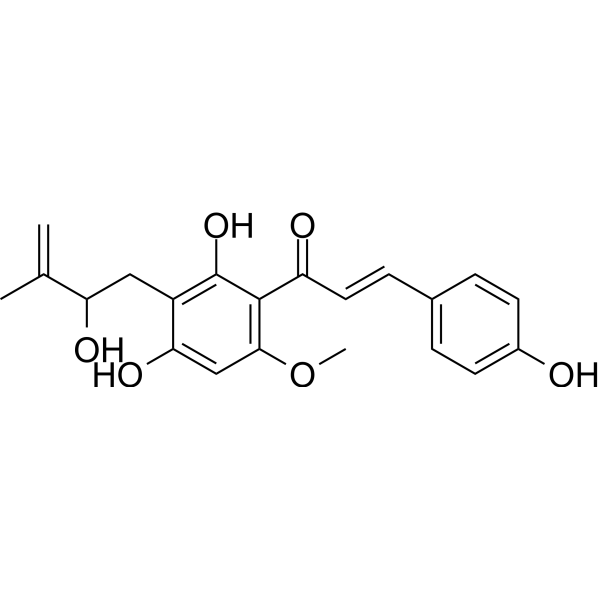
Xanthohumol D
Based on 1 publication(s) in Google Scholar
Xanthohumol D, isolated from hops, is an inhibitor of quinone reductase-2 (QR-2) with the IC50 value of 110 μM, and binds to the active site of QR-2. Xanthohumol D shows antiproliferative activity on human cancer cell lines in vitro.
For research use only. We do not sell to patients.
- Purity : 99.21%
- CAS No.: 274675-25-1
- Formula: C21H22O6
- Molecular Weight:370.40
-
Storage:
4°C, protect from light
* In solvent : -80°C, 6 months; -20°C, 1 month (protect from light)

To place orders, for customer services and technical support, please contact: MedChemExpress USA
Tel: 609-228-6898 E-mail: [email protected] [email protected]


-
 Biological Activity
-
Chemical Information
-
Solvent & Solubility
- Protocols
- Purity & Documentation
- References
-
 Help & FAQs


Publications Citing Use of MedChemExpress (MCE) Xanthohumol D
More

Biological Activity
Description
IC50 & Target
IC50: 110 μM (Quinone reductase-2)[1]
Cellular Effect
|
Cell Line

|
Type | Value | Description | References |
|---|---|---|---|---|
| HT-29 | IC50 |
78.83 μM
Compound: 2
|
Cytotoxicity against human HT-29 cells after 72 hrs by SRB assay
Cytotoxicity against human HT-29 cells after 72 hrs by SRB assay
|
[PMID: 23434138] |
| MCF7 | IC50 |
20.6 μM
Compound: 2
|
Cytotoxicity against human MCF7 cells after 72 hrs by SRB assay
Cytotoxicity against human MCF7 cells after 72 hrs by SRB assay
|
[PMID: 23434138] |
| PC-3 | IC50 |
37.88 μM
Compound: 2
|
Cytotoxicity against human PC3 cells after 72 hrs by SRB assay
Cytotoxicity against human PC3 cells after 72 hrs by SRB assay
|
[PMID: 23434138] |
| RAW264.7 | IC50 |
9.4 μM
Compound: 2
|
Inhibition of LPS/IFN-gamma-induced NO production in mouse RAW264.7 cells after 16 hrs
Inhibition of LPS/IFN-gamma-induced NO production in mouse RAW264.7 cells after 16 hrs
|
[PMID: 15679315] |


Chemical Information
-
CAS No. 274675-25-1
-
Appearance Solid
-
Molecular Weight 370.40
-
Formula C21H22O6
-
Color Light yellow to green yellow
-
SMILES
O=C(C1=C(OC)C=C(O)C(CC(O)C(C)=C)=C1O)/C=C/C2=CC=C(O)C=C2
-
Structure Classification
-
Initial Source
-
Shipping
Room temperature in continental US; may vary elsewhere.
-
Storage
4°C, protect from light
* In solvent : -80°C, 6 months; -20°C, 1 month (protect from light)


Publications (1)
-
Journal Impact Factor
-
Most Recent
-
Phytother Res
Xanthohumol inhibits non-small cell lung cancer via directly targeting T-lymphokine-activated killer cell-originated protein kinase. [Abstract]2023 Jul;37(7):3057-3068. PMID: 36882184


Solvent & Solubility
In Vitro:
DMSO : 50 mg/mL (134.99 mM; Need ultrasonic; Hygroscopic DMSO has a significant impact on the solubility of product, please use newly opened DMSO)
Please refer to the solubility information to select the appropriate solvent. Once prepared, please aliquot and store the solution to prevent product inactivation from repeated freeze-thaw cycles.
Storage method and period of stock solution: -80°C, 6 months; -20°C, 1 month (protect from light). When stored at -80°C, please use it within 6 months. When stored at -20°C, please use it within 1 month.
Please refer to the solubility information to select the appropriate solvent. Once prepared, please aliquot and store the solution to prevent product inactivation from repeated freeze-thaw cycles.
Storage method and period of stock solution: -80°C, 6 months; -20°C, 1 month (protect from light). When stored at -80°C, please use it within 6 months. When stored at -20°C, please use it within 1 month.
Concentration (start) × Volume (start) = Concentration (final) × Volume (final)


Purity & Documentation
-
Data Sheet (270 KB)
-
SDS (393 KB)
- English - EN (393 KB)
- Français - FR (393 KB)
- Deutsch - DE (393 KB)
- Norwegian - NO (393 KB)
- Español - ES (393 KB)
- Swedish - SV (393 KB)
- Italian - IT (393 KB)
- Korean - KR (393 KB)
- Portuguese - PT (393 KB)
-
Handling Instructions (2659 KB)
References
[1]. Choi Y, et al. Screening natural products for inhibitors of quinone reductase-2 using ultrafiltration LC-MS. Anal Chem. 2011 Feb 1;83(3):1048-52. [Content Brief]
[2]. Tronina T, et al. Fungal metabolites of xanthohumol with potent antiproliferative activity on human cancer cell lines in vitro. Bioorg Med Chem. 2013 Apr 1;21(7):2001-6. [Content Brief]


Complete Stock Solution Preparation Table
Please refer to the solubility information to select the appropriate solvent. Once prepared, please aliquot and store the solution to prevent product inactivation from repeated freeze-thaw cycles.
Storage method and period of stock solution: -80°C, 6 months; -20°C, 1 month (protect from light). When stored at -80°C, please use it within 6 months. When stored at -20°C, please use it within 1 month.
| Optional Solvent | Concentration Solvent Mass | 1 mg | 5 mg | 10 mg | 25 mg |
|---|---|---|---|---|---|
| DMSO | 1 mM | 2.6998 mL | 13.4989 mL | 26.9978 mL | 67.4946 mL |
| 5 mM | 0.5400 mL | 2.6998 mL | 5.3996 mL | 13.4989 mL | |
| 10 mM | 0.2700 mL | 1.3499 mL | 2.6998 mL | 6.7495 mL | |
| 15 mM | 0.1800 mL | 0.8999 mL | 1.7999 mL | 4.4996 mL | |
| 20 mM | 0.1350 mL | 0.6749 mL | 1.3499 mL | 3.3747 mL | |
| 25 mM | 0.1080 mL | 0.5400 mL | 1.0799 mL | 2.6998 mL | |
| 30 mM | 0.0900 mL | 0.4500 mL | 0.8999 mL | 2.2498 mL | |
| 40 mM | 0.0675 mL | 0.3375 mL | 0.6749 mL | 1.6874 mL | |
| 50 mM | 0.0540 mL | 0.2700 mL | 0.5400 mL | 1.3499 mL | |
| 60 mM | 0.0450 mL | 0.2250 mL | 0.4500 mL | 1.1249 mL | |
| 80 mM | 0.0337 mL | 0.1687 mL | 0.3375 mL | 0.8437 mL | |
| 100 mM | 0.0270 mL | 0.1350 mL | 0.2700 mL | 0.6749 mL |


Xanthohumol D Related Classifications
HY-N1066 Related Classifications
 Powered by Bioz