



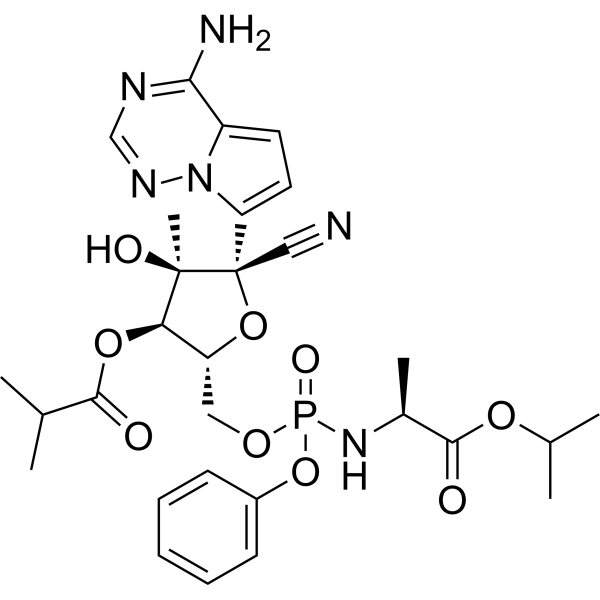
GS-6620

Based on 1 Customer Validation
GS-6620 is potent and selective HCV inhibitor. GS-6620 inhibits HCV replication in genotype 1-6 subgenomic replicons and genotype 2a infectious virus, with EC50 values of 0.048-0.68 μM. GS-6620 can be used for the researches of infection and inflammation, such as Hepatitis C Virus (HCV).
For research use only. We do not sell to patients.
- Purity : 98.93%
- CAS No.: 1350735-70-4
- Formula: C29H37N6O9P
- Molecular Weight:644.61
-
Storage:Powder -20°C, 3 years , 4°C, 2 years ; In solvent -80°C, 6 months , -20°C, 1 month

To place orders, for customer services and technical support, please contact: MedChemExpress USA
Tel: 609-228-6898 E-mail: [email protected] [email protected]


-
 Biological Activity
-
Chemical Information
-
Solvent & Solubility
- Protocols
- Purity & Documentation
- References
-
 Help & FAQs




Biological Activity
Description
IC50 & Target
[1]|
GT3a 0.048 μM (EC50) |
GT4a 0.11 μM (EC50) |
GT6a 0.11 μM (EC50) |
GT5a 0.14 μM (EC50) |
GT1a 0.18 μM (EC50) |
GT1b 0.46 μM (EC50) |
GT2a 0.68 μM (EC50) |
Cellular Effect
|
Cell Line

|
Type | Value | Description | References |
|---|---|---|---|---|
| HeLa | EC50 |
>20 μM
Compound: 13b
|
Antiviral activity against Ebolavirus Kikwit infected in human HeLa cells assessed as reduction in viral glycoprotein levels preincubated with cells for 2 hrs followed by viral infection measured after 48 hrs by immunostaining based assay
Antiviral activity against Ebolavirus Kikwit infected in human HeLa cells assessed as reduction in viral glycoprotein levels preincubated with cells for 2 hrs followed by viral infection measured after 48 hrs by immunostaining based assay
|
[PMID: 28124907] |
| HEp-2 | CC50 |
95 μM
Compound: 13b
|
Cytotoxicity against human Hep2 cells assessed as reduction in cell viability after 4 to 5 days by Cell-Titer Glo assay
Cytotoxicity against human Hep2 cells assessed as reduction in cell viability after 4 to 5 days by Cell-Titer Glo assay
|
[PMID: 28124907] |
| Huh-7 | CC50 |
47 μM
Compound: 16
|
Cytotoxicity against human HuH7 cells after 3 days by fluorescence assay
Cytotoxicity against human HuH7 cells after 3 days by fluorescence assay
|
[PMID: 23547794] |
| Huh-7 | CC50 |
51 μM
Compound: 13b
|
Cytotoxicity against human HuH7 cells assessed as reduction in cell viability after 3 days by calcein-AM dye based fluorescence assay
Cytotoxicity against human HuH7 cells assessed as reduction in cell viability after 3 days by calcein-AM dye based fluorescence assay
|
[PMID: 28124907] |
| Huh-7 | EC50 |
0.61 μM
Compound: 16
|
Antiviral activity against HCV genotype 1b infected in human HuH7 cells assessed as inhibition of viral replication after 3 days by luminescence assay
Antiviral activity against HCV genotype 1b infected in human HuH7 cells assessed as inhibition of viral replication after 3 days by luminescence assay
|
[PMID: 23547794] |
| MT4 | CC50 |
7.8 μM
Compound: 13b
|
Cytotoxicity against human MT4 cells assessed as reduction in cell viability after 4 to 5 days by Cell-Titer Glo assay
Cytotoxicity against human MT4 cells assessed as reduction in cell viability after 4 to 5 days by Cell-Titer Glo assay
|
[PMID: 28124907] |
In Vitro
GS-6620 (72 h) inhibits HCV replication in genotype 1-6 subgenomic replicons and genotype 2a infectious virus, with EC50 values of 0.048-0.68 μM and shows weak activity against bovine viral diarrhea virus (BVDV, EC50 = 1.5 μM)[1].
GS-6620 (active metabolite) (0.39-1.3 μM, 70-90 mins) inhibits HCV NS5B polymerase[1].
GS-6620 (0-100 μM, 5 days) shows low cytotoxicity in Huh-7, HepG2, PC-3 and PBMCs with CC50 values of 67, 66, 40 and >100 μM[1].
GS-6620 (20-100 μM, 5-10 days) does not reduce mitochondrial DNA content in HepG2 cells or inhibit mitochondrial protein synthesis in PC-3 cells[1].
MedChemExpress (MCE) has not independently confirmed the accuracy of these methods. They are for reference only. Further protocols information, click here.
In Vivo
MedChemExpress (MCE) has not independently confirmed the accuracy of these methods. They are for reference only.
Clinical Trial
| NCT Number | Sponsor | Condition | Start Date |
Phase
|
|---|---|---|---|---|
| NCT01329991 | Plexxikon| | 2011-05 | PHASE1 |


Chemical Information
-
CAS No. 1350735-70-4
-
Appearance Solid
-
Molecular Weight 644.61
-
Formula C29H37N6O9P
-
Color White to off-white
-
SMILES
NC1=NC=NN2C1=CC=C2[C@@]3(C#N)[C@@](O)(C)[C@H](OC(C(C)C)=O)[C@@H](CO[P@](OC4=CC=CC=C4)(N[C@@H](C)C(OC(C)C)=O)=O)O3
-
Shipping
Room temperature in continental US; may vary elsewhere.
-
Storage
Powder -20°C 3 years 4°C 2 years In solvent -80°C 6 months -20°C 1 month


Solvent & Solubility
In Vitro:
DMSO : ≥ 100 mg/mL (155.13 mM; Hygroscopic DMSO has a significant impact on the solubility of product, please use newly opened DMSO)
* "≥" means soluble, but saturation unknown.
Please refer to the solubility information to select the appropriate solvent. Once prepared, please aliquot and store the solution to prevent product inactivation from repeated freeze-thaw cycles.
Storage method and period of stock solution: -80°C, 6 months; -20°C, 1 month. When stored at -80°C, please use it within 6 months. When stored at -20°C, please use it within 1 month.
Please refer to the solubility information to select the appropriate solvent. Once prepared, please aliquot and store the solution to prevent product inactivation from repeated freeze-thaw cycles.
Storage method and period of stock solution: -80°C, 6 months; -20°C, 1 month. When stored at -80°C, please use it within 6 months. When stored at -20°C, please use it within 1 month.
Concentration (start) × Volume (start) = Concentration (final) × Volume (final)

Protocols
-
Research Protocol for Infectious Diseases
Infectious-disease experiments test how pathogens interact with host barriers, innate immune receptors, inflammatory signaling, pathogen replication, and tissue injury; pattern-recognition receptors such as TLRs, RIG-I-like receptors, NOD-like receptors, and inflammasomes detect microbial molecules and activate NF-κB, interferon, and cytokine responses. The central hypothesis is that infection severity reflects the balance between pathogen burden and host response: protective inflammation restricts pathogen growth, whereas excessive or mislocalized inflammation contributes to tissue damage and disease phenotype. Unresolved questions include which host pathways are protective versus pathogenic, why some infection models fail to translate to human disease, and which combined readouts best predict clinically relevant infection outcomes.
-
Research Protocol for Inflammation-related Diseases
The NLRP3 inflammasome is a cytosolic innate immune signaling platform that integrates priming signals and danger-signal activation to promote caspase-1 activation, maturation of IL-1β and IL-18, and gasdermin D-mediated pyroptotic cell death. The core experimental logic is to determine whether inflammatory disease phenotypes are driven by increased NLRP3 expression, ASC-containing inflammasome assembly, caspase-1 cleavage, GSDMD cleavage, and extracellular release of IL-1β/IL-18 rather than by nonspecific cell injury alone. The pathway is strongly linked to inflammation-related disease phenotypes because monosodium urate crystals activate NALP3/NLRP3 inflammasome signaling in gout-like crystal inflammation, cholesterol crystals activate NLRP3 inflammasomes in atherogenesis models, and DSS-induced intestinal inflammation has been reported to involve NLRP3 inflammasome activity. However, experimental colitis studies also show context-dependent protective effects of NLRP3 inflammasome co


Purity & Documentation
-
Data Sheet (276 KB)
-
SDS (251 KB)
- English - EN (251 KB)
- Français - FR (251 KB)
- Deutsch - DE (251 KB)
- Norwegian - NO (251 KB)
- Español - ES (251 KB)
- Swedish - SV (251 KB)
- Italian - IT (251 KB)
- Korean - KR (251 KB)
- Portuguese - PT (251 KB)
-
Handling Instructions (2659 KB)
References
[1]. Joy Y Feng, et al. Inhibition of hepatitis C virus replication by GS-6620, a potent C-nucleoside monophosphate prodrug. Antimicrob Agents Chemother. 2014;58(4):1930-42. [Content Brief]
[2]. Cho A, et al. Discovery of the first C-nucleoside HCV polymerase inhibitor (GS-6620) with demonstrated antiviral response in HCV infected patients. J Med Chem. 2014 Mar 13;57(5):1812-25. [Content Brief]


Complete Stock Solution Preparation Table
Please refer to the solubility information to select the appropriate solvent. Once prepared, please aliquot and store the solution to prevent product inactivation from repeated freeze-thaw cycles.
Storage method and period of stock solution: -80°C, 6 months; -20°C, 1 month. When stored at -80°C, please use it within 6 months. When stored at -20°C, please use it within 1 month.
| Optional Solvent | Concentration Solvent Mass | 1 mg | 5 mg | 10 mg | 25 mg |
|---|---|---|---|---|---|
| DMSO | 1 mM | 1.5513 mL | 7.7566 mL | 15.5133 mL | 38.7831 mL |
| 5 mM | 0.3103 mL | 1.5513 mL | 3.1027 mL | 7.7566 mL | |
| 10 mM | 0.1551 mL | 0.7757 mL | 1.5513 mL | 3.8783 mL | |
| 15 mM | 0.1034 mL | 0.5171 mL | 1.0342 mL | 2.5855 mL | |
| 20 mM | 0.0776 mL | 0.3878 mL | 0.7757 mL | 1.9392 mL | |
| 25 mM | 0.0621 mL | 0.3103 mL | 0.6205 mL | 1.5513 mL | |
| 30 mM | 0.0517 mL | 0.2586 mL | 0.5171 mL | 1.2928 mL | |
| 40 mM | 0.0388 mL | 0.1939 mL | 0.3878 mL | 0.9696 mL | |
| 50 mM | 0.0310 mL | 0.1551 mL | 0.3103 mL | 0.7757 mL | |
| 60 mM | 0.0259 mL | 0.1293 mL | 0.2586 mL | 0.6464 mL | |
| 80 mM | 0.0194 mL | 0.0970 mL | 0.1939 mL | 0.4848 mL | |
| 100 mM | 0.0155 mL | 0.0776 mL | 0.1551 mL | 0.3878 mL |


GS-6620 Related Classifications
HY-12633 Related Classifications
 Powered by Bioz