



Tebideutorexant

Based on 1 Customer Validation
Tebideutorexant is an OX1R-selective inhibitor with oral bioavailability and blood-brain barrier permeability, with human OX1R pKi 8.17 and rat OX1R pKi 8.13.Tebideutorexant selectively modulates OX1R, with no significant functional effect on OX2R. Tebideutorexant can be used for the research of panic and anxiety disorders.
For research use only. We do not sell to patients.
- Purity : 98.95%
- CAS No.: 1637681-55-0
- Formula: C23H16D2F4N4O2
- Molecular Weight:460.42
-
Storage:Powder -20°C, 3 years ; In solvent -80°C, 6 months , -20°C, 1 month


To place orders, for customer services and technical support, please contact: MedChemExpress USA
Tel: 609-228-6898 E-mail: [email protected] [email protected]


-
 Biological Activity
-
Chemical Information
- Protocols
- Purity & Documentation
- References
-
 Help & FAQs


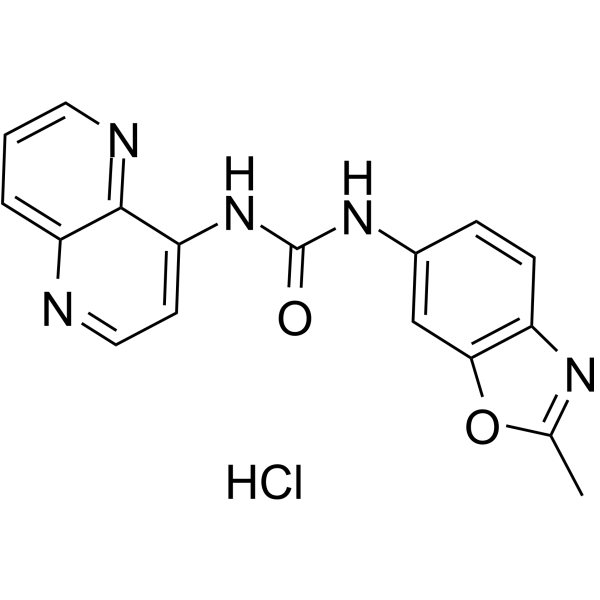
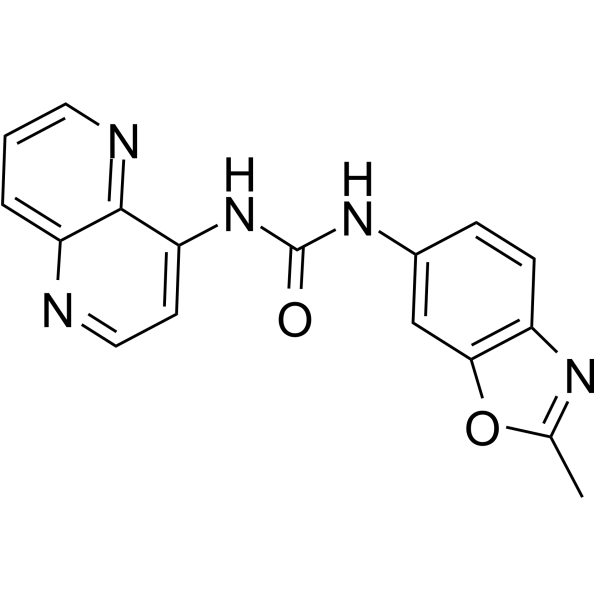
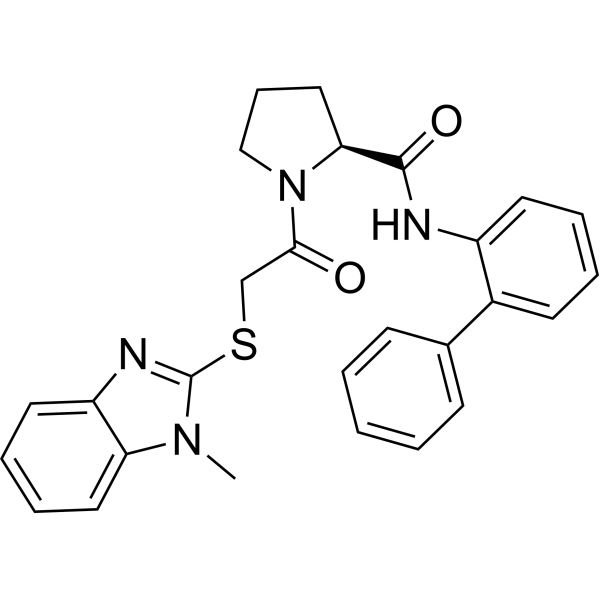


All Orexin Receptor (OX Receptor) Isoforms
More

Biological Activity
Description
Cellular Effect
|
Cell Line

|
Type | Value | Description | References |
|---|---|---|---|---|
| Vero C1008 | IC50 |
>2.0 × 10⁵M
Compound: COVC-2283598831
|
Antiviral activity determined as inhibition of SARS-CoV-2 induced cytotoxicity of VERO-6 cells at 10 uM after 48 hours exposure to 0.01 MOI SARS CoV-2 virus by high content imaging
Antiviral activity determined as inhibition of SARS-CoV-2 induced cytotoxicity of VERO-6 cells at 10 uM after 48 hours exposure to 0.01 MOI SARS CoV-2 virus by high content imaging
|
10.6019/CHEMBL4651402 |
In Vitro
Tebideutorexant (JNJ-61393215) exhibits high affinity, potency, and selectivity for human and rat OX1R over OX2R and other molecular targets in vitro[1].
MedChemExpress (MCE) has not independently confirmed the accuracy of these methods. They are for reference only. Further protocols information, click here.
Parmacokinetics
In Vivo
Tebideutorexant (0.1-10 mg/kg; p.o.) shows dose- and time-dependent brain OX1R occupancy in rats, with oral bioavailability and brain penetration[1].
Tebideutorexant (10 mg/kg; p.o.) reduces NREM and REM sleep latency without altering total sleep duration in rats[1].
Tebideutorexant (30 mg/kg; p.o.) selectively promotes REM sleep in OX2R KO mice, demonstrating in vivo OX1R target engagement[1].
MedChemExpress (MCE) has not independently confirmed the accuracy of these methods. They are for reference only.
-
Animal Model:Sprague-Dawley (male, 300-400 g)[1]
-
Dosage:3, 10, 30 mg/kg
-
Administration:p.o., single dose
-
Result:Blocked CO₂-induced reduction in social interaction behaviors at 10 and 30 mg/kg; attenuated CO₂-induced bradycardia responses at 8 and 9 minutes post-challenge at 30 mg/kg.
-
Animal Model:Sprague-Dawley (male, 300-400 g)[1]
-
Dosage:0.1, 1, 10 mg/kg
-
Administration:p.o., single dose
-
Result:Produced time- and dose-dependent brain OX1R occupancy; reached 89% maximal occupancy at 15 minutes and remained above 47% for 8 hours at 10 mg/kg; achieved plasma EC50 of 34 ng/mL for 50% occupancy.
-
Animal Model:Sprague-Dawley (male, 350-450 g)[1]
-
Dosage:10 mg/kg
-
Administration:p.o., single dose
-
Result:Did not alter total NREM or REM sleep duration; significantly decreased NREM and REM sleep latency.
-
Animal Model:C57Bl6 OX2R knockout (male, 30-35 g, OX2R KO model)[1]
-
Dosage:30 mg/kg
-
Administration:p.o., single dose
-
Result:Significantly reduced REM sleep latency; prolonged REM sleep duration in the first 2 hours post-treatment; showed no effect on NREM sleep parameters.
Application
1. This compound can be used as a tracer
2. This compound can be used as an internal standard for quantitative analysis by NMR, GC-MS, or LC-MS.


Chemical Information
-
CAS No. 1637681-55-0
-
Unlabeled CAS 1628320-31-9
-
Appearance Solid
-
Molecular Weight 460.42
-
Formula C23H16D2F4N4O2
-
Color White to off-white
-
SMILES
O=C(C1=C(C2=NC=CC=N2)C(F)=CC=C1)N3[C@@H]4[C@@H](C[C@H](C3([2H])[2H])C4)OC5=CC=C(C=N5)C(F)(F)F
-
Synonyms
JNJ-61393215
-
Shipping
Room temperature in continental US; may vary elsewhere.
-
Storage
Powder -20°C 3 years In solvent -80°C 6 months -20°C 1 month

Protocols
-
Protocol for Pharmacokinetic Study
Pharmacokinetic studies quantify how an organism handles a drug over time through absorption, distribution, metabolism, and excretion, and the core experimental readout is the concentration-time profile of parent drug and, when relevant, metabolites in biological matrices such as plasma, whole blood, urine, bile, or tissue. Pharmacokinetic analysis links dose, route, exposure, clearance, half-life, distribution, bioavailability, and systemic exposure to drug efficacy and toxicity hypotheses rather than measuring a signaling pathway directly. The literature links pharmacokinetics to drug-development phenotypes by showing that drug metabolism and pharmacokinetics influence compound progression, exposure-response interpretation, safety margins, dosing strategy, and failure risk during discovery and development. DMPK science contributes to compound optimization by integrating physicochemical properties, in vitro metabolism, transporter behavior, in vivo exposure, and pharmacodynamic contex
-
Transepithelial/transendothelial electrical resistance assay
TEER measures electrical resistance across epithelial or endothelial monolayers cultured on permeable supports, and the readout reflects ionic conductance through the cell barrier, especially the paracellular pathway regulated by junctional integrity. TEER can be measured without destroying the monolayer and is commonly used before or during transport, permeability, barrier-disruption, and barrier-maturation experiments. TEER values are influenced by biological maturation and technical conditions; reported factors include temperature, medium formulation, passage number, electrode geometry, membrane properties, and junctional length during early monolayer maturation. Therefore, TEER should be interpreted with blank-insert subtraction, area normalization, repeated readings, and, when possible, orthogonal barrier readouts such as FITC-dextran flux or tight-junction staining.


Purity & Documentation
-
Data Sheet (273 KB)
-
SDS (252 KB)
- English - EN (252 KB)
- Français - FR (252 KB)
- Deutsch - DE (252 KB)
- Norwegian - NO (252 KB)
- Español - ES (252 KB)
- Swedish - SV (252 KB)
- Italian - IT (252 KB)
- Korean - KR (252 KB)
- Portuguese - PT (252 KB)
-
Handling Instructions (2659 KB)
References

Calculators
Concentration (start) × Volume (start) = Concentration (final) × Volume (final)


Tebideutorexant Related Classifications
HY-147403S Related Classifications
 Powered by Bioz