



Dried aluminum hydroxide gel,United States Pharmacopeia (USP) Reference Standard

Based on 1 Customer Validation
Dried aluminum hydroxide gel, United States Pharmacopeia (USP) Reference Standard is a commonly used antacid with remarkable compound adhesion and release activity. Dried aluminum hydroxide gel, United States Pharmacopeia (USP) Reference Standard can effectively neutralize gastric acid and relieve stomach discomfort. Dried aluminum hydroxide gel, United States Pharmacopeia (USP) Reference Standard is also often used as an adjuvant in vaccines to enhance immune responses. Dried aluminum hydroxide gel, United States Pharmacopeia (USP) Reference Standard can improve the stability and bioavailability of compounds in preparations.
For research use only. We do not sell to patients.
- CAS No.: 21645-51-2
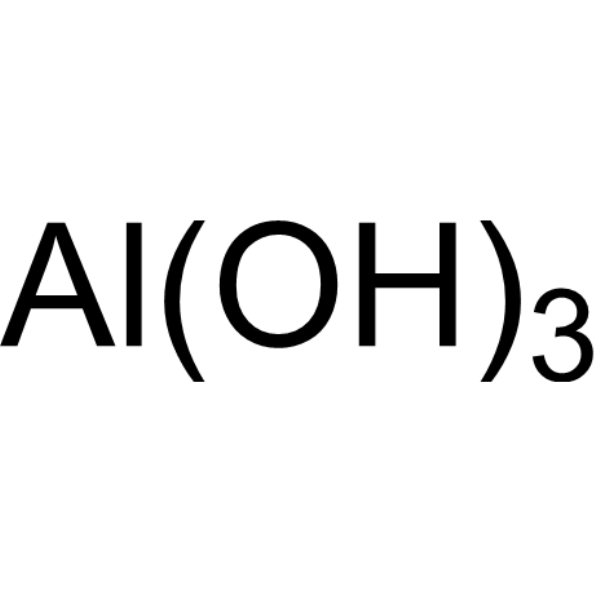
- Formula: Al(OH)3
- Molecular Weight:78.00
-
Storage:Powder -20°C, 3 years , 4°C, 2 years ; In solvent -80°C, 6 months , -20°C, 1 month


To place orders, for customer services and technical support, please contact: MedChemExpress USA
Tel: 609-228-6898 E-mail: [email protected] [email protected]


-
 Biological Activity
-
Chemical Information
-
Solvent & Solubility
- Protocols
- Purity & Documentation
- References
-
 Help & FAQs


-

HY-W250978
OvalbuminsAllergen -
HY-B1521
Aluminum HydroxideAntacid Aegnt -

HY-Y0292
Lithium carbonateBiochemical Reagent -
HY-101092
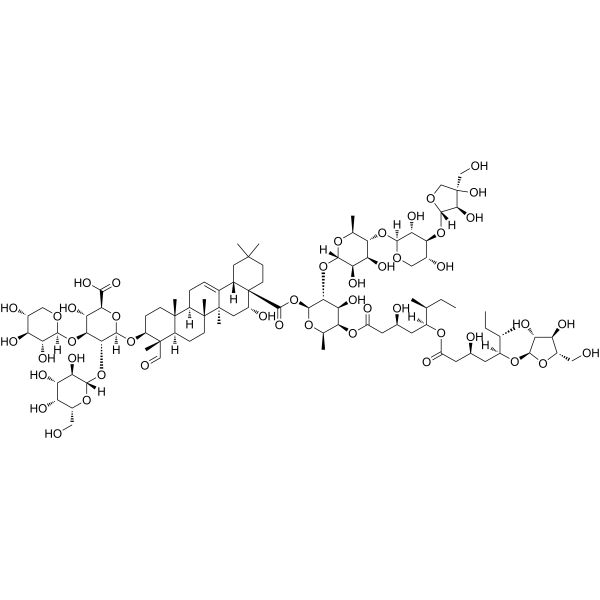
QS-21-ApiNLRP3 Activator -
HY-12815
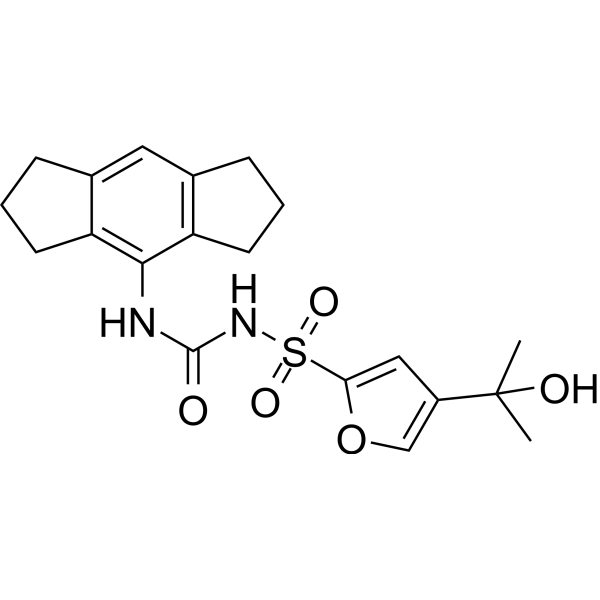
MCC950NLRP3 Inhibitor -
HY-ER013C
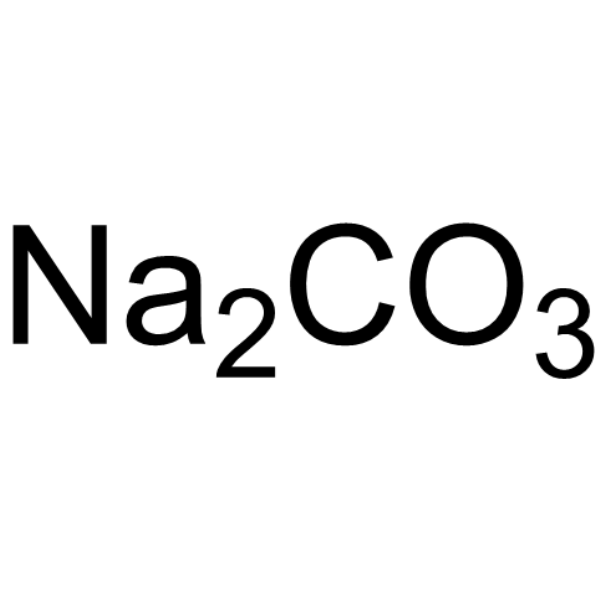
Sodium carbonate anhydrous, 99.8%Biochemical Reagent -

HY-B1770
Sodium Iodide,99%Iodide Salt -

HY-Y0537
Potassium chloride, AR, 99.5%Potassium Supplement -

HY-Y0537E
Potassium chloride, for cell cultureInorganic Salt -

HY-Y0344D
Sodium chloride, for cell cultureBiochemical Assay Reagent


Biological Activity
Description
In Vitro
Dried aluminum hydroxide gel's antacid effect is significantly inhibited by pepsin, whereas ovalbumin and hemoglobin only slightly delay its action.[1].
Dried aluminum hydroxide gel reversibly precipitates pepsin, and the precipitate dissolves in dilute gastric acid to release active pepsin[1].
MedChemExpress (MCE) has not independently confirmed the accuracy of these methods. They are for reference only. Further protocols information, click here.


Chemical Information
-
CAS No. 21645-51-2
-
Appearance Solid
-
Molecular Weight 78.00
-
Formula Al(OH)3
-
Color White to off-white
-
SMILES
O[Al](O)O
-
Shipping
Room temperature in continental US; may vary elsewhere.
-
Storage
Powder -20°C 3 years 4°C 2 years In solvent -80°C 6 months -20°C 1 month


Solvent & Solubility
In Vitro:
H2O : < 0.1 mg/mL (insoluble)

Protocols
-
Protocol for Pharmacokinetic Study
Pharmacokinetic studies quantify how an organism handles a drug over time through absorption, distribution, metabolism, and excretion, and the core experimental readout is the concentration-time profile of parent drug and, when relevant, metabolites in biological matrices such as plasma, whole blood, urine, bile, or tissue. Pharmacokinetic analysis links dose, route, exposure, clearance, half-life, distribution, bioavailability, and systemic exposure to drug efficacy and toxicity hypotheses rather than measuring a signaling pathway directly. The literature links pharmacokinetics to drug-development phenotypes by showing that drug metabolism and pharmacokinetics influence compound progression, exposure-response interpretation, safety margins, dosing strategy, and failure risk during discovery and development. DMPK science contributes to compound optimization by integrating physicochemical properties, in vitro metabolism, transporter behavior, in vivo exposure, and pharmacodynamic contex


Purity & Documentation
-
Data Sheet (272 KB)
-
SDS (393 KB)
- English - EN (393 KB)
- Français - FR (393 KB)
- Deutsch - DE (393 KB)
- Norwegian - NO (393 KB)
- Español - ES (393 KB)
- Swedish - SV (393 KB)
- Italian - IT (393 KB)
- Korean - KR (393 KB)
- Portuguese - PT (393 KB)
-
Handling Instructions (2659 KB)
References

Calculators
Concentration (start) × Volume (start) = Concentration (final) × Volume (final)


Dried aluminum hydroxide gel,United States Pharmacopeia (USP) Reference Standard Related Classifications
HY-W116335A Related Classifications
 Powered by Bioz