



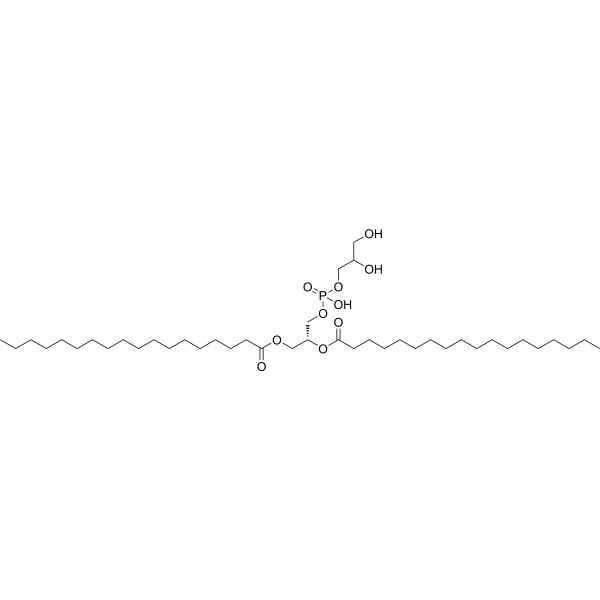
1,2-Distearoyl-sn-Glycero-3-Phosphatidylglycerol
1,2-Distearoyl-sn-Glycero-3-Phosphatidylglycerol (DSPG) is an anionic (negatively charged) phospholipid. 1,2-Distearoyl-sn-Glycero-3-Phosphatidylglycerol is used to prepare lipid microbubbles as ultrasound contrast agents. 1,2-Distearoyl-sn-Glycero-3-Phosphatidylglycerol can be used to construct liposomes as vaccine carriers for the treatment of atherosclerosis. 1,2-Distearoyl-sn-Glycero-3-Phosphatidylglycerol is applicable to the research of drug delivery and diagnostic preparations.
For research use only. We do not sell to patients.
- CAS No.: 217939-97-4
- Formula: C42H83O10P
- Molecular Weight:779.08
-
Storage:
Please store the product under the recommended conditions in the Certificate of Analysis.

To place orders, for customer services and technical support, please contact: MedChemExpress USA
Tel: 609-228-6898 E-mail: [email protected] [email protected]


-
 Biological Activity
-
Chemical Information
- Protocols
- Purity & Documentation
- References
-
 Help & FAQs




Biological Activity
Description
In Vitro
1,2-Distearoyl-sn-Glycero-3-Phosphatidylglycerol forms part of the protein corona of liposomes and mediates the uptake by antigen-presenting cells[1].
When incorporated at a ratio of 60%, 1,2-Distearoyl-sn-Glycero-3-Phosphatidylglycerol enhances the stability of lipid-based microbubble shells, which helps prolong in vivo blood flow imaging duration and reduce hepatic uptake[2].
MedChemExpress (MCE) has not independently confirmed the accuracy of these methods. They are for reference only.


Chemical Information
-
CAS No. 217939-97-4
-
Molecular Weight 779.08
-
Formula C42H83O10P
-
SMILES
OCC(O)COP(OC[C@@H](COC(CCCCCCCCCCCCCCCCC)=O)OC(CCCCCCCCCCCCCCCCC)=O)(O)=O
-
Synonyms
DSPG
-
Shipping
Room temperature in continental US; may vary elsewhere.
-
Storage
Please store the product under the recommended conditions in the Certificate of Analysis.


Purity & Documentation
-
Data Sheet (266 KB)
-
SDS (252 KB)
- Français - FR (252 KB)
- Deutsch - DE (252 KB)
- Norwegian - NO (252 KB)
- Español - ES (252 KB)
- Swedish - SV (252 KB)
- Italian - IT (252 KB)
- Korean - KR (252 KB)
- Portuguese - PT (252 KB)
-
Handling Instructions (2659 KB)
References
[1]. Benne N, et al. Anionic 1,2-distearoyl-sn-glycero-3-phosphoglycerol (DSPG) liposomes induce antigen-specific regulatory T cells and prevent atherosclerosis in mice. J Control Release. 2018;291:135-146. [Content Brief]
[2]. Maruyama T, et al. Effect of lipid shell composition in DSPG-based microbubbles on blood flow imaging with ultrasonography. Int J Pharm. 2020;590:119886. [Content Brief]

Calculators
Concentration (start) × Volume (start) = Concentration (final) × Volume (final)


1,2-Distearoyl-sn-Glycero-3-Phosphatidylglycerol Related Classifications
HY-148601 Related Classifications
 Powered by Bioz