



Echinosporin
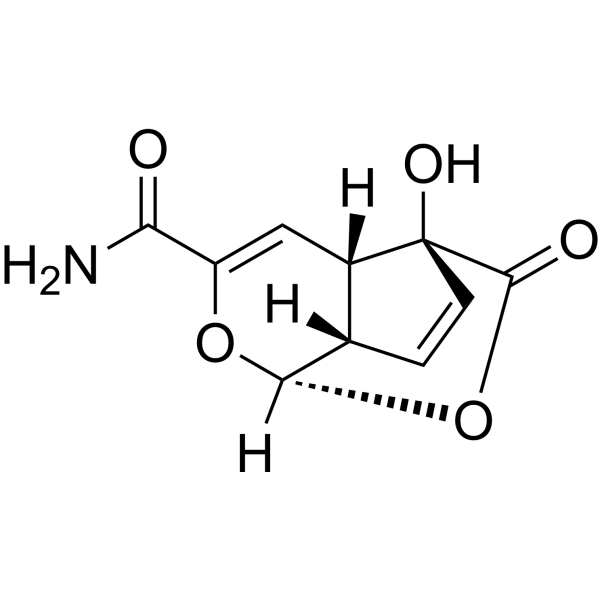
Echinosporin (XK-213) is an antibiotic. Echinosporin can be isolated from Amycolatopsis strain. Echinosporin has antifungal activity and antitumor activity.
For research use only. We do not sell to patients.
- CAS No.: 79127-35-8
- Formula: C10H9NO5
- Molecular Weight:223.18
-
Storage:
Please store the product under the recommended conditions in the Certificate of Analysis.

To place orders, for customer services and technical support, please contact: MedChemExpress USA
Tel: 609-228-6898 E-mail: [email protected] [email protected]


-
 Biological Activity
-
Chemical Information
- Protocols
- Purity & Documentation
- References
-
 Help & FAQs




Biological Activity
Description
IC50 & Target
MIC50: 64 μg/mL (Fusarium oxysporum); 64 μg/mL (Fusarium solani); 32 μg/mL (Alternaria panax); 64 μg/mL (Phoma herbarum)[2].
In Vitro
Echinosporin (XK-213) exhibits weak antibacterial activities against Gram-positive and -negative microorganisms and its shows antitumor activity[1].
Echinosporin exhibits antifungal activity against root-rot pathogens of Panax notoginseng include Fusarium oxysporum, Fusarium solani, Alternaria panax, and Phoma herbarum with the MIC50 value at 64, 64, 32, and 64 μg/mL, respectively[2].
MedChemExpress (MCE) has not independently confirmed the accuracy of these methods. They are for reference only. Further protocols information, click here.


Chemical Information
-
CAS No. 79127-35-8
-
Molecular Weight 223.18
-
Formula C10H9NO5
-
SMILES
O=C(C1=C[C@@]([C@@](C(O2)=O)(O)C=C3)([H])[C@@]3([H])[C@@]2([H])O1)N
-
Synonyms
XK-213
-
Initial Source
streptomyces echinosporus MK-213
-
Shipping
Room temperature in continental US; may vary elsewhere.
-
Storage
Please store the product under the recommended conditions in the Certificate of Analysis.

Protocols
-
Subcutaneous Cell-Line-Derived Xenograft
Subcutaneous cell-line-derived xenograft (CDX) models are established by implanting cultured human cancer cell lines into immunodeficient mice, where the injected cells form localized tumors that can be monitored in vivo as a measure of tumorigenic potential, growth kinetics, and treatment response. These models are widely used in oncology research because they allow reproducible tumor formation and enable comparative assessment of tumor growth between different cell lines or genetic manipulations in a controlled in vivo microenvironment. Subcutaneous implantation of cancer cells in immunodeficient mice is a standard approach for evaluating tumor growth behavior and therapeutic response across multiple cancer types, including prostate, esophageal, pancreatic, and colon cancer models.


Purity & Documentation
References
[1]. T Sato, et al. A new antibiotic echinosporin (XK-213) - producing organism, isolation and characterization. J Antibiot (Tokyo). 1982 Mar;35(3):266-71. [Content Brief]
[2]. Xindong Xu, et al. Echinosporin antibiotics isolated from Amycolatopsis strain and their antifungal activity against root-rot pathogens of the Panax notoginseng. Folia Microbiol (Praha). 2019 Mar;64(2):171-175. [Content Brief]

Calculators
Concentration (start) × Volume (start) = Concentration (final) × Volume (final)


Echinosporin Related Classifications
HY-113799 Related Classifications
 Powered by Bioz