



Fulvine
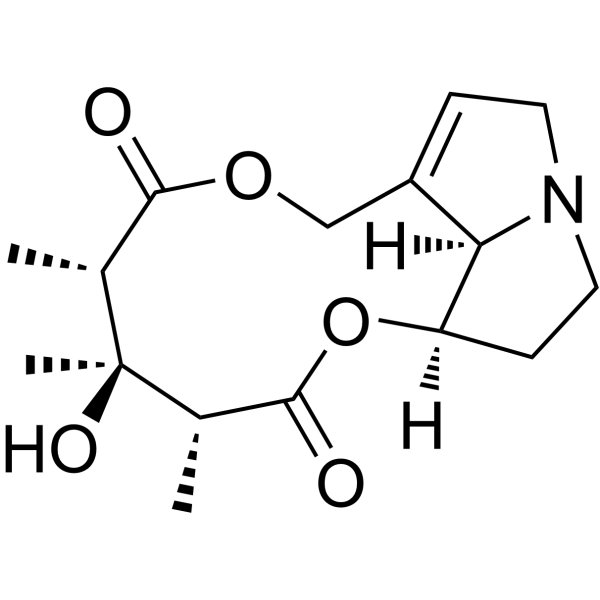
Fulvine is a pyrrolizidine alkaloid isolated from the seeds of Crotalaria fulva. Fulvine is hepatotoxic and can be used to induce hypertensive pulmonary vascular disease in vivo.
Nur für Forschungszwecke. Wir verkaufen nicht an Patienten.
- CAS. Nr.: 6029-87-4
- Formel: C16H23NO5
- Molecular Weight:309.36
-
Speicherung:
Please store the product under the recommended conditions in the Certificate of Analysis.

To place orders, for customer services and technical support, please contact: MedChemExpress USA
Tel: 609-228-6898 E-mail: [email protected] [email protected]


-
 Biologische Aktivität
-
Chemical Information
- Protokoll
- Reinheit & Dokumentation
- Verweise
-
 Help & FAQs




Biologische Aktivität
Beschreibung
Induced Disease Models
Please do not refer to only one article to determine the experimental conditions. It is recommended to determine the optimal experimental conditions (animal strain, age, dosage, frequency and cycle, detection time and indicators, etc.) through preliminary experiments before the formal experiment.
Fulvine can be used in animal modeling to create respiratory disease models[1][2].
Administration: 30-45 mg/kg• neutralised aqueous solution by stomach tube• a single dose[1]
Rat: Male and Female• weighing 40-80 g[2]
Administration: 50 mg/kg• given by stomach tube• a single dose[2]
.
Crystalline Fulvine was dissolved in dilute hydrochloric acid, neutralised and diluted to give a 1% solution[2]
.
.
Behavioral observation: Fulvine induced some developed difficulty in breathing and slowing or cessation of growth in rats[1]
.
Histological analysis: Fulvine induced moderate ascites, well marked fibrous thickening of the central vein walls, endothelial proliferation and some perivascular centrilobular fibrosis with possibly partial venous occlusion[2]
.
MedChemExpress (MCE) has not independently confirmed the accuracy of these methods. They are for reference only.


Chemical Information
-
CAS. Nr. 6029-87-4
-
Molecular Weight 309.36
-
Formel C16H23NO5
-
SMILES
O=C(O[C@]1([H])CCN2[C@]1([H])C(CO3)=CC2)[C@H](C)[C@@](C)(O)[C@H](C)C3=O
-
Versand
Room temperature in continental US; may vary elsewhere.
-
Speicherung
Please store the product under the recommended conditions in the Certificate of Analysis.

Protokoll
-
Research Protocol for Cardiovascular Diseases
Cardiovascular disease can be modeled as maladaptive cardiac remodeling, where ischemic injury or pressure overload activates inflammatory signaling, fibroblast activation, extracellular-matrix deposition, cardiomyocyte hypertrophy, vascular remodeling, and progressive ventricular dysfunction. The TGF-β/SMAD axis is a central profibrotic pathway after myocardial injury and pressure overload, while innate immune and cytokine pathways regulate leukocyte recruitment, scar formation, and adverse remodeling. Key unresolved questions include which inflammatory signals are reparative versus harmful, when fibrosis is protective versus maladaptive, and whether pathway inhibition improves function without weakening necessary infarct healing or compensatory remodeling.


Reinheit & Dokumentation
Verweise
[1]. Schoental R. Rat lung lesions due to Fulvine. J Pathol Bacteriol. 1966 Apr;91(2):629-31. [Content Brief]
[2]. BARNES JM, et al. LESIONS IN THE LUNGS AND LIVERS OF RATS POISONED WITH THE PYRROLIZIDINE ALKALOID Fulvine AND ITS N-OXIDE. J Pathol Bacteriol. 1964 Oct;88:521-31. [Content Brief]
[3]. J M Kay, et al.Fulvine and the pulmonary circulation. Thorax [Content Brief]

Calculators
Konzentration (Stammlösung) × Volumen (Stammlösung) = Konzentration (Ziellösung) × Volumen (Ziellösung)


Fulvine Related Classifications
HY-133589 Related Classifications
 Powered by Bioz