



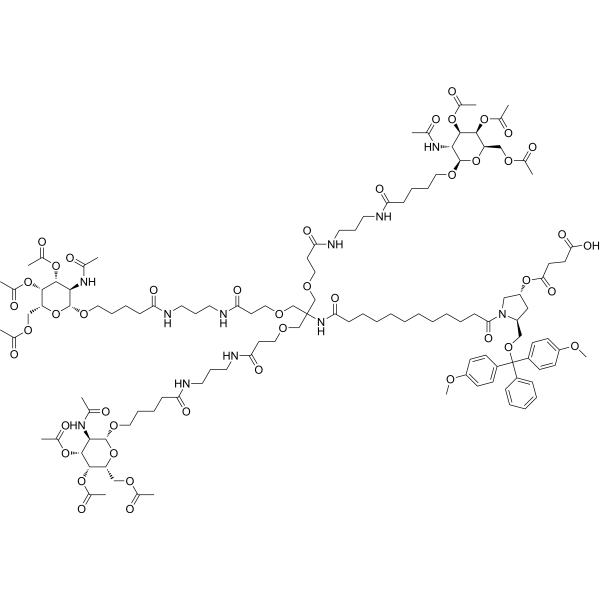
GalNAc-L96 free base
GalNAc-L96 free base is a conjugate of GalNAc and its ligand L96. When conjugated with the A-rich HCV sequence (H12), GalNAc-L96 free base binds potently to ASGPR, with a Ki value of 10.4 nM. GalNAc-L96 free base promotes siRNA delivery to hepatocytes.
For research use only. We do not sell to patients.
- CAS No.: 1159408-61-3
- Formula: C121H179N11O45
- Molecular Weight:2507.76
-
Storage:
Please store the product under the recommended conditions in the Certificate of Analysis.

To place orders, for customer services and technical support, please contact: MedChemExpress USA
Tel: 609-228-6898 E-mail: [email protected] [email protected]


-
 Biological Activity
-
Chemical Information
- Protocols
- Purity & Documentation
- References
-
 Help & FAQs




Biological Activity
Description
In Vitro
When conjugated to an A-rich HCV sequence (H12), GalNAc-L96 free base binds potently to ASGPR in primary mouse hepatocytes, with a Ki value of 10.4 nM[2].
MedChemExpress (MCE) has not independently confirmed the accuracy of these methods. They are for reference only. Further protocols information, click here.
In Vivo
MedChemExpress (MCE) has not independently confirmed the accuracy of these methods. They are for reference only.
-
Animal Model:Humanized PCSK9 mice[1]
-
Dosage:6 mg/kg
-
Administration:s.c.; single dose
-
Result:Reduced serum PCSK9 protein levels to ~10.2% of baseline at day 14 post-dose.
Reduced hepatic PCSK9 mRNA levels to ~19.9% of baseline at day 14 post-dose.


Chemical Information
-
CAS No. 1159408-61-3
-
Molecular Weight 2507.76
-
Formula C121H179N11O45
-
SMILES
CC(N[C@H]([C@H]([C@H]([C@H](O1)COC(C)=O)OC(C)=O)OC(C)=O)[C@@H]1OCCCCC(NCCCNC(CCOCC(COCCC(NCCCNC(CCCCO[C@H]2[C@@H]([C@H]([C@H]([C@H](O2)COC(C)=O)OC(C)=O)OC(C)=O)NC(C)=O)=O)=O)(COCCC(NCCCNC(CCCCO[C@H]3[C@@H]([C@H]([C@H]([C@H](O3)COC(C)=O)OC(C)=O)OC(C)=O)NC(C)=O)=O)=O)NC(CCCCCCCCCCC(N(C[C@@H](C4)OC(CCC(O)=O)=O)[C@@H]4COC(C5=CC=C(C=C5)OC)(C6=CC=CC=C6)C7=CC=C(C=C7)OC)=O)=O)=O)=O)=O
-
Shipping
Room temperature in continental US; may vary elsewhere.
-
Storage
Please store the product under the recommended conditions in the Certificate of Analysis.

Protocols
-
RNA interference technology
RNA interference (RNAi) is a cellular mechanism that inhibits gene expression by suppressing gene transcription or activating RNA degradation. This mechanism was discovered in plants in 1998 by Andrew Fire and Craig Mello. Today, this phenomenon can be observed in almost all eukaryotes, including protozoa, flies, nematodes, insects, parasites, and mammals.


Purity & Documentation
References
[1]. Pradeep SP, et al. Enhanced liver-targeted delivery with ribofuranose-based GalNAc conjugates. Mol Ther Nucleic Acids. 2026;37(1):102871. Published 2026 Mar 4. [Content Brief]
[2]. Clua A, et al. Properties of Parallel Tetramolecular G-Quadruplex Carrying N-Acetylgalactosamine as Potential Enhancer for Oligonucleotide Delivery to Hepatocytes. Molecules. 2022;27(12):3944. Published 2022 Jun 20. [Content Brief]

Calculators
Concentration (start) × Volume (start) = Concentration (final) × Volume (final)


GalNAc-L96 free base Related Classifications
HY-153184 Related Classifications
 Powered by Bioz