



Kirromycin
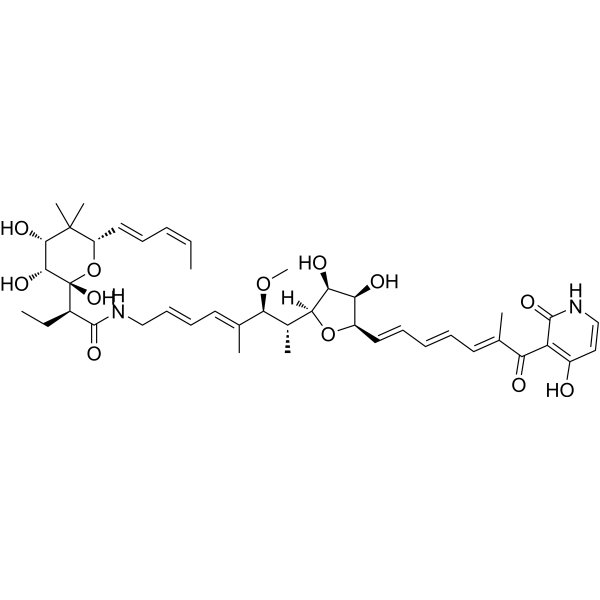
Kirromycin (Mocimycin; Delvomycin) is an elongation factor Tu (EF-Tu) inhibitor targeting protein biosynthesis. As an antibiotic, Kirromycin exerts antibacterial activity against Gram-negative bacteria by acting on EF-Tu to interfere with the peptidyl transfer reaction. Kirromycin is applicable to studies on bacterial infections.
For research use only. We do not sell to patients.
- CAS No.: 50935-71-2
- Formula: C43H60N2O12
- Molecular Weight:796.94
-
Storage:
Please store the product under the recommended conditions in the Certificate of Analysis.

To place orders, for customer services and technical support, please contact: MedChemExpress USA
Tel: 609-228-6898 E-mail: [email protected] [email protected]


-
 Biological Activity
-
Chemical Information
- Protocols
- Purity & Documentation
- References
-
 Help & FAQs


All Antibiotic Isoforms
More

Biological Activity
Description
In Vitro
Kirromycin (5 min) potently inhibits poly (U)-directed polyphenylalanine synthesis in an *E. coli* cell-free translation system, with an IC50 of 5 × 10⁻⁷ M[1].
Kirromycin (5 min) doubles the EF-T-dependent GTP hydrolysis activity, strongly inhibits EF-T-dependent peptide bond formation, and does not alter EF-T-mediated binding of Phe-tRNAPhe to ribosomes in the *Escherichia coli* ribosome assay system[1].
When incubated with EF-T and GTP for 5 min, kirromycin increases the binding amount of [3H]GTP to *Escherichia coli* EF-T to more than three times the original level[1].
Kirromycin (500 pmol; 10 min) induces Escherichia coli EF-T-dependent GTP hydrolysis in the absence of ribosomes or aminoacyl-tRNA; this activity is specifically activated only in the presence of Phe-tRNAPhe (but not uncharged tRNAPhe or Ac-Phe-tRNAPhe); it significantly enhances this activity in the presence of ribosomes; its GTP Km is 2 × 10⁻⁷ M, which is consistent with the GTP Km of ribosome- and Phe-tRNAPhe-dependent EF-T GTPase in the absence of antibiotics[1].
Kirromycin (1 nmol; 5 min) enables EF-T-dependent binding of Phe-tRNAPhe to poly (U)-ribosome complexes in *E. coli* in the absence of GTP, with the amount of [14C]Phe-tRNAPhe bound to ribosomes reaching 3.5 pmol[1].
At 4°C, kirromycin reduces the affinity of *E. coli* EF-Tu-GTP for aa-tRNA by approximately 3 orders of magnitude, resulting in a Kd of 2 μM; it also equalizes the affinity of *E. coli* EF-Tu-GDP for aa-tRNA to a Kd of 7 μM at 4°C, thereby eliminating the significant difference in affinity between EF-Tu-GTP and EF-Tu-GDP for aa-tRNA observed in the absence of this antibiotic[3].
Kirromycin (0.4-26 μM) binds to EF-Tu-GDP (as well as EF-Tu-GTP) from *E. coli* at a 1:1 molar ratio to form a complex, induces conformational changes that increase the net negative charge and electrophoretic mobility of EF-Tu, and exhibits an extremely low dissociation rate[3].
MedChemExpress (MCE) has not independently confirmed the accuracy of these methods. They are for reference only. Further protocols information, click here.


Chemical Information
-
CAS No. 50935-71-2
-
Molecular Weight 796.94
-
Formula C43H60N2O12
-
SMILES
O=C(NC/C=C/C=C(C)/[C@@H](OC)[C@H]([C@]([C@H]([C@H]1O)O)([H])O[C@@H]1/C=C/C=C/C=C(C)/C(C(C2=O)=C(C=CN2)O)=O)C)[C@H]([C@@](O[C@H](C(C)3C)/C=C/C=C\C)([C@@H]([C@@H]3O)O)O)CC
-
Synonyms
Mocimycin; Delvomycin
-
Structure Classification
-
Initial Source
Streptomyces collinus Tue 365
-
Shipping
Room temperature in continental US; may vary elsewhere.
-
Storage
Please store the product under the recommended conditions in the Certificate of Analysis.

Protocols
-
Research Protocol for Infectious Diseases
Infectious-disease experiments test how pathogens interact with host barriers, innate immune receptors, inflammatory signaling, pathogen replication, and tissue injury; pattern-recognition receptors such as TLRs, RIG-I-like receptors, NOD-like receptors, and inflammasomes detect microbial molecules and activate NF-κB, interferon, and cytokine responses. The central hypothesis is that infection severity reflects the balance between pathogen burden and host response: protective inflammation restricts pathogen growth, whereas excessive or mislocalized inflammation contributes to tissue damage and disease phenotype. Unresolved questions include which host pathways are protective versus pathogenic, why some infection models fail to translate to human disease, and which combined readouts best predict clinically relevant infection outcomes.
-
Gram Staining of Tissue Sections
Gram staining of tissue sections is a histochemical technique used to differentiate Gram-positive and Gram-negative bacteria within histological specimens based on differences in bacterial cell wall structure and dye retention, adapted from classical bacteriological Gram staining into tissue-compatible “histological Gram stain” variants. In tissue applications, modifications of the Brown-Hopps and Brown-Brenn methods are commonly used to improve differentiation of microorganisms embedded within host connective tissue and to reduce overstaining or loss of Gram-negative signal, which are known limitations of earlier approaches. The principle relies on crystal violet-iodine complex retention in Gram-positive organisms and subsequent decolorization and counterstaining steps that allow contrast visualization of Gram-negative organisms against tissue background.
-
Bacterial live/dead nucleic-acid viability staining
The LIVE/DEAD bacterial viability staining method is based on differential permeability of nucleic-acid-binding fluorescent dyes, most commonly SYTO 9 and propidium iodide (PI), which enables discrimination of bacterial populations with intact versus compromised cytoplasmic membranes. SYTO 9 penetrates both intact and damaged bacterial membranes and binds nucleic acids to produce green fluorescence, whereas propidium iodide penetrates only cells with compromised membranes and fluoresces red while also reducing SYTO 9 signal through competitive binding and fluorescence interactions. The resulting fluorescence pattern is interpreted as a proxy for membrane integrity, which is widely used as an indicator of bacterial viability in microscopy, flow cytometry, and spectroscopic platforms. However, mechanistic studies show that SYTO 9 and PI interactions involve displacement and fluorescence resonance energy transfer effects, which can influence signal interpretation depending on dye ratios a


Purity & Documentation
References
[1]. Wolf H, et al. Kirromycin, an inhibitor of protein biosynthesis that acts on elongation factor Tu. Proc Natl Acad Sci U S A. 1974;71(12):4910-4914. [Content Brief]
[2]. Olsthoorn-Tieleman LN, et al. Elongation factor Tu3 (EF-Tu3) from the kirromycin producer Streptomyces ramocissimus Is resistant to three classes of EF-Tu-specific inhibitors. J Bacteriol. 2007;189(9):3581-3590. [Content Brief]
[3]. Abrahams JP, et al. Kirromycin drastically reduces the affinity of Escherichia coli elongation factor Tu for aminoacyl-tRNA. Biochemistry. 1991;30(27):6705-6710. [Content Brief]

Calculators
Concentration (start) × Volume (start) = Concentration (final) × Volume (final)


Kirromycin Related Classifications
HY-122386 Related Classifications
 Powered by Bioz