



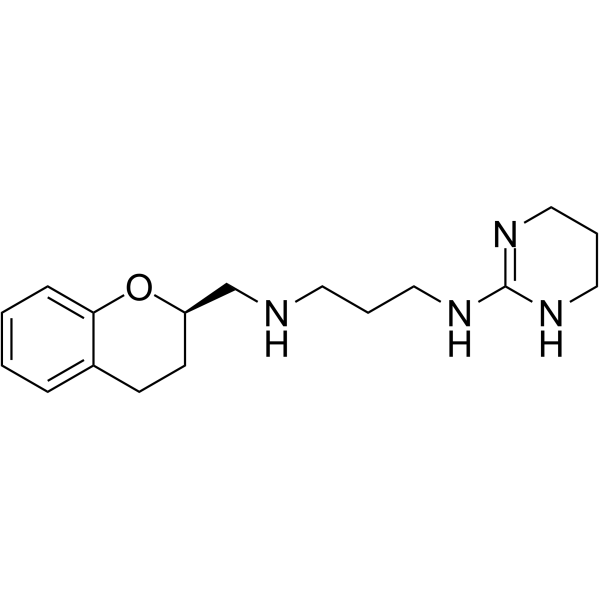
Alniditan
Alniditan (Alnitidan) is a potent 5-HT1B and 5-HT1D receptors agonist, with IC50s of 1.7 nM and 1.3 nM for h5-HT1B and h5-HT1D receptors in HEK293 cells, respectively. Alniditan has migraine-preventive effects.
Para uso exclusivo en investigación. No vendemos a pacientes.
- No. CAS: 152317-89-0
- Fòrmula: C17H26N4O
- Peso molecular:302.41
-
Almacenamiento:
Please store the product under the recommended conditions in the Certificate of Analysis.

To place orders, for customer services and technical support, please contact: MedChemExpress USA
Tel: 609-228-6898 E-mail: [email protected] [email protected]


-
 Actividad biológica
-
Chemical Information
- Pureza y Documentación
- Referencias
-
 Help & FAQs


Ver todos los productos específicos de isoformas 5-HT Receptor
More

Actividad biológica
Descripciòn
IC50 & Target
[2]|
human 5-HT1B Receptor 1.7 nM (IC50, in HEK 293 cell) |
human 5-HT1D Receptor 1.3 nM (IC50, in HEK 293 cell) |
5-HT1B Receptor 0.9 nM (Kd) |
5-HT1D Receptor 1.2 nM (Kd) |
In Vitro
In vitro, Alniditan exhibits little vasoconstrictive effects on the rat basilar artery, although at a very high concentration 1 mM, Alniditan causes intensive constriction, most likely through a mechanism independent from 5-HT receptor activation[1].
MedChemExpress (MCE) has not independently confirmed the accuracy of these methods. They are for reference only. .
In Vivo
MedChemExpress (MCE) has not independently confirmed the accuracy of these methods. They are for reference only.


Chemical Information
-
No. CAS 152317-89-0
-
Peso molecular 302.41
-
Fòrmula C17H26N4O
-
SMILES
C1(NCCCNC[C@H]2CCC3=CC=CC=C3O2)=NCCCN1
-
Synonyms
Alnitidan
-
Envío
Room temperature in continental US; may vary elsewhere.
-
Almacenamiento
Please store the product under the recommended conditions in the Certificate of Analysis.


Pureza y Documentación
Referencias
[1]. Limmroth V, et al. Effects of alniditan on neurogenic oedema in the rat dura mater and on contraction of rat basilar artery. Eur J Pharmacol. 1999 Oct 8;382(2):103-9. [Content Brief]
[2]. Lesage AS, et al. Agonistic properties of alniditan, sumatriptan and dihydroergotamine on human 5-HT1B and 5-HT1D receptors expressed in various mammalian cell lines. Br J Pharmacol. 1998 Apr;123(8):1655-65. [Content Brief]

Calculators
Concentration (start) × Volume (start) = Concentration (final) × Volume (final)


Alniditan Related Classifications
HY-101698 Related Classifications
 Powered by Bioz