



Amylose

Based on 1 Customer Validation
Amylose is not a typical small-molecule ligand with a specific traditional receptor-binding target. It is a polysaccharide. In food science and biological systems, amylose can interact with proteins and free fatty acids through non-covalent forces like hydrophobic interactions and electrostatic interactions. For example, it can form a ternary complex with them, which is related to the structure and digestion of starch. It is widely studied in the fields of food science, carbohydrate metabolism, and is also relevant in research on controlling glycemic responses, as it affects starch digestion rate.
Para uso exclusivo en investigación. No vendemos a pacientes.
- No. CAS: 9005-82-7
-
Almacenamiento:Powder -20°C, 3 years ; In solvent -80°C, 6 months , -20°C, 1 month


To place orders, for customer services and technical support, please contact: MedChemExpress USA
Tel: 609-228-6898 E-mail: [email protected] [email protected]


-
 Actividad biológica
-
Chemical Information
-
Solvente y solubilidad
- Pureza y Documentación
- Referencias
-
 Help & FAQs


-
HY-W145520
AmylopectinBranched Glucan Ppolymer -
HY-B2225A
Starch (from potato)Starch -

HY-N7075
InulinEndogenous Metabolite -
HY-B2225B
Starch (from corn)Biochemical Assay Reagent -

HY-N6664
Gum arabicComplex Branched Polysaccharide -
HY-139413
β-D-GlucanNon-digestible Polysaccharide -

HY-107846
XylanActive Compound -
HY-W145481
D-Galacto-D-mannan, 95%Biochemical Assay Reagent -

HY-W145481A
D-Galacto-D-mannanDectin-2 Agonist -
HY-W250120
Konjac glucomannan (Viscosity≥15000mPa.s)Biochemical Assay Reagents -

HY-W350004
(+)-Arabinogalactan,from larch wood, 80%Sugar -
HY-113870
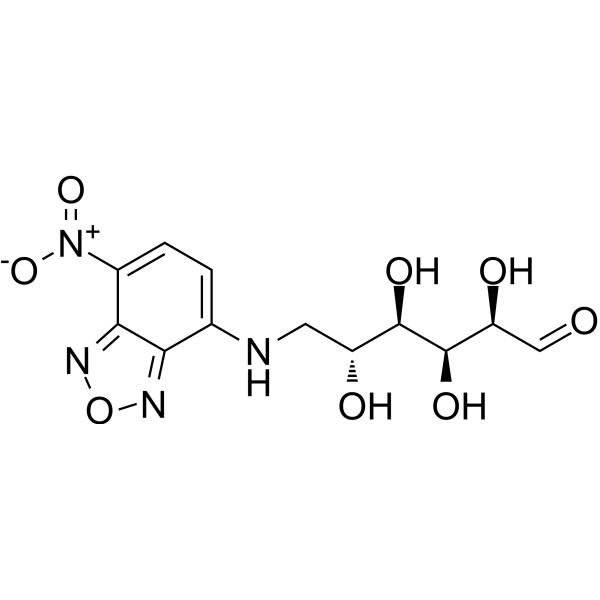
6-NBDGFluorescent Dye
Ver todos los productos específicos de isoformas Endogenous Metabolite
More

Actividad biológica
Descripciòn
IC50 & Target
|
Human Endogenous Metabolite |
In Vitro
Amylose (1.0 mg/mL; heated in a boiling water bath for 20 minutes and then slowly cooled overnight) was self-assembled with whey protein isolate (50 mg/mL) and free fatty acids (250 mg/mL) to form a water-soluble ternary nanocomposite (Mw=6-7×10⁶) with a gyration radius of 20-100 nm[1].
MedChemExpress (MCE) has not independently confirmed the accuracy of these methods. They are for reference only.
Ensayo clínico
| NCT Number | Sponsor | Condition | Start Date |
Phase

|
|---|---|---|---|---|
| NCT01329991 | Plexxikon| | 2011-05 | PHASE1 |


Chemical Information
-
No. CAS 9005-82-7
-
Appearance Solid
-
Color White to off-white
-
SMILES
[Amylose]
-
Structure Classification
-
Initial Source
-
Envío
Room temperature in continental US; may vary elsewhere.
-
Almacenamiento
Powder -20°C 3 years In solvent -80°C 6 months -20°C 1 month


Solvente y solubilidad
In Vitro:
H2O : 1 mg/mL (ultrasonic and warming and heat to 60°C)


Pureza y Documentación
-
Ficha de datos (269 KB)
-
SDS (393 KB)
- English - EN (393 KB)
- Français - FR (393 KB)
- Deutsch - DE (393 KB)
- Norwegian - NO (393 KB)
- Español - ES (393 KB)
- Swedish - SV (393 KB)
- Italian - IT (393 KB)
- Korean - KR (393 KB)
- Portuguese - PT (393 KB)
-
Instrucciones de manejo (2659 KB)
Referencias

Calculators
Concentration (start) × Volume (start) = Concentration (final) × Volume (final)


Amylose Related Classifications
HY-W145665 Related Classifications
 Powered by Bioz