



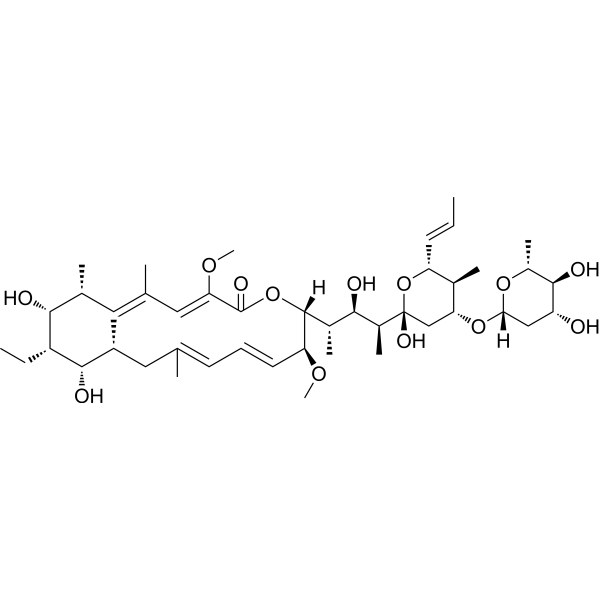
Concanamycin C

Based on 1 Customer Validation
Concanamycin C is a macrolide antibiotic with inhibitory activity against certain fungi and yeasts, but no activity against bacteria. Concanamycin C inhibits the proliferation of mouse splenic lymphocytes. Concanamycin C exhibits acute toxicity in ddY mice. Concanamycin C can be used in studies related to fungal infections and yeast infections.
Para uso exclusivo en investigación. No vendemos a pacientes.
- Pureza : 99.9%
- No. CAS: 81552-34-3
- Fòrmula: C45H74O13
- Peso molecular:823.06
-
Almacenamiento:Powder -20°C, 3 years ; In solvent -80°C, 6 months , -20°C, 1 month

To place orders, for customer services and technical support, please contact: MedChemExpress USA
Tel: 609-228-6898 E-mail: [email protected] [email protected]


-
 Actividad biológica
-
Chemical Information
- Protocolo
- Pureza y Documentación
- Referencias
-
 Help & FAQs


Ver todos los productos específicos de isoformas Antibiotic
More

Actividad biológica
Descripciòn
In Vitro
Concanamycin C exhibits in vitro inhibitory activity against specific fungi and yeasts, including Saccharomyces cerevisiae, S. sake, Alternaria citri, Penicillium citrinum, and Pirricularia oryzae, but has no activity against tested bacteria and other fungi/yeasts[1].
MedChemExpress (MCE) has not independently confirmed the accuracy of these methods. They are for reference only. Further protocols information, click here.
In Vivo
MedChemExpress (MCE) has not independently confirmed the accuracy of these methods. They are for reference only.
-
Animal Model:ddY mice[1]
-
Dosage:0.1 mg/kg; 1.0 mg/kg
-
Administration:i.p.; single dose
-
Result:Resulted in 100% survival in ddY mice.
Resulted in 100% mortality in ddY mice.


Chemical Information
-
No. CAS 81552-34-3
-
Appearance Solid
-
Peso molecular 823.06
-
Fòrmula C45H74O13
-
Color White to off-white
-
SMILES
C[C@H](C/C(C)=C\C=C\[C@H](OC)[C@]([C@@H](C)[C@@H](O)[C@H](C)[C@@]1(O)C[C@@H](O[C@@]2([H])C[C@@H](O)[C@H](O)[C@@H](C)O2)[C@H](C)[C@@H](/C=C/C)O1)([H])O3)[C@H](O)[C@H](CC)[C@H](O)[C@H](C)/C=C(C)/C=C(OC)/C3=O
-
Structure Classification
-
Initial Source
Streptomyces diastatochromogenes S-45
-
Envío
Room temperature in continental US; may vary elsewhere.
-
Almacenamiento
Powder -20°C 3 years In solvent -80°C 6 months -20°C 1 month

Protocolo
-
Acute Systemic Toxicity Study
Acute systemic toxicity studies evaluate adverse effects occurring after a single exposure, or repeated exposure within a short acute window, and the main in vivo readouts are mortality, moribund condition, clinical signs, body-weight change, and gross pathological findings; acute oral toxicity methods were developed to replace classical LD50 testing with reduced-animal designs such as fixed-dose procedure, acute toxic class method, and up-and-down procedure. The fixed-dose procedure classifies acute toxicity by administering predefined dose levels and observing evident toxicity rather than using death as the primary endpoint, whereas the acute toxic class method uses sequential groups of three animals per step and the up-and-down procedure doses animals sequentially to estimate an LD50 with fewer animals than conventional LD50 testing.
-
Cell Viability Determination by MTT Colorimetric Assay
The following protocol uses the MTT colorimetric assay as a classic literature-established method for assessing cell viability/metabolic activity in cultured mammalian cells. MTT[3-(4,5-dimethylthiazol-2-yl)-2,5-diphenyltetrazolium bromide] is reduced by metabolically active cells to a colored formazan product; the amount of formazan is quantified spectrophotometrically and provides an indirect measure of metabolically active viable cells. Importantly, MTT reduction reflects cellular oxidoreductase/metabolic activity rather than an absolute direct count of living cells, so changes in cellular metabolism can alter the signal independently of cell number.


Pureza y Documentación
-
Ficha de datos (267 KB)
-
SDS (481 KB)
- English - EN (481 KB)
- Français - FR (481 KB)
- Deutsch - DE (481 KB)
- Norwegian - NO (481 KB)
- Español - ES (481 KB)
- Swedish - SV (481 KB)
- Italian - IT (481 KB)
- Korean - KR (481 KB)
- Portuguese - PT (481 KB)
-
Instrucciones de manejo (2659 KB)
Referencias

Calculators
Concentration (start) × Volume (start) = Concentration (final) × Volume (final)


Concanamycin C Related Classifications
HY-126813 Related Classifications
 Powered by Bioz