



Dermorphin TFA
Based on 1 publication(s) in Google Scholar
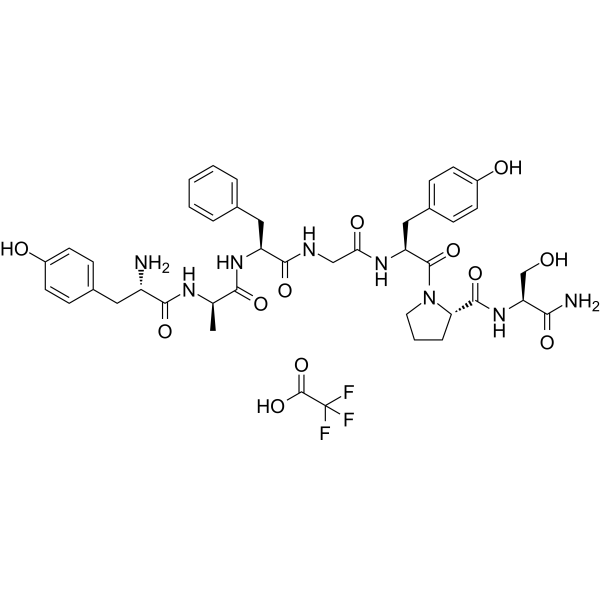
Dermorphin TFA is a natural heptapeptide μ-opioid receptor (MOR) agonist found in amphibian skin. Inhibition of neuropathic pain.
Para uso exclusivo en investigación. No vendemos a pacientes.
- No. CAS: 78331-26-7
- Fòrmula: C42H51F3N8O12
- Peso molecular:916.90
-
Almacenamiento:
Please store the product under the recommended conditions in the Certificate of Analysis.

To place orders, for customer services and technical support, please contact: MedChemExpress USA
Tel: 609-228-6898 E-mail: [email protected] [email protected]


-
 Actividad biológica
-
Chemical Information
-
Solvente y solubilidad
- Pureza y Documentación
- Referencias
-
 Help & FAQs


Publications Citing Use of MedChemExpress (MCE) Dermorphin TFA
MoreVer todos los productos específicos de isoformas Opioid Receptor
More

Actividad biológica
Descripciòn
IC50 & Target
|
μ Opioid Receptor/MOR |
In Vitro
Dermorphin, a peptide isolated from the skin of Phyllomedusa frogs and the peptide receptor (NOP) component by the endogenous agonist nociceptin/orphanin FQ (N/OFQ). In displacement binding studies at CHOhMu, Dermorphin and DeNo displac the binding of [3H]-DPN in a concentration dependent and saturable manner. Dermorphin displays an affinity of 7.17, while N/OFQ fails to displace [3H]-DPN at the Delta receptor. Dermorphin and DeNo stimulate the binding of GTPγ[35S] in a concentration dependent and saturable manner at the Mu receptor[2].
MedChemExpress (MCE) has not independently confirmed the accuracy of these methods. They are for reference only.


Chemical Information
-
No. CAS 78331-26-7
-
Peso molecular 916.90
-
Fòrmula C42H51F3N8O12
-
Structure Classification
-
Initial Source
the skin of an Amazonian frog
-
Envío
Room temperature in continental US; may vary elsewhere.
-
Almacenamiento
Please store the product under the recommended conditions in the Certificate of Analysis.


Publications (1)
-
Journal Impact Factor
-
Most Recent


Solvente y solubilidad
In Vitro
H2O
Peptide Solubility and Storage Guidelines:
1. Calculate the length of the peptide.
2. Calculate the overall charge of the entire peptide according to the following table:
| Contents | Assign value | |
|---|---|---|
| Acidic amino acid | Asp (D), Glu (E), and the C-terminal -COOH. | -1 |
| Basic amino acid | Arg (R), Lys (K), His (H), and the N-terminal -NH2 | +1 |
| Neutral amino acid | Gly (G), Ala (A), Leu (L), Ile (I), Val (V), Cys (C), Met (M), Thr (T), Ser (S), Phe (F), Tyr (Y), Trp (W), Pro (P), Asn (N), Gln (Q) | 0 |
3. Recommended solution:
| Overall charge of peptide | Details |
|---|---|
| Negative (<0) |
1. Try to dissolve the peptide in water first. 2. If water fails, add NH4OH (<50 μL). 3. If the peptide still does not dissolve, add DMSO (50-100 μL) to solubilize the peptide. |
| Positive (>0) |
1. Try to dissolve the peptide in water first. 2. If water fails, try dissolving the peptide in a 10%-30% acetic acid solution. 3. If the peptide still does not dissolve, try dissolving the peptide in a small amount of DMSO. |
| Zero (=0) |
1. Try to dissolve the peptide in organic solvent (acetonitrile, methanol, etc.) first. 2. For very hydrophobic peptides, try dissolving the peptide in a small amount of DMSO, and then dilute the solution with water to the desired concentration. |


Pureza y Documentación
Referencias
[1]. Tiwari V, et al. Activation of Peripheral μ-opioid Receptors by Dermorphin [D-Arg2, Lys4] (1-4) Amide Leads to Modality-preferred Inhibition of Neuropathic Pain. Anesthesiology. 2016 Mar;124(3):706-20. [Content Brief]
[2]. Bird MF, et al. Characterisation of the Novel Mixed Mu-NOP Peptide Ligand Dermorphin-N/OFQ (DeNo). PLoS One. 2016 Jun 7;11(6):e0156897. [Content Brief]

Calculators
Concentration (start) × Volume (start) = Concentration (final) × Volume (final)


Dermorphin TFA Related Classifications
HY-P0244A Related Classifications
 Powered by Bioz