



Lonigutamab

Based on 1 Customer Validation
Lonigutamab (hz208F2-4) is a humanized anti-IGF-1R monoclonal antibody, serveing as a targeting vector for antibody-drug conjugates (ADCs). Lonigutamab causes G2-M phase cell cycle arrest and increases apoptosis in IGF-1R-overexpressing tumor cells. Lonigutamab demonstrates potent antitumor efficacy in IGF-1R-overexpressing xenograft models. Lonigutamab can be used for the study of Solid tumors with overexpression of IGF-1R and thyroid eye diseases.
Para uso exclusivo en investigación. No vendemos a pacientes.
- Pureza : 98.90%
- No. CAS: 2362015-67-4
- Peso molecular:145.12 kDa
-
Almacenamiento:
Please store the product under the recommended conditions in the Certificate of Analysis.


To place orders, for customer services and technical support, please contact: MedChemExpress USA
Tel: 609-228-6898 E-mail: [email protected] [email protected]


-
 Actividad biológica
-
Chemical Information
- Protocolo
- Pureza y Documentación
- Referencias
-
 Help & FAQs





Actividad biológica
Descripciòn
Isotype
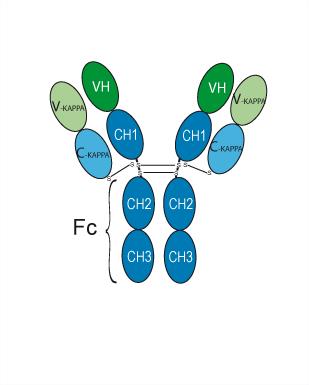
Human IgG1 kappa
Recommend Isotype Controls
Species Reactivity
Human
IC50 & Target
IGF1R/CD221
In Vitro
Lonigutamab (0-10 μg/mL, 6 d) induces nearly 100% cell death in IGF-1R-highly expressing MCF-7 (IC50 = 5.1×10⁻¹¹ mol/L) and NCI-H2122 (IC50 = 6.25×10⁻¹⁰ mol/L) cells[1].
Lonigutamab (10 μg/mL, 10-120 min) exhibits rapid internalization in MCF-7 cellsand colocalizes with lysosomes[1].
Lonigutamab (10 μg/mL, 72 h) causes massive M-phase cell cycle arrest in MCF-7 cells and significantly increases the proportion of apoptotic and late necrotic cells[1].
MedChemExpress (MCE) has not independently confirmed the accuracy of these methods. They are for reference only.
In Vivo
MedChemExpress (MCE) has not independently confirmed the accuracy of these methods. They are for reference only.
-
Animal Model:MCF-7, CaoV3, SBC5, NCI-H2122 and Hs746t cells were subcutaneously implanted into the flanks of 7-week-old female Swiss nude mice[1]
-
Dosage:3 mg/kg
-
Administration:i.v., once for four days, 4 cycles
-
Result:Achieved tumor growth inhibition.
Showed no significant changes in body weight.
- Annexin V plus membrane-impermeant dye apoptosis staining
- BrdU Incorporation Assay
- Protocol for Cell Cycle
- Detection of Apoptosis
- TUNEL staining for apoptotic DNA fragmentation
- Flow cytometric DNA-content cell-cycle staining
- Research Protocol for Endocrine Diseases
- Patient-Derived Xenograft (PDX)
- Apoptosis Solutions
- Splenic/Portal-Vein Liver Metastasis Xenograft
- Subcutaneous Cell-Line-Derived Xenograft
- Orthotopic Cell-Line Xenograft
- Intraperitoneal/Peritoneal Dissemination Xenograft
Ensayo clínico
| NCT Number | Sponsor | Condition | Start Date |
Phase

|
|---|---|---|---|---|
| NCT01329991 | Plexxikon| | 2011-05 | PHASE1 |
Gene ID
Accession
Conjugated
Unconjugated
Reconsititution
The product can be reconstituted/diluted with sterile PBS or saline.
Format
-
Human IgG1 kappa
Aplicación
ELISA, FACS, Functional assay
Verified Bioactivity
-
 Flow cytometric analysis of 1X10⁶ MCF-7 cells with Lonigutamab (HY-P99712, red). Cells were fixed with 4% paraformaldehyde. Then stained with the primary antibody at 1/200 dilution for an hour at 4℃. Alexa Fluor 488-conjugated AffiniPure Goat Anti-Human IgG H&L (AF488) (HY-P83776) was used as the secondary antibody at 1/1,000 dilution for 30 minutes at 4℃. Human IgG1 kappa (HY-P99001, blue) was used as the isotype control.


Chemical Information
-
No. CAS 2362015-67-4
-
Appearance Liquid
-
Peso molecular 145.12 kDa
-
Color Colorless to light yellow
-
SMILES
[Lonigutamab]
-
Synonyms
hz208F2-4
-
Envío
Shipping with dry ice.
-
Formulation
Please refer to the lot-specific COA for specific buffer information.
-
Almacenamiento
Please store the product under the recommended conditions in the Certificate of Analysis.


Pureza y Documentación
-
Ficha de datos (261 KB)
-
SDS (251 KB)
- English - EN (251 KB)
- Français - FR (251 KB)
- Deutsch - DE (251 KB)
- Norwegian - NO (251 KB)
- Español - ES (251 KB)
- Swedish - SV (251 KB)
- Italian - IT (251 KB)
- Korean - KR (251 KB)
- Portuguese - PT (251 KB)
-
Inhibitory Antibodies User Guide (603 KB)
Referencias
[1]. Akla B, et al. Efficacy of the Antibody-Drug Conjugate W0101 in Preclinical Models of IGF-1 Receptor Overexpressing Solid Tumors. Mol Cancer Ther. 2020 Jan;19(1):168-177. [Content Brief]
[2]. Pimenta EM, et al. Epigenetic dysregulation of metabolic programs mediates liposarcoma cell plasticity. bioRxiv [Preprint]. 2025 Jan 24:2025.01.20.633920. [Content Brief]

Calculators
Concentration (start) × Volume (start) = Concentration (final) × Volume (final)


Lonigutamab Related Classifications
HY-P99712 Related Classifications
 Powered by Bioz