



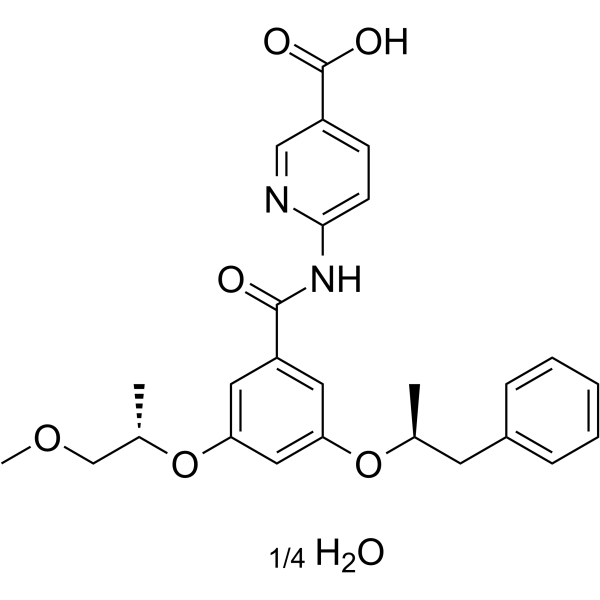
GKA50 quarterhydrate
GKA50 quarterhydrate is a potent glucokinase activator (EC50=33 nM at 5 mM glucose) and stimulates insulin release from mouse islets of Langerhans. GKA50 quarterhydrate is a glucose-like activator of beta-cell metabolism in rodent and human islets and a Ca2+-dependent modulator of insulin secretion. GKA50 quarterhydrate shows significant glucose lowering in high fat fed female rats.
For research use only. We do not sell to patients.
- Formula: C26H28N2O6.1/4H2O
- Molecular Weight:469.01
-
Storage:Powder -20°C, 3 years ; In solvent -80°C, 6 months , -20°C, 1 month

To place orders, for customer services and technical support, please contact: MedChemExpress USA
Tel: 609-228-6898 E-mail: [email protected] [email protected]


-
 Biological Activity
-
Chemical Information
-
Solvent & Solubility
- Protocols
- Purity & Documentation
- References
-
 Help & FAQs




Biological Activity
Description
In Vitro
GKA50 (0.01-100 μM; 24 hours) enhances INS-1 cell proliferation with EC50 values ranging from 1 to 2 μM[2].
GKA50 (1.2 μM+40 μM glucose; 2-4 days) treatment reduces apoptosis induced by chronic high glucose in INS-1 cells[2].
GKA50 activates human glucokinase enzymatic activity with an EC50 of 0.022 μM. GKA50 stimulates insulin secretion in the pancreatic insulinoma cell line, INS-1, with an EC50 of 0.065 μM. GKA50 reduces chronic-high-glucose-induced apoptosis via modulation of glucokinase and apoptotic protein BAD[2].
MedChemExpress (MCE) has not independently confirmed the accuracy of these methods. They are for reference only.
-
Cell Line:INS-1 cells (starved overnight with 3 μM glucose)
-
Concentration:0.01-100 μM
-
Incubation Time:24 hours
-
Result:Stimulated cell proliferation in a dose-dependent manner, with EC50 values ranging from 1 to 2 μM.
In Vivo
MedChemExpress (MCE) has not independently confirmed the accuracy of these methods. They are for reference only.
-
Animal Model:High-fat-fed obese female Zucker (fa/fa) rats[1]
-
Dosage:1, 3, 10, 30 mg/kg
-
Administration:Oral administration
-
Result:Significant percentage glucose lowering.


Chemical Information
-
Appearance Solid
-
Molecular Weight 469.01
-
Formula C26H28N2O6.1/4H2O
-
Color White to off-white
-
SMILES
O=C(C1=CC=C(NC(C2=CC(O[C@@H](C)CC3=CC=CC=C3)=CC(O[C@@H](C)COC)=C2)=O)N=C1)O.[1/4].O
-
Shipping
Room temperature in continental US; may vary elsewhere.
-
Storage
Powder -20°C 3 years In solvent -80°C 6 months -20°C 1 month


Solvent & Solubility
In Vitro:
DMSO : 46 mg/mL (98.08 mM; Need ultrasonic and warming; Hygroscopic DMSO has a significant impact on the solubility of product, please use newly opened DMSO)
Please refer to the solubility information to select the appropriate solvent. Once prepared, please aliquot and store the solution to prevent product inactivation from repeated freeze-thaw cycles.
Storage method and period of stock solution: -80°C, 6 months; -20°C, 1 month. When stored at -80°C, please use it within 6 months. When stored at -20°C, please use it within 1 month.
Please refer to the solubility information to select the appropriate solvent. Once prepared, please aliquot and store the solution to prevent product inactivation from repeated freeze-thaw cycles.
Storage method and period of stock solution: -80°C, 6 months; -20°C, 1 month. When stored at -80°C, please use it within 6 months. When stored at -20°C, please use it within 1 month.
Concentration (start) × Volume (start) = Concentration (final) × Volume (final)


Purity & Documentation
-
Data Sheet (277 KB)
-
SDS (251 KB)
- English - EN (251 KB)
- Français - FR (251 KB)
- Deutsch - DE (251 KB)
- Norwegian - NO (251 KB)
- Español - ES (251 KB)
- Swedish - SV (251 KB)
- Italian - IT (251 KB)
- Korean - KR (251 KB)
- Portuguese - PT (251 KB)
-
Handling Instructions (2659 KB)
References
[1]. Coope GJ, et al. Predictive blood glucose lowering efficacy by Glucokinase activators in high fat fed female Zucker rats. Br J Pharmacol. 2006 Oct;149(3):328-35. [Content Brief]
[2]. McGlasson L, et al. The glucokinase activator GKA50 causes an increase in cell volume and activation of volume-regulated anion channels in rat pancreatic β-cells. Mol Cell Endocrinol. 2011 Aug 6;342(1-2):48-53. [Content Brief]
[3]. Johnson D, et al. Glucokinase activators: molecular tools for studying the physiology of insulin-secreting cells. Biochem Soc Trans. 2007;35(Pt 5):1208-1210. [Content Brief]
[4]. Johnson D, et al. Glucose-dependent modulation of insulin secretion and intracellular calcium ions by GKA50, a glucokinase activator. Diabetes. 2007;56(6):1694-1702. [Content Brief]


Complete Stock Solution Preparation Table
Please refer to the solubility information to select the appropriate solvent. Once prepared, please aliquot and store the solution to prevent product inactivation from repeated freeze-thaw cycles.
Storage method and period of stock solution: -80°C, 6 months; -20°C, 1 month. When stored at -80°C, please use it within 6 months. When stored at -20°C, please use it within 1 month.
| Optional Solvent | Concentration Solvent Mass | 1 mg | 5 mg | 10 mg | 25 mg |
|---|---|---|---|---|---|
| DMSO | 1 mM | 2.1322 mL | 10.6608 mL | 21.3215 mL | 53.3038 mL |
| 5 mM | 0.4264 mL | 2.1322 mL | 4.2643 mL | 10.6608 mL | |
| 10 mM | 0.2132 mL | 1.0661 mL | 2.1322 mL | 5.3304 mL | |
| 15 mM | 0.1421 mL | 0.7107 mL | 1.4214 mL | 3.5536 mL | |
| 20 mM | 0.1066 mL | 0.5330 mL | 1.0661 mL | 2.6652 mL | |
| 25 mM | 0.0853 mL | 0.4264 mL | 0.8529 mL | 2.1322 mL | |
| 30 mM | 0.0711 mL | 0.3554 mL | 0.7107 mL | 1.7768 mL | |
| 40 mM | 0.0533 mL | 0.2665 mL | 0.5330 mL | 1.3326 mL | |
| 50 mM | 0.0426 mL | 0.2132 mL | 0.4264 mL | 1.0661 mL | |
| 60 mM | 0.0355 mL | 0.1777 mL | 0.3554 mL | 0.8884 mL | |
| 80 mM | 0.0267 mL | 0.1333 mL | 0.2665 mL | 0.6663 mL |


GKA50 quarterhydrate Related Classifications
HY-15671A Related Classifications
 Powered by Bioz