



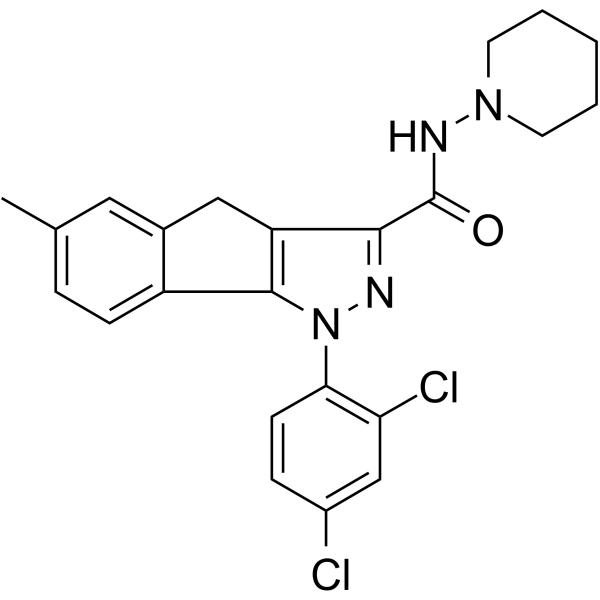
GP1a
Based on 1 publication(s) in Google Scholar
GP1a is a potent agonist of cannabinoid receptor 2 (CB2). Gp1a is beneficial to skin wound healing. GP1a inhibits inflammation and fibrogenesis while promoting re-epithelialization.
Nur für Forschungszwecke. Wir verkaufen nicht an Patienten.
- Reinheit : 99.69%
- CAS. Nr.: 511532-96-0
- Formel: C23H22Cl2N4O
- Molecular Weight:441.35
-
Speicherung:
4°C, protect from light
* In solvent : -80°C, 6 months; -20°C, 1 month (protect from light)

To place orders, for customer services and technical support, please contact: MedChemExpress USA
Tel: 609-228-6898 E-mail: [email protected] [email protected]


-
 Biologische Aktivität
-
Chemical Information
-
Lösungsmittel & Löslichkeit
- Protokoll
- Reinheit & Dokumentation
- Verweise
-
 Help & FAQs


Publications Citing Use of MedChemExpress (MCE) GP1a
More

Biologische Aktivität
Beschreibung


Chemical Information
-
CAS. Nr. 511532-96-0
-
Appearance Solid
-
Molecular Weight 441.35
-
Formel C23H22Cl2N4O
-
Color White to off-white
-
SMILES
O=C(C1=NN(C2=C(C=C(Cl)C=C2)Cl)C3=C1CC4=CC(C)=CC=C34)NN5CCCCC5
-
Versand
Room temperature in continental US; may vary elsewhere.
-
Speicherung
4°C, protect from light
* In solvent : -80°C, 6 months; -20°C, 1 month (protect from light)


Publications (1)
-
Journal Impact Factor
-
Most Recent


Lösungsmittel & Löslichkeit
In Vitro:
DMSO : 125 mg/mL (283.22 mM; Need ultrasonic; Hygroscopic DMSO has a significant impact on the solubility of product, please use newly opened DMSO)
Please refer to the solubility information to select the appropriate solvent. Once prepared, please aliquot and store the solution to prevent product inactivation from repeated freeze-thaw cycles.
Storage method and period of stock solution: -80°C, 6 months; -20°C, 1 month (protect from light). When stored at -80°C, please use it within 6 months. When stored at -20°C, please use it within 1 month.
Please refer to the solubility information to select the appropriate solvent. Once prepared, please aliquot and store the solution to prevent product inactivation from repeated freeze-thaw cycles.
Storage method and period of stock solution: -80°C, 6 months; -20°C, 1 month (protect from light). When stored at -80°C, please use it within 6 months. When stored at -20°C, please use it within 1 month.
Konzentration (Stammlösung) × Volumen (Stammlösung) = Konzentration (Ziellösung) × Volumen (Ziellösung)


Reinheit & Dokumentation
-
Data Sheet (270 KB)
-
SDS (251 KB)
- English - EN (251 KB)
- Français - FR (251 KB)
- Deutsch - DE (251 KB)
- Norwegian - NO (251 KB)
- Español - ES (251 KB)
- Swedish - SV (251 KB)
- Italian - IT (251 KB)
- Korean - KR (251 KB)
- Portuguese - PT (251 KB)
-
Handling Instructions (2659 KB)
Verweise


Complete Stock Solution Preparation Table
Please refer to the solubility information to select the appropriate solvent. Once prepared, please aliquot and store the solution to prevent product inactivation from repeated freeze-thaw cycles.
Storage method and period of stock solution: -80°C, 6 months; -20°C, 1 month (protect from light). When stored at -80°C, please use it within 6 months. When stored at -20°C, please use it within 1 month.
| Optional Solvent | Concentration Solvent Mass | 1 mg | 5 mg | 10 mg | 25 mg |
|---|---|---|---|---|---|
| DMSO | 1 mM | 2.2658 mL | 11.3289 mL | 22.6578 mL | 56.6444 mL |
| 5 mM | 0.4532 mL | 2.2658 mL | 4.5316 mL | 11.3289 mL | |
| 10 mM | 0.2266 mL | 1.1329 mL | 2.2658 mL | 5.6644 mL | |
| 15 mM | 0.1511 mL | 0.7553 mL | 1.5105 mL | 3.7763 mL | |
| 20 mM | 0.1133 mL | 0.5664 mL | 1.1329 mL | 2.8322 mL | |
| 25 mM | 0.0906 mL | 0.4532 mL | 0.9063 mL | 2.2658 mL | |
| 30 mM | 0.0755 mL | 0.3776 mL | 0.7553 mL | 1.8881 mL | |
| 40 mM | 0.0566 mL | 0.2832 mL | 0.5664 mL | 1.4161 mL | |
| 50 mM | 0.0453 mL | 0.2266 mL | 0.4532 mL | 1.1329 mL | |
| 60 mM | 0.0378 mL | 0.1888 mL | 0.3776 mL | 0.9441 mL | |
| 80 mM | 0.0283 mL | 0.1416 mL | 0.2832 mL | 0.7081 mL | |
| 100 mM | 0.0227 mL | 0.1133 mL | 0.2266 mL | 0.5664 mL |


GP1a Related Classifications
HY-110050 Related Classifications
 Powered by Bioz