



GPR81 agonist 2
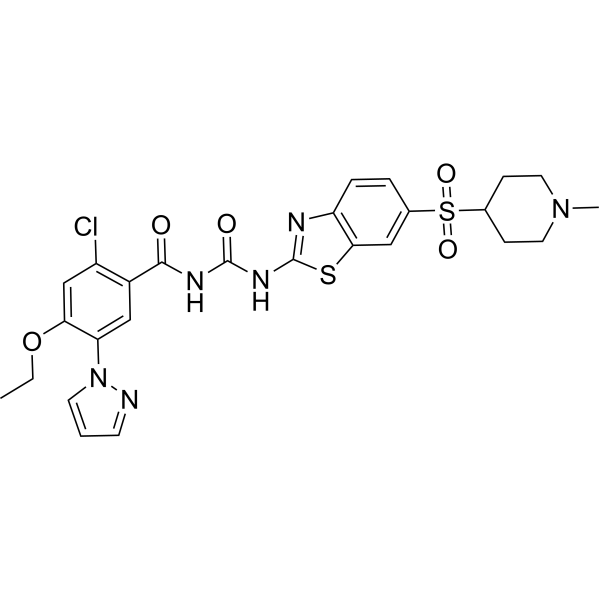
GPR81 agonist 2 is a GPR81 agonist with an EC50 of 0.023 μM for the human receptor. GPR81 agonist 2 activates the lactate-sensing receptor GPR81, inhibits forskolin-stimulated cAMP production and GTP binding of Gi protein. GPR81 agonist 2 can be used for research on type 2 diabetes.
For research use only. We do not sell to patients.
- CAS No.: 1143024-28-5
- Formula: C26H27ClN6O5S2
- Molecular Weight:603.11
-
Storage:
Please store the product under the recommended conditions in the Certificate of Analysis.

To place orders, for customer services and technical support, please contact: MedChemExpress USA
Tel: 609-228-6898 E-mail: [email protected] [email protected]


-
 Biological Activity
-
Chemical Information
- Protocols
- Purity & Documentation
- References
-
 Help & FAQs




Biological Activity
Description
IC50 & Target
[1]|
GPR81 0.023 μM (EC50) |
Cellular Effect
|
Cell Line

|
Type | Value | Description | References |
|---|---|---|---|---|
| CHO | EC50 |
0.023 μM
|
Agonist activity against human GPR81 overexpressing CHO cells assessed by functional cell-based cAMP assay.
Agonist activity against human GPR81 overexpressing CHO cells assessed by functional cell-based cAMP assay.
|
31932225 |
In Vitro
MedChemExpress (MCE) has not independently confirmed the accuracy of these methods. They are for reference only.


Chemical Information
-
CAS No. 1143024-28-5
-
Molecular Weight 603.11
-
Formula C26H27ClN6O5S2
-
SMILES
O=C(NC1=NC2=C(S1)C=C(S(=O)(C3CCN(CC3)C)=O)C=C2)NC(C4=C(Cl)C=C(OCC)C(N5N=CC=C5)=C4)=O
-
Shipping
Room temperature in continental US; may vary elsewhere.
-
Storage
Please store the product under the recommended conditions in the Certificate of Analysis.


Purity & Documentation
References

Calculators
Concentration (start) × Volume (start) = Concentration (final) × Volume (final)


GPR81 agonist 2 Related Classifications
HY-148563 Related Classifications
 Powered by Bioz