



GSK2983559
Based on 2 publication(s) in Google Scholar
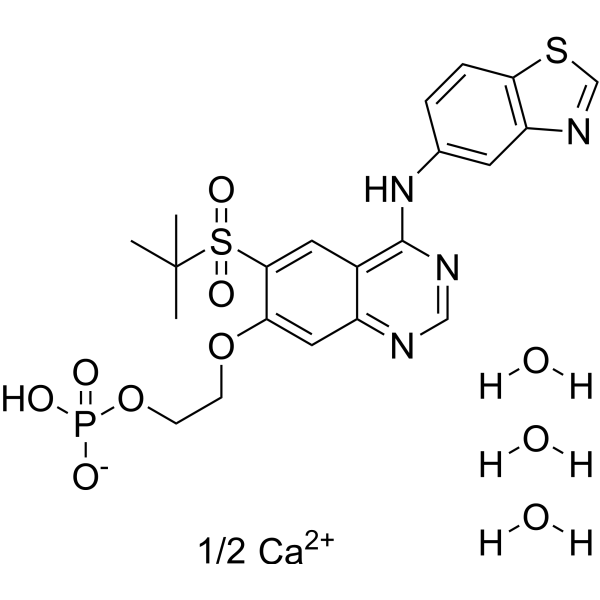
GSK2983559 is an orally active and potent receptor interacting protein 2 (RIP2) kinase inhibitor. GSK2983559 blocks many proinflammatory cytokine responses in vivo and in human inflammatory bowel disease explant samples.
For research use only. We do not sell to patients.
- Purity : 99.49%
- Formula: C21H23N4O7PS2.1/2Ca.3H2O
- Molecular Weight:612.63
-
Storage:
-20°C, sealed storage, away from moisture
* In solvent : -80°C, 6 months; -20°C, 1 month (sealed storage, away from moisture)

To place orders, for customer services and technical support, please contact: MedChemExpress USA
Tel: 609-228-6898 E-mail: [email protected] [email protected]


-
 Biological Activity
-
Chemical Information
-
Solvent & Solubility
- Protocols
- Purity & Documentation
- References
-
 Help & FAQs


Publications Citing Use of MedChemExpress (MCE) GSK2983559
More

Biological Activity
Description
IC50 & Target
[1]|
RIPK2 |
In Vitro
GSK2983559 (1-1024 nM; 2 h) blocks MDP-induced IL-8 in THP-1 cells[2].
MedChemExpress (MCE) has not independently confirmed the accuracy of these methods. They are for reference only. Further protocols information, click here.
-
Cell Line:THP-1 cells
-
Concentration:1-1024 nM
-
Incubation Time:2 hours
-
Result:Inhibited IL-8 production with an IC50 of 1.34 nM.
In Vivo
MedChemExpress (MCE) has not independently confirmed the accuracy of these methods. They are for reference only.
-
Animal Model:C57BL/6 mice (female) injected with MDP (100 μg)[2]
-
Dosage:3 and 10 mg/kg
-
Administration:Oral gavage; 3 and 10 mg/kg; once
-
Result:Suppressed serum IL-6 levels in a dose-dependent manner.


Chemical Information
-
Appearance Solid
-
Molecular Weight 612.63
-
Formula C21H23N4O7PS2.1/2Ca.3H2O
-
Color Yellow to brown
-
SMILES
CC(C)(C)S(C(C(OCCOP(O)([O-])=O)=CC1=NC=N2)=CC1=C2NC3=CC(N=CS4)=C4C=C3)(=O)=O.[H]O[H].[H]O[H].[H]O[H].[Ca+2]
-
Shipping
Room temperature in continental US; may vary elsewhere.
-
Storage
-20°C, sealed storage, away from moisture
* In solvent : -80°C, 6 months; -20°C, 1 month (sealed storage, away from moisture)


Publications (2)


Solvent & Solubility
In Vitro:
DMSO : < 1 mg/mL (insoluble or slightly soluble)
DMF : < 1 mg/mL (insoluble)
Ethanol : < 1 mg/mL (insoluble)
* GSK2983559 is usually formulated as a suspension.

Protocols
-
DSS-Induced Colitis
Dextran sulfate sodium (DSS)-induced colitis is generated by administering DSS in mouse drinking water, producing epithelial injury, barrier disruption, weight loss, diarrhea, fecal blood, colon shortening, histologic mucosal damage, and inflammatory mediator changes; the model is mainly used to study acute or chronic intestinal inflammation resembling selected features of ulcerative colitis. DSS injury is interpreted through clinical and tissue readouts rather than a single molecular endpoint: daily body weight, stool consistency, and bleeding are combined into a disease activity index, while colon length, histology, cytokines, myeloperoxidase activity, intestinal permeability, and tight-junction markers provide complementary measures of inflammation and barrier damage.
-
TNBS-Induced Colitis
TNBS-induced colitis is produced by intrarectal delivery of 2,4,6-trinitrobenzene sulfonic acid in ethanol, where ethanol disrupts the mucosal barrier and TNBS haptenates colonic proteins, generating immune-mediated colonic inflammation with weight loss, diarrhea, ulceration, transmural injury, inflammatory-cell infiltration, and cytokine responses. The model is used as an experimental intestinal inflammation model with Crohn’s disease–like features, especially when Th1-type responses, IL-12–dependent inflammation, chronic relapsing inflammation, or fibrosis-related endpoints are studied.
-
Research Protocol for Inflammation-related Diseases
The NLRP3 inflammasome is a cytosolic innate immune signaling platform that integrates priming signals and danger-signal activation to promote caspase-1 activation, maturation of IL-1β and IL-18, and gasdermin D-mediated pyroptotic cell death. The core experimental logic is to determine whether inflammatory disease phenotypes are driven by increased NLRP3 expression, ASC-containing inflammasome assembly, caspase-1 cleavage, GSDMD cleavage, and extracellular release of IL-1β/IL-18 rather than by nonspecific cell injury alone. The pathway is strongly linked to inflammation-related disease phenotypes because monosodium urate crystals activate NALP3/NLRP3 inflammasome signaling in gout-like crystal inflammation, cholesterol crystals activate NLRP3 inflammasomes in atherogenesis models, and DSS-induced intestinal inflammation has been reported to involve NLRP3 inflammasome activity. However, experimental colitis studies also show context-dependent protective effects of NLRP3 inflammasome co


Purity & Documentation
-
Data Sheet (280 KB)
-
SDS (252 KB)
- English - EN (252 KB)
- Français - FR (252 KB)
- Deutsch - DE (252 KB)
- Norwegian - NO (252 KB)
- Español - ES (252 KB)
- Swedish - SV (252 KB)
- Italian - IT (252 KB)
- Korean - KR (252 KB)
- Portuguese - PT (252 KB)
-
Handling Instructions (2659 KB)
References
[1]. Pamela A Haile, et al. Discovery of a First-in-Class Receptor Interacting Protein 2 (RIP2) Kinase Specific Clinical Candidate, 2-((4-(Benzo[d]thiazol-5-ylamino)-6-(tert-butylsulfonyl)quinazolin-7-yl)oxy)ethyl Dihydrogen Phosphate, for the Treatment of Inflammatory Diseases. J Med Chem. 2019 Jul 25;62(14):6482-6494. [Content Brief]
[2]. Shuwei Wu, et al. Design, synthesis, and structure-activity relationship of novel RIPK2 inhibitors. Bioorg Med Chem Lett. 2022 Sep 2;75:128968. [Content Brief]

Calculators
Concentration (start) × Volume (start) = Concentration (final) × Volume (final)


GSK2983559 Related Classifications
HY-112038A Related Classifications
 Powered by Bioz