



Homocarnosine
Based on 1 publication(s) in Google Scholar
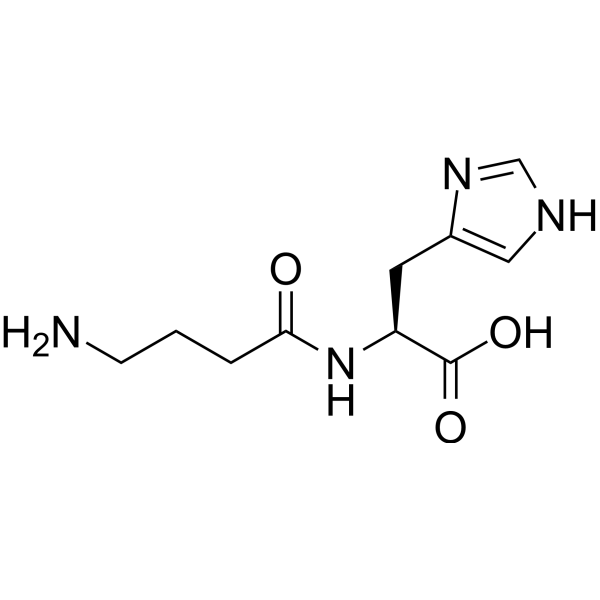
Homocarnosine is a dipeptide of γ-aminobutyric acid (GABA) and histidine unique to brain. Homocarnosine is an inhibitory neuromodulator synthesized in the neuron from GABA and exhibiting anticonvulsant effects.Homocarnosine has antioxidant and anti-inflammatory actions, prevention of DNA damage, and inhibition of advanced glycation end-product formation.
For research use only. We do not sell to patients.
- CAS No.: 3650-73-5
- Formula: C10H16N4O3
- Molecular Weight:240.26
-
Storage:
Please store the product under the recommended conditions in the Certificate of Analysis.

To place orders, for customer services and technical support, please contact: MedChemExpress USA
Tel: 609-228-6898 E-mail: [email protected] [email protected]


-
 Biological Activity
-
Chemical Information
- Protocols
- Purity & Documentation
- References
-
 Help & FAQs


-
HY-114481
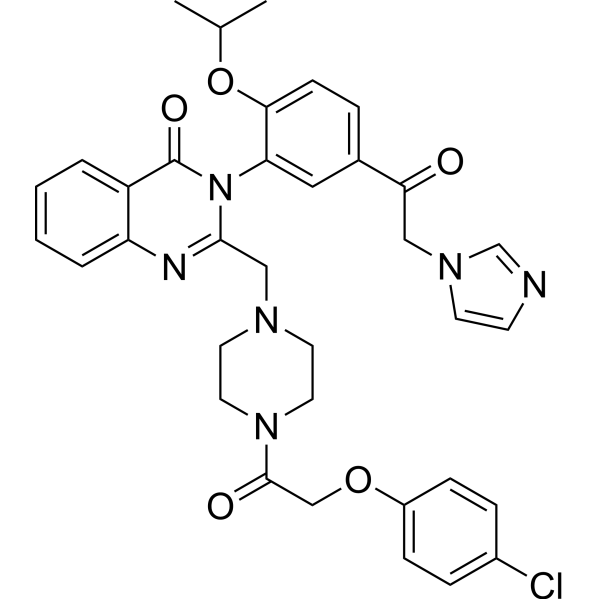
Imidazole ketone erastinFerroptosis Inducer -
HY-13681
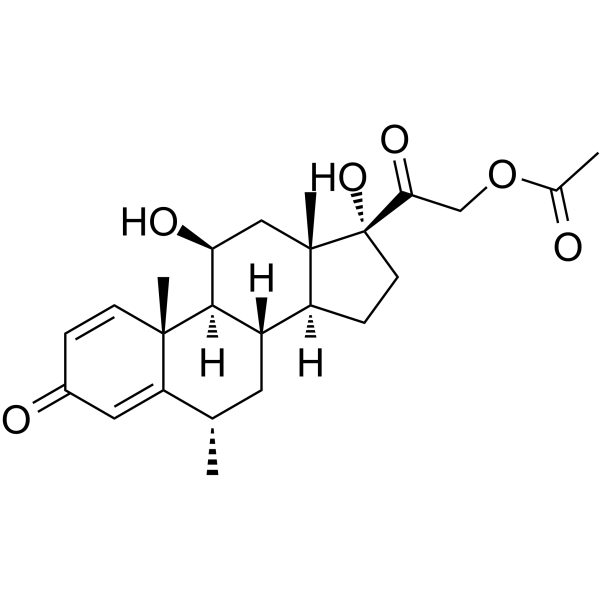
Methylprednisolone acetateCorticosteroid Hormone -
![Fmoc-L-Lys[Oct-(OtBu)-Glu-(OtBu)-AEEA-AEEA]-OH](https://file.medchemexpress.com/product_pic/hy-w615153.gif)
HY-W615153
Fmoc-L-Lys[Oct-(OtBu)-Glu-(OtBu)-AEEA-AEEA]-OHL-Lys Derivative -

HY-45894
tBuO-Ste-Glu(AEEA-AEEA-OH)-OtBuSemaglutide Intermediate -
HY-W250116
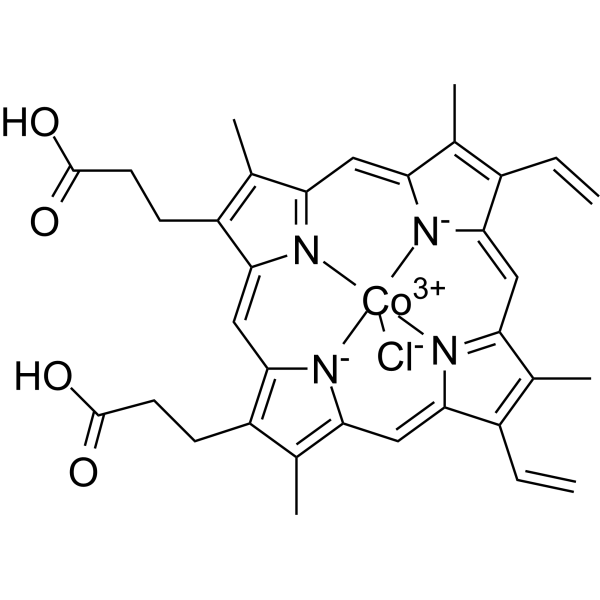
Co(III) protoporphyrin IX chlorideHO-1 Inducer -
HY-122591
PTUPBsEH/COX-1 Inhibitor -

HY-117037
FR900359Gαq/11/14 Inhibitor -
HY-113071A
Mevalonic acid lithium saltEndogenous Metabolite -
HY-13681R
Methylprednisolone acetate (Standard) -

HY-116028
15-deoxy-Δ12,14-Prostaglandin D2DP2 Receptor/PPARγ Agonist -
HY-103234B
GYKI 52466 hydrochlorideiGluR Antagonist -

HY-114296
2,3-Oxidosqualene药物中间体
Publications Citing Use of MedChemExpress (MCE) Homocarnosine
MoreAll Endogenous Metabolite Isoforms
More

Biological Activity
Description
IC50 & Target
|
Human Endogenous Metabolite |
In Vitro
Homocarnosine, a dipeptide of γ-aminobutyric acid (GABA) and histidine, is an inhibitory neuromodulator synthesized in subclasses of GABAergic neurons[1]. Homocarnosine is a potent alternative imidazole peptide for skeletal muscle based on its structural similarity to Carnosine. Homocarnosine is composed of γ-aminobutyric acid (GABA) and histidine and has a similar structure to Carnosine, with the only difference being an extra carbon atom in GABA compared to that in β-alanine of carnosine. Homocarnosine possesses greater tolerance to degradation by serum carnosinase relative to Carnosine. Homocarnosine is known to be exclusively present in brain and cerebrospinal fluid and acts as a neuroprotective agent in a broad range of disease conditions. Homocarnosine exerts antioxidant activity and prevent DNA oxidative damage to a similar extent as Carnosine[2].
MedChemExpress (MCE) has not independently confirmed the accuracy of these methods. They are for reference only. Further protocols information, click here.


Chemical Information
-
CAS No. 3650-73-5
-
Molecular Weight 240.26
-
Formula C10H16N4O3
-
Synonyms
L-Homocarnosine
-
Sequence
His-{N-(4-aminobutyryl)}
-
Sequence Shortening
H-{N-(4-aminobutyryl)}
-
Structure Classification
-
Initial Source
-
Shipping
Room temperature in continental US; may vary elsewhere.
-
Storage
Please store the product under the recommended conditions in the Certificate of Analysis.


Publications (1)
-
Journal Impact Factor
-
Most Recent
-
Nature
2025 Jul;643(8070):192-200. PMID: 39695227

Protocols
-
Research Protocol for Inflammation-related Diseases
The NLRP3 inflammasome is a cytosolic innate immune signaling platform that integrates priming signals and danger-signal activation to promote caspase-1 activation, maturation of IL-1β and IL-18, and gasdermin D-mediated pyroptotic cell death. The core experimental logic is to determine whether inflammatory disease phenotypes are driven by increased NLRP3 expression, ASC-containing inflammasome assembly, caspase-1 cleavage, GSDMD cleavage, and extracellular release of IL-1β/IL-18 rather than by nonspecific cell injury alone. The pathway is strongly linked to inflammation-related disease phenotypes because monosodium urate crystals activate NALP3/NLRP3 inflammasome signaling in gout-like crystal inflammation, cholesterol crystals activate NLRP3 inflammasomes in atherogenesis models, and DSS-induced intestinal inflammation has been reported to involve NLRP3 inflammasome activity. However, experimental colitis studies also show context-dependent protective effects of NLRP3 inflammasome co
-
Genotoxicity/Mutagenicity Study
The bacterial reverse mutation assay detects point mutations that restore amino-acid prototrophy in auxotrophic Salmonella typhimurium or Escherichia coli tester strains; after exposure to a test article, mutagenic activity is read out as an increased number of revertant colonies on minimal agar compared with the vehicle control. The assay uses tester strains with different mutation targets so that base-substitution and frameshift mutagens can be detected, and testing is performed with and without exogenous mammalian metabolic activation because some chemicals require biotransformation to become mutagenic.


Purity & Documentation
References
[1]. O A Petroff, et al. Vigabatrin increases human brain homocarnosine and improves seizure control. Ann Neurol. 1998 Dec;44(6):948-52. [Content Brief]
[2]. Thanutchaporn Kumrungsee, et al. Dietary GABA induces endogenous synthesis of a novel imidazole peptide homocarnosine in mouse skeletal muscles. Amino Acids. 2020 May;52(5):743-753. [Content Brief]

Calculators
Concentration (start) × Volume (start) = Concentration (final) × Volume (final)


Homocarnosine Related Classifications
HY-114883 Related Classifications
 Powered by Bioz