



Hydroxyethyl cellulose, Viscosity(2%):150mPa.s
Based on 1 publication(s) in Google Scholar
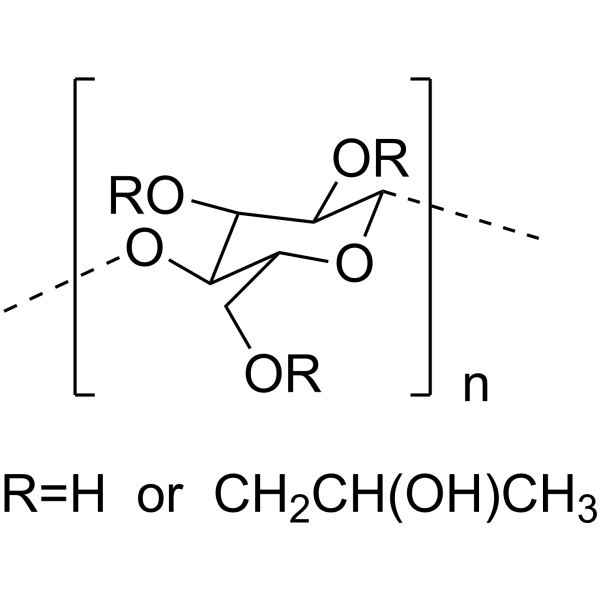
Hydroxyethyl cellulose, Viscosity(2%):150mPa.s is a class of nonionic cellulose ether gel-forming polymers with pH-independent drug release properties. When used as a tablet coating, Hydroxyethyl cellulose, Viscosity(2%):150mPa.s regulates the water permeation rate, thereby altering the drug release lag time; the higher the viscosity, the longer the drug release lag time. When used as a hydrogel thickener, it increases the dynamic viscosity of the system. Hydroxyethyl cellulose, Viscosity(2%):150mPa.s can be used in organic synthesis-related research, such as pharmaceutical excipients, hydrogel thickeners, etc.
For research use only. We do not sell to patients.
- CAS No.: 9004-62-0
-
Storage:
Store at room temperature, keep dry and cool.
In solvent -80°C, 1 year , -20°C, 6 months


To place orders, for customer services and technical support, please contact: MedChemExpress USA
Tel: 609-228-6898 E-mail: [email protected] [email protected]


-
 Biological Activity
-
Chemical Information
- Protocols
- Purity & Documentation
- References
-
 Help & FAQs


-

HY-B2144K
Chitosan (≥85% deacetylated, viscosity>90 mPa.s, MW 15000)Polysaccharid -
HY-Y0703
Sodium carboxymethyl cellulose (Viscosity:800-1200 mPa.s)Biochemical Assay Reagent -
HY-Y0703C
Sodium carboxymethyl cellulose (Viscosity:300-800mpa.s)Biochemical Assay Reagent -
HY-Y1889A
Sodium carboxymethyl cellulose (MW 250000)Anti-adhesion agent -
HY-Y0703A
Sodium carboxymethyl cellulose (Viscosity:1200-1400 mPa.s)Biochemical Assay Reagent -

HY-W115746
Ethyl cellulose (viscosity 100 cP)Pharmaceutical Excipient -
HY-Y0703D
Sodium carboxymethyl cellulose (average Mw 90000)Biochemical Assay Reagent -
HY-Y1889
Sodium carboxymethyl cellulose (Viscosity:5000-15000 mPa.s) -
HY-100557
Hydroxypropyl CellulosePharmaceutical Excipient -

HY-125861
Methyl cellulose(Viscosity:100000mPa.s)Polymer -

HY-125861E
Methyl cellulose(Viscosity:4000mPa.s)Polymer -

HY-125861B
Methyl cellulose(Viscosity:400mPa.s)Polymer
Publications Citing Use of MedChemExpress (MCE) Hydroxyethyl cellulose, Viscosity(2%):150mPa.s
More

Biological Activity
Description
In Vitro
Hydroxyethyl cellulose, Viscosity(2%):150mPa.s (gelling excipient), forms pseudoplastic hydrogels. It exhibits a transient viscosity change in the initial stage of preparation and maintains rheological stability for up to 20 weeks. It barely alters the total skin permeation amount of Sulfadiazine sodium (HY-B0273A), but slightly reduces the drug permeation depth[1].
Hydroxyethyl cellulose, Viscosity(2%):150mPa.s (tablet coating matrix), produces a longer release lag time for Diltiazem hydrochloride (HY-14656). After gel formation, its water absorption rate decreases, and the release lag time is almost independent of pH; compounding with water-soluble lactose effectively shortens the release lag time[2].
MedChemExpress (MCE) has not independently confirmed the accuracy of these methods. They are for reference only. Further protocols information, click here.


Chemical Information
-
CAS No. 9004-62-0
-
Appearance Solid
-
Color White to off-white
-
SMILES
[Hydroxyethyl cellulose, Viscosity(2%):150mPa.s]
-
Shipping
Room temperature in continental US; may vary elsewhere.
-
Storage
Store at room temperature, keep dry and cool
In solvent -80°C 1 year -20°C 6 months


Publications (1)
-
Journal Impact Factor
-
Most Recent

Protocols
-
3D Hydrogel Synthetic Scaffold Culture
3D hydrogel synthetic scaffold culture embeds cells, spheroids, organoids, or tissue fragments inside a hydrated crosslinked polymer network so that cells receive matrix and cell-cell cues in three dimensions rather than from a flat plastic surface. A literature-supported model protocol is PEG-4MAL hydrogel culture, in which four-arm maleimide-terminated PEG is functionalized with cysteine-containing adhesive peptides such as RGD and crosslinked with protease-degradable peptides such as GPQ-W; this creates a defined, modular scaffold that supports human organoid generation and culture. The readouts are scaffold-supported growth, morphology, lumen formation, budding, viability, proliferation, lineage-marker expression, and matrix-dependent expansion or differentiation; reported assays include transmitted-light imaging, immunofluorescence, in situ hybridization, qRT-PCR, and rheological characterization.


Purity & Documentation
-
Data Sheet (272 KB)
-
SDS (252 KB)
- English - EN (252 KB)
- Français - FR (252 KB)
- Deutsch - DE (252 KB)
- Norwegian - NO (252 KB)
- Español - ES (252 KB)
- Swedish - SV (252 KB)
- Italian - IT (252 KB)
- Korean - KR (252 KB)
- Portuguese - PT (252 KB)
-
Handling Instructions (2659 KB)
References

Calculators
Concentration (start) × Volume (start) = Concentration (final) × Volume (final)


Hydroxyethyl cellulose, Viscosity(2%):150mPa.s Related Classifications
HY-B2221B1 Related Classifications
 Powered by Bioz