



Padsevonil
Based on 2 publication(s) in Google Scholar
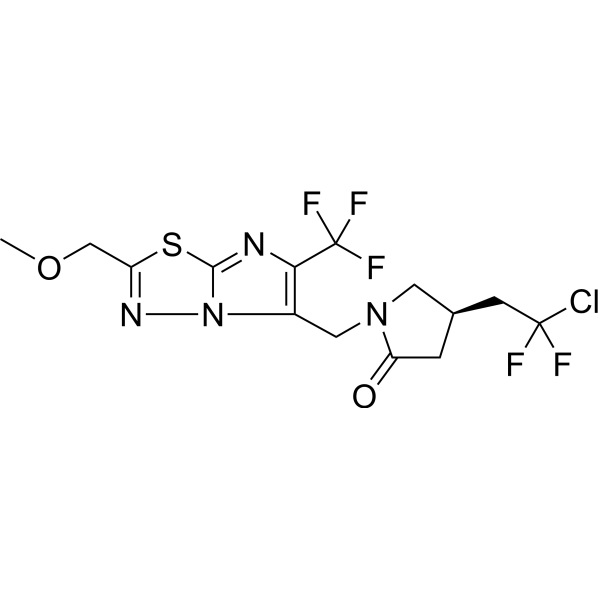
Padsevonil (UCB0942) is a potent antiepileptic agent that selectively acts on presynaptic and postsynaptic targets. Padsevonil binds to synaptic vesicular protein 2 (SV2) with high affinity. Padsevonil is also a positive allosteric modulator and partial agonist of GABAAR, with high potency against α1 and α5 receptors. Padsevonil has antiepileptic effects in a variety of rodent models.
For research use only. We do not sell to patients.
- Purity : 99.65%
- CAS No.: 1294000-61-5
- Formula: C14H14ClF5N4O2S
- Molecular Weight:432.80
-
Storage:Powder -20°C, 3 years , 4°C, 2 years ; In solvent -80°C, 2 years , -20°C, 1 year

To place orders, for customer services and technical support, please contact: MedChemExpress USA
Tel: 609-228-6898 E-mail: [email protected] [email protected]


-
 Biological Activity
-
Chemical Information
-
Solvent & Solubility
- Purity & Documentation
- References
-
 Help & FAQs


Publications Citing Use of MedChemExpress (MCE) Padsevonil
More

Biological Activity
Description
In Vitro
Padsevonil (0.01-30 µM) regulates GABAAR activity through allosteric sites on the receptor in CHO cells that stably express human α1β2γ2 GABAAR with an EC50 of 138 nM[1].
Padsevonil (0-30 µM) enhances natural GABAAR activity in a concentration-dependent manner in primary rat neurons with an EC50 of 208 nM[1].
MedChemExpress (MCE) has not independently confirmed the accuracy of these methods. They are for reference only. .
In Vivo
Padsevonil (0.14-30 mg/kg; intraperitoneal injection; single dose) has a protective effect in a rodent model of chronic epilepsy [2].
MedChemExpress (MCE) has not independently confirmed the accuracy of these methods. They are for reference only.
-
Animal Model:Kainate treated male C57BL/6 mice[2]
-
Dosage:1, 3, 10 and 30 mg/kg
-
Administration:Intraperitoneal injection (i.p.); single dose
-
Result:Significantly decreased the number of hippocampal paroxysmal discharges in dose-dependent manner.
-
Animal Model:Platinum electrodes treated male Wistar rats[2]
-
Dosage:0.14, 0.43, 1.38 and 4.33 mg/kg
-
Administration:Intraperitoneal injection (i.p.); single dose
-
Result:Produced dose-related suppression in the cumulative duration of spontaneous spike and wave discharges, and the suppression was almost complete at a dose of 4.33 mg/kg.
Clinical Trial
| NCT Number | Sponsor | Condition | Start Date |
Phase

|
|---|---|---|---|---|
| NCT01329991 | Plexxikon| | 2011-05 | PHASE1 |


Chemical Information
-
CAS No. 1294000-61-5
-
Appearance Solid
-
Molecular Weight 432.80
-
Formula C14H14ClF5N4O2S
-
Color White to off-white
-
SMILES
O=C1N(C[C@@H](CC(F)(F)Cl)C1)CC(N(N=C(COC)S2)C2=N3)=C3C(F)(F)F
-
Synonyms
UCB-0942
-
Shipping
Room temperature in continental US; may vary elsewhere.
-
Storage
Powder -20°C 3 years 4°C 2 years In solvent -80°C 2 years -20°C 1 year


Publications (2)
-
Journal Impact Factor
-
Most Recent
-
Nat Commun
Structural pharmacology of SV2A reveals an allosteric modulation mechanism in the major facilitator superfamily. [Abstract]2025 Nov 28;16(1):10748. PMID: 41315229 -
Pharmacol Rep
2024 Oct;76(5):1055-1066. PMID: 39028384


Solvent & Solubility
In Vitro:
DMSO : 100 mg/mL (231.05 mM; Need ultrasonic; Hygroscopic DMSO has a significant impact on the solubility of product, please use newly opened DMSO)
Please refer to the solubility information to select the appropriate solvent. Once prepared, please aliquot and store the solution to prevent product inactivation from repeated freeze-thaw cycles.
Storage method and period of stock solution: -80°C, 2 years; -20°C, 1 year. When stored at -80°C, please use it within 2 years. When stored at -20°C, please use it within 1 year.
Please refer to the solubility information to select the appropriate solvent. Once prepared, please aliquot and store the solution to prevent product inactivation from repeated freeze-thaw cycles.
Storage method and period of stock solution: -80°C, 2 years; -20°C, 1 year. When stored at -80°C, please use it within 2 years. When stored at -20°C, please use it within 1 year.
Concentration (start) × Volume (start) = Concentration (final) × Volume (final)
In Vivo:
Select the appropriate dissolution method based on your experimental animal and administration route.
- For the following dissolution methods, please ensure to first prepare a clear stock solution using an In Vitro approach and then sequentially add co-solvents:
- To ensure reliable experimental results, the clarified stock solution can be appropriately stored based on storage conditions. As for the working solution for In Vivo experiments, it is recommended to prepare freshly and use it on the same day.
- The percentages shown for the solvents indicate their volumetric ratio in the final prepared solution. If precipitation or phase separation occurs during preparation, heat and/or sonication can be used to aid dissolution.
Add each solvent one by one: 10% DMSO 40% PEG300 5% Tween-80 45% Saline
Solubility: ≥ 2.5 mg/mL (5.78 mM); Clear solution
This protocol yields a clear solution of ≥ 2.5 mg/mL (saturation unknown).
Taking 1 mL working solution as an example, add 100 μL DMSO stock solution (25.0 mg/mL) to 400 μL PEG300, and mix evenly; then add 50 μL Tween-80 and mix evenly; then add 450 μL Saline to adjust the volume to 1 mL.
Preparation of Saline: Dissolve 0.9 g sodium chloride in ddH₂O and dilute to 100 mL to obtain a clear Saline solution.
In Vivo Dissolution Calculator
Please enter the basic information of animal experiments:
-
-
-
-
Recommended: Prepare an additional quantity of animals to account for potential losses during experiments.
Please enter your animal formula composition:
-
%DMSO +
Recommended: Keep the proportion of DMSO in working solution below 2% if your animal is weak.
-
%+
-
+%Tween-80 + +
-
%Saline +
The co-solvents required include: DMSO, . All of co-solvents are available by MedChemExpress (MCE). , Tween 80. All of co-solvents are available by MedChemExpress (MCE).
Working solution concentration: 0.22 mg/mL
Method for preparing stock solution: mg drug dissolved in μL DMSO. Stock solution concentration: mg/mL.
1. Take μL DMSO stock solution;
2. Add μL .
μL , mix evenly;
3. Then add μL Tween 80, mix evenly;
4. Then add μL
Please ensure that the stock solution in the first step is dissolved to a clear state, and add co-solvents in sequence. You can use ultrasonic heating (ultrasonic cleaner, recommended frequency 20-40 kHz), vortexing, etc. to assist dissolution.


Purity & Documentation
-
Data Sheet (273 KB)
-
SDS (254 KB)
- English - EN (254 KB)
- Français - FR (254 KB)
- Deutsch - DE (254 KB)
- Norwegian - NO (254 KB)
- Español - ES (254 KB)
- Swedish - SV (254 KB)
- Italian - IT (254 KB)
- Korean - KR (254 KB)
- Portuguese - PT (254 KB)
-
Handling Instructions (2659 KB)
References
[1]. Niespodziany I, et al. Functional characterization of the antiepileptic drug candidate, padsevonil, on GABAA receptors. Epilepsia. 2020 May;61(5):914-923. [Content Brief]
[2]. Leclercq K, et al. Pharmacological Profile of the Novel Antiepileptic Drug Candidate Padsevonil: Characterization in Rodent Seizure and Epilepsy Models. J Pharmacol Exp Ther. 2020 Jan;372(1):11-20. [Content Brief]


Complete Stock Solution Preparation Table
Please refer to the solubility information to select the appropriate solvent. Once prepared, please aliquot and store the solution to prevent product inactivation from repeated freeze-thaw cycles.
Storage method and period of stock solution: -80°C, 2 years; -20°C, 1 year. When stored at -80°C, please use it within 2 years. When stored at -20°C, please use it within 1 year.
| Optional Solvent | Concentration Solvent Mass | 1 mg | 5 mg | 10 mg | 25 mg |
|---|---|---|---|---|---|
| DMSO | 1 mM | 2.3105 mL | 11.5527 mL | 23.1054 mL | 57.7634 mL |
| 5 mM | 0.4621 mL | 2.3105 mL | 4.6211 mL | 11.5527 mL | |
| 10 mM | 0.2311 mL | 1.1553 mL | 2.3105 mL | 5.7763 mL | |
| 15 mM | 0.1540 mL | 0.7702 mL | 1.5404 mL | 3.8509 mL | |
| 20 mM | 0.1155 mL | 0.5776 mL | 1.1553 mL | 2.8882 mL | |
| 25 mM | 0.0924 mL | 0.4621 mL | 0.9242 mL | 2.3105 mL | |
| 30 mM | 0.0770 mL | 0.3851 mL | 0.7702 mL | 1.9254 mL | |
| 40 mM | 0.0578 mL | 0.2888 mL | 0.5776 mL | 1.4441 mL | |
| 50 mM | 0.0462 mL | 0.2311 mL | 0.4621 mL | 1.1553 mL | |
| 60 mM | 0.0385 mL | 0.1925 mL | 0.3851 mL | 0.9627 mL | |
| 80 mM | 0.0289 mL | 0.1444 mL | 0.2888 mL | 0.7220 mL | |
| 100 mM | 0.0231 mL | 0.1155 mL | 0.2311 mL | 0.5776 mL |


Padsevonil Related Classifications
HY-109009 Related Classifications
 Powered by Bioz