



SBI-993

Based on 1 Customer Validation
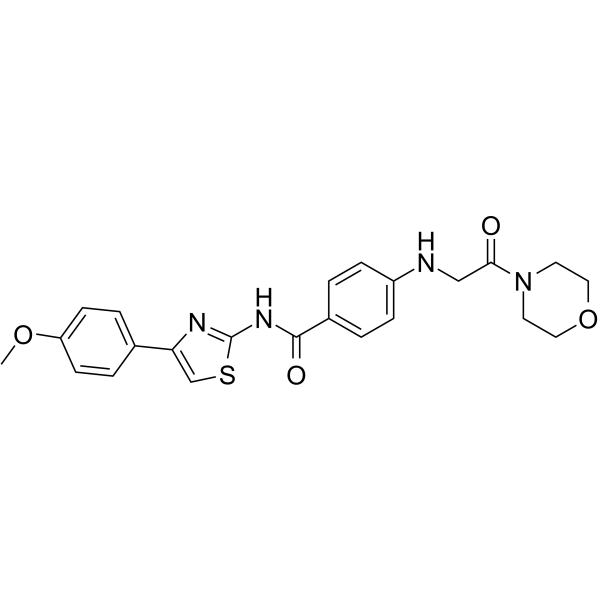
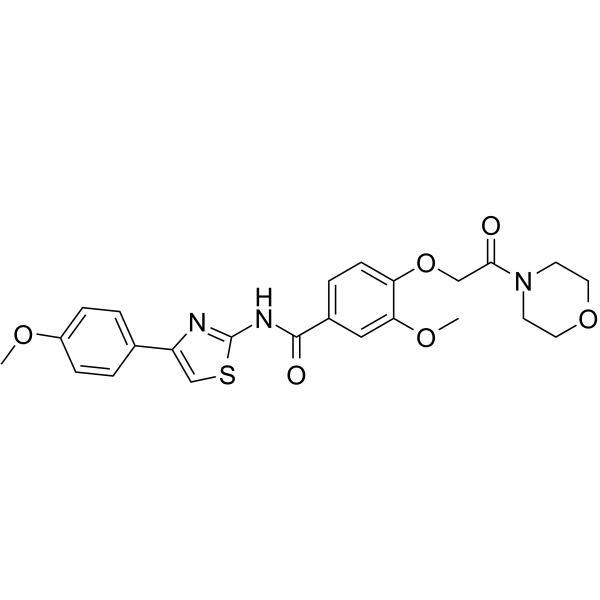
SBI-993 is a SBI-477 analog with improved potency and suitable pharmacokinetic properties for in vivo bioavailability. SBI-993 stimulates insulin signaling by deactivating the transcription factor MondoA.
For research use only. We do not sell to patients.
- Purity : 98.79%
- CAS No.: 2073059-82-0
- Formula: C23H24N4O4S
- Molecular Weight:452.53
-
Storage:
4°C, protect from light
* In solvent : -80°C, 6 months; -20°C, 1 month (protect from light)

To place orders, for customer services and technical support, please contact: MedChemExpress USA
Tel: 609-228-6898 E-mail: [email protected] [email protected]


-
 Biological Activity
-
Chemical Information
-
Solvent & Solubility
- Protocols
- Purity & Documentation
- References
-
 Help & FAQs




Biological Activity
Description
In Vitro
In Vivo
SBI-993 improves insulin signaling in both muscle and liver following an acute insulin challenge[1].
MedChemExpress (MCE) has not independently confirmed the accuracy of these methods. They are for reference only.
-
Animal Model:Mice are fed a 60% high-fat diet (HFD)[1]
-
Dosage:50 mg/kg
-
Administration:s.c.; daily; for 7 days
-
Result:Reduced the expression of triacylglyceride synthesis and lipogenic genes in both muscle and liver.


Chemical Information
-
CAS No. 2073059-82-0
-
Appearance Solid
-
Molecular Weight 452.53
-
Formula C23H24N4O4S
-
Color White to off-white
-
SMILES
O=C(NC1=NC(C2=CC=C(OC)C=C2)=CS1)C3=CC=C(NCC(N4CCOCC4)=O)C=C3
-
Shipping
Room temperature in continental US; may vary elsewhere.
-
Storage
4°C, protect from light
* In solvent : -80°C, 6 months; -20°C, 1 month (protect from light)


Solvent & Solubility
In Vitro:
DMSO : 100 mg/mL (220.98 mM; ultrasonic and warming and heat to 60°C; Hygroscopic DMSO has a significant impact on the solubility of product, please use newly opened DMSO)
Please refer to the solubility information to select the appropriate solvent. Once prepared, please aliquot and store the solution to prevent product inactivation from repeated freeze-thaw cycles.
Storage method and period of stock solution: -80°C, 6 months; -20°C, 1 month (protect from light). When stored at -80°C, please use it within 6 months. When stored at -20°C, please use it within 1 month.
Please refer to the solubility information to select the appropriate solvent. Once prepared, please aliquot and store the solution to prevent product inactivation from repeated freeze-thaw cycles.
Storage method and period of stock solution: -80°C, 6 months; -20°C, 1 month (protect from light). When stored at -80°C, please use it within 6 months. When stored at -20°C, please use it within 1 month.
Concentration (start) × Volume (start) = Concentration (final) × Volume (final)


Purity & Documentation
-
Data Sheet (270 KB)
-
SDS (252 KB)
- English - EN (252 KB)
- Français - FR (252 KB)
- Deutsch - DE (252 KB)
- Norwegian - NO (252 KB)
- Español - ES (252 KB)
- Swedish - SV (252 KB)
- Italian - IT (252 KB)
- Korean - KR (252 KB)
- Portuguese - PT (252 KB)
-
Handling Instructions (2659 KB)
References


Complete Stock Solution Preparation Table
Please refer to the solubility information to select the appropriate solvent. Once prepared, please aliquot and store the solution to prevent product inactivation from repeated freeze-thaw cycles.
Storage method and period of stock solution: -80°C, 6 months; -20°C, 1 month (protect from light). When stored at -80°C, please use it within 6 months. When stored at -20°C, please use it within 1 month.
| Optional Solvent | Concentration Solvent Mass | 1 mg | 5 mg | 10 mg | 25 mg |
|---|---|---|---|---|---|
| DMSO | 1 mM | 2.2098 mL | 11.0490 mL | 22.0980 mL | 55.2450 mL |
| 5 mM | 0.4420 mL | 2.2098 mL | 4.4196 mL | 11.0490 mL | |
| 10 mM | 0.2210 mL | 1.1049 mL | 2.2098 mL | 5.5245 mL | |
| 15 mM | 0.1473 mL | 0.7366 mL | 1.4732 mL | 3.6830 mL | |
| 20 mM | 0.1105 mL | 0.5524 mL | 1.1049 mL | 2.7622 mL | |
| 25 mM | 0.0884 mL | 0.4420 mL | 0.8839 mL | 2.2098 mL | |
| 30 mM | 0.0737 mL | 0.3683 mL | 0.7366 mL | 1.8415 mL | |
| 40 mM | 0.0552 mL | 0.2762 mL | 0.5524 mL | 1.3811 mL | |
| 50 mM | 0.0442 mL | 0.2210 mL | 0.4420 mL | 1.1049 mL | |
| 60 mM | 0.0368 mL | 0.1841 mL | 0.3683 mL | 0.9207 mL | |
| 80 mM | 0.0276 mL | 0.1381 mL | 0.2762 mL | 0.6906 mL | |
| 100 mM | 0.0221 mL | 0.1105 mL | 0.2210 mL | 0.5524 mL |


SBI-993 Related Classifications
HY-122682 Related Classifications
 Powered by Bioz