



Isothiafludine

Based on 1 Customer Validation
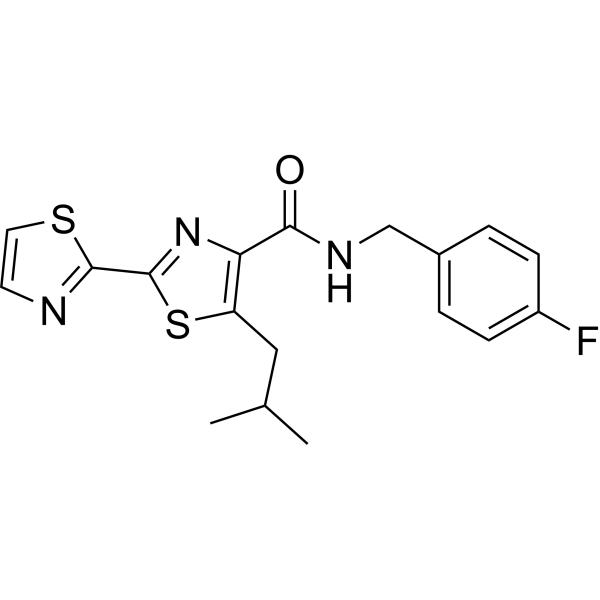
Isothiafludine is an orally active non-nucleosidic anti-HBV compound. Isothiafludine inhibits hepatitis B virus replication by blocking pregenomic RNA encapsidation.
For research use only. We do not sell to patients.
- Purity : 99.87%
- CAS No.: 960527-22-4
- Formula: C18H18FN3OS2
- Molecular Weight:375.48
-
Storage:
4°C, stored under nitrogen
* In solvent : -80°C, 6 months; -20°C, 1 month (stored under nitrogen)

To place orders, for customer services and technical support, please contact: MedChemExpress USA
Tel: 609-228-6898 E-mail: [email protected] [email protected]


-
 Biological Activity
-
Chemical Information
- Purity & Documentation
- References
-
 Help & FAQs




Biological Activity
Description
Cellular Effect
|
Cell Line

|
Type | Value | Description | References |
|---|---|---|---|---|
| HepG2 | CC50 |
29 μM
Compound: NZ-4; 10
|
Cytotoxicity against human HepG2 cells assessed as reduction in cell viability incubated for 2 days prior to compound washout followed by compound redosing and measured after 2 days by XTT assay
Cytotoxicity against human HepG2 cells assessed as reduction in cell viability incubated for 2 days prior to compound washout followed by compound redosing and measured after 2 days by XTT assay
|
[PMID: 30594676] |
| HepG2 2.2.15 | CC50 |
50.4 μM
Compound: II-8c; NZ-4
|
Cytotoxicity against human HepG2.2.15 cells assessed as reduction in cell viability incubated for 4 days prior to compound washout followed by compound addition and measured after 4 days by MTT assay
Cytotoxicity against human HepG2.2.15 cells assessed as reduction in cell viability incubated for 4 days prior to compound washout followed by compound addition and measured after 4 days by MTT assay
|
[PMID: 32712535] |
| HepG2 2.2.15 | CC50 |
51.47 μM
Compound: NZ-4
|
Cytotoxicity against human HepG2.2.15 cells assessed as decrease in cell viability after 8 days by CCK-8 assay
Cytotoxicity against human HepG2.2.15 cells assessed as decrease in cell viability after 8 days by CCK-8 assay
|
[PMID: 27484509] |
| HepG2 2.2.15 | CC50 |
59.2 μM
Compound: II-8c; NZ-4
|
Cytotoxicity against human HepG2.2.15 cells assessed as reduction in cell viability incubated for 4 days prior to compound washout followed by compound addition and measured after 4 days by CCK8 assay
Cytotoxicity against human HepG2.2.15 cells assessed as reduction in cell viability incubated for 4 days prior to compound washout followed by compound addition and measured after 4 days by CCK8 assay
|
[PMID: 32712535] |
| HepG2 2.2.15 | IC50 |
50.4 μM
Compound: NZ-4
|
Cytotoxicity against human HepG2.2.15 cells assessed as decrease in cell viability after 8 days by MTT assay
Cytotoxicity against human HepG2.2.15 cells assessed as decrease in cell viability after 8 days by MTT assay
|
[PMID: 27484509] |
In Vitro
Isothiafludine inhibits HBV DNA replication, with an IC50 of 1.33 μM[1].
Isothiafludine (8 days) shows an IC50 (50% cytotoxicity) of 50.4 μM against HepG2.2.15 cells[1].
Isothiafludine (1.25-20 μM, 48 h) also inhibits the replication of 3TC/ETV-dual-resistant and ADV-resistant HBV mutants in virus transfected Huh7 cells[1].
Isothiafludine (10-20 μM, 8 days) decreases the levels of encapsidated HBV pgRNA in HepG2.2.15 cells[1].
MedChemExpress (MCE) has not independently confirmed the accuracy of these methods. They are for reference only. .
In Vivo
MedChemExpress (MCE) has not independently confirmed the accuracy of these methods. They are for reference only.
-
Animal Model:DHBV-infected duck model[2]
-
Dosage:25-100 mg/kg
-
Administration:p.o., for 15 days
-
Result:Inhibited DHBV DNA in the sera on day 15.


Chemical Information
-
CAS No. 960527-22-4
-
Appearance Solid
-
Molecular Weight 375.48
-
Formula C18H18FN3OS2
-
Color White to off-white
-
SMILES
O=C(C1=C(CC(C)C)SC(C2=NC=CS2)=N1)NCC3=CC=C(F)C=C3
-
Synonyms
NZ-4
-
Shipping
Room temperature in continental US; may vary elsewhere.
-
Storage
4°C, stored under nitrogen
* In solvent : -80°C, 6 months; -20°C, 1 month (stored under nitrogen)


Purity & Documentation
-
Data Sheet (268 KB)
-
SDS (252 KB)
- English - EN (252 KB)
- Français - FR (252 KB)
- Deutsch - DE (252 KB)
- Norwegian - NO (252 KB)
- Español - ES (252 KB)
- Swedish - SV (252 KB)
- Italian - IT (252 KB)
- Korean - KR (252 KB)
- Portuguese - PT (252 KB)
-
Handling Instructions (2659 KB)
References

Calculators
Concentration (start) × Volume (start) = Concentration (final) × Volume (final)


Isothiafludine Related Classifications
HY-111003 Related Classifications
 Powered by Bioz