



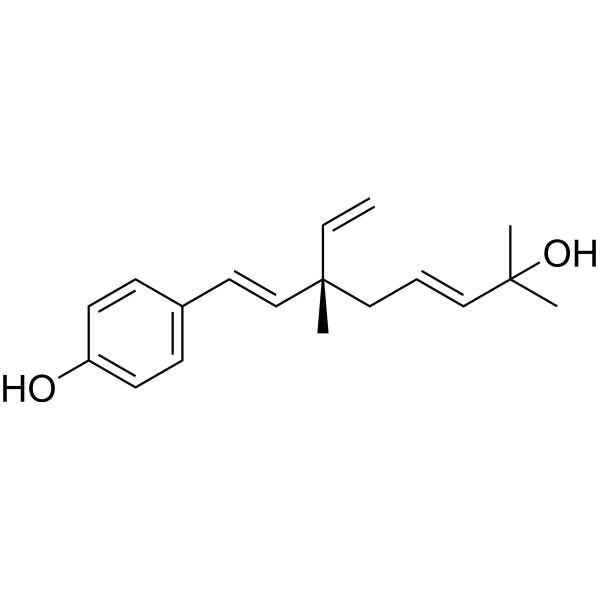
13-Hydroxyisobakuchiol
13-Hydroxyisobakuchiol (Delta3,2-Hydroxylbakuchiol), an analog of Bakuchiol (HY-N0235) that can be isolated from Psoralea corylifolia (L.), is a potent selective monoamine transporter inhibitor. 13-Hydroxyisobakuchiol is more selective for the dopamine transporter (DAT) (IC50 = 0.58 μM) and norepinephrine transporter (NET) (IC50 = 0.69 μM) than for the serotonin transporter (SERT) (IC50 = 312.02 μM). 13-Hydroxyisobakuchiol increases the activity of intact mice and improves the decreased activity of reserpinized mice in vivo. 13-Hydroxyisobakuchiol can be used for the research of disorders such as Parkinson's disease and depression.
商品は「研究用試薬」です。人や動物の医療用・臨床診断用・食品用の製品ではありません。
研究用途以外に使用した場合、当社は一切の責任を負いかねます。
- CAS 番号: 178765-49-6
- 分子式: C18H24O2
- 分子量:272.38
-
保管条件:
Please store the product under the recommended conditions in the Certificate of Analysis.

To place orders, for customer services and technical support, please contact: MedChemExpress USA
Tel: 609-228-6898 E-mail: [email protected] [email protected]


-
 生物活性
生物活性
-
化学情報
- プロトコル
- 純度とドキュメンテーション
- 参考文献
-
 Help & FAQs




生物活性
製品説明
IC50 & Target
IC50: 0.58 μM (dopamine transporter)
IC50: 0.69 μM (norepinephrine transporter)[1]
Cellular Effect
|
Cell Line

|
Type | Value | Description | References |
|---|---|---|---|---|
| A549 | IC50 |
>10 μM
Compound: 19
|
Cytotoxicity against human A549 cells after 48 hrs by MTT assay
Cytotoxicity against human A549 cells after 48 hrs by MTT assay
|
[PMID: 25710081] |
| K562 | IC50 |
>10 μM
Compound: 19
|
Cytotoxicity against human K562 cells after 48 hrs by MTT assay
Cytotoxicity against human K562 cells after 48 hrs by MTT assay
|
[PMID: 25710081] |
体外実験
13-Hydroxyisobakuchiol (Delta3,2-Hydroxylbakuchiol) (10 μM, 20 min) inhibits dopamine (DA), norepinephrine (NE) and 5-HT uptake by respective Tr-CHO cells (D8, N1, or S6)[1].
13-Hydroxyisobakuchiol (0.03-10 μM, 20 min) inhibits DA and NE uptake by human neuroblastoma cell line SK-N-SH cells[1].
13-Hydroxyisobakuchiol (0.03-333 μM, 15 min) inhibits DA and NE uptake by synaptosomes from rat striatum or hippocampus[1].
13-Hydroxyisobakuchiol (1-500 μM, 4 h) dose-dependently prevents MPP+-induced cell toxicity in D8 cells[1].
MedChemExpress (MCE) has not independently confirmed the accuracy of these methods. They are for reference only. Further protocols information, click here.
-
Cell Line:D8 cells
-
Concentration:1, 10, 100, 500 μM
-
Incubation Time:4 h
-
Result:Dose-dependently prevented MPP+-induced cell toxicity.
Exhibited pEC50 and Emax values for protection against D8 lesion of -0.34 and 82.31%, respectively.
体内実験
13-Hydroxyisobakuchiol (5, 20, and 100 mg/kg, i.p. once) improves the decreased activity of Reserpinized mice[1].
MedChemExpress (MCE) has not independently confirmed the accuracy of these methods. They are for reference only.
-
Animal Model:Male C57BL/6 mice (2 months old, 18-22g)[1]
-
Dosage:4, 20, and 100 mg/kg
-
Administration:i.p., once
-
Result:Induced a dose-dependent increase in locomotor activity.
-
Animal Model:Male C57BL/6 mice (2 months old, 18-22g) subcutaneously injected with 10 mg/kg Reserpine (HY-N0480)[1]
-
Dosage:5, 20, and 100 mg/kg
-
Administration:i.p., once
-
Result:Markedly and dose-dependently increased horizontal movement in in Reserpine-pretreated mice.
-
Animal Model:Male C57BL/6 mice (2 months old, 18-22g)[1]
-
Dosage:10 and 100 mg/kg
-
Administration:i.p., once
-
Result:Showed no significant place preference response in the reward system.


化学情報
-
CAS 番号 178765-49-6
-
分子量 272.38
-
分子式 C18H24O2
-
SMILES
OC1=CC=C(/C=C/[C@](C)(C=C)C/C=C/C(C)(O)C)C=C1
-
別名
Delta3,2-Hydroxylbakuchiol
-
Structure Classification
-
Initial Source
-
輸送条件
Room temperature in continental US; may vary elsewhere.
-
保管条件
Please store the product under the recommended conditions in the Certificate of Analysis.

プロトコル
-
Human pluripotent stem cell midbrain dopaminergic neuron differentiation
Human pluripotent stem cells are directed toward midbrain dopaminergic neurons by first inducing a neural floor-plate-like progenitor state, then patterning cells with ventralizing SHH signaling and midbrain/WNT-FGF cues, and finally maturing progenitors into neurons expressing dopaminergic markers such as TH, NURR1/NR4A2, PITX3, DAT/SLC6A3, VMAT2/SLC18A2, GIRK2/KCNJ6, FOXA2, LMX1A, and EN1. The main readouts are loss of pluripotency, acquisition of FOXA2+/LMX1A+ midbrain floor-plate progenitors, emergence of βIII-tubulin+/MAP2+ neurons, and production of TH+ dopaminergic neurons with molecular, dopamine-release, and electrophysiological features of midbrain dopaminergic identity.


純度とドキュメンテーション
参考文献

Calculators
濃度 (開始) × 体積 (開始) = 濃度 (終了) × 体積 (終了)


13-Hydroxyisobakuchiol 関連分類
HY-N7506 関連分類
 Powered by Bioz